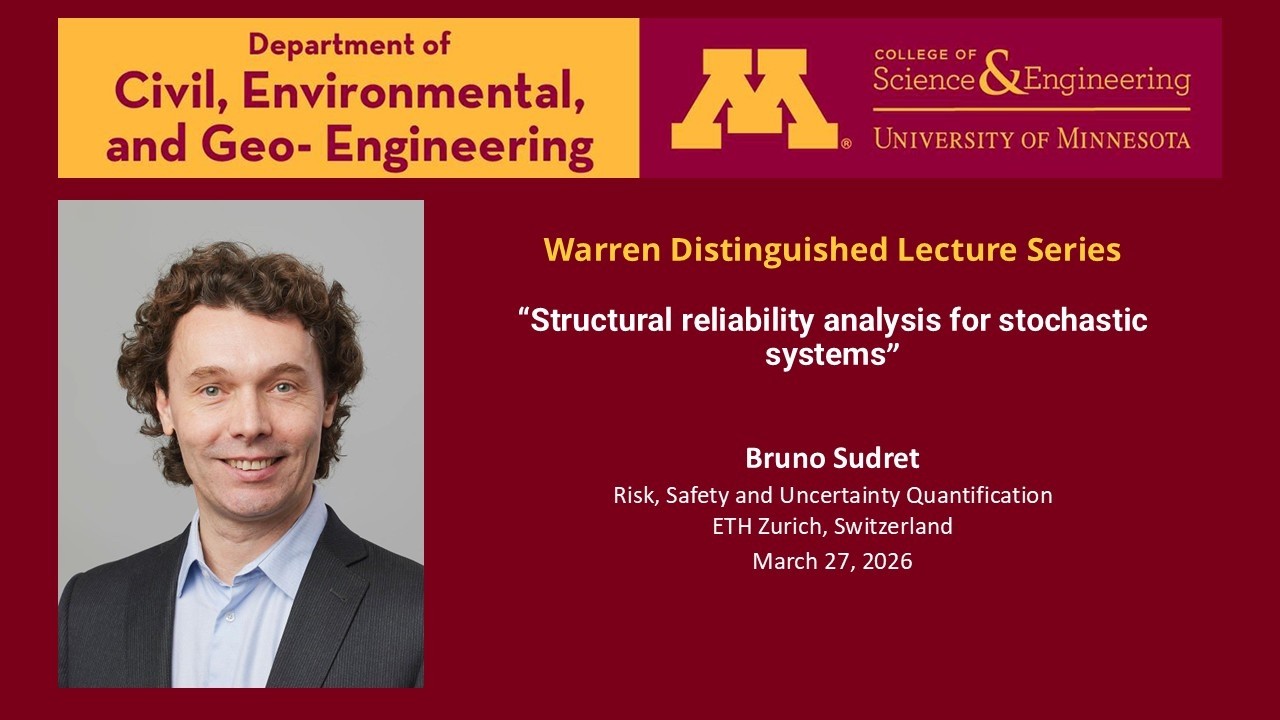
Structural reliability analysis for stochastic systems
Keywords
Summary
198 words
Critical Evaluation
Value of the Information & Strength of the Argument
The lecture provides high-value information by addressing a cutting-edge topic in uncertainty quantification: reliability analysis for stochastic simulators. It clearly explains the limitations of classical methods and justifies the need for new approaches. The argumentation is solid, building from fundamental concepts to advanced methods, and is supported by references to peer-reviewed publications. The presentation of the active learning strategy is particularly valuable, as it offers a practical solution to a computationally challenging problem. The use of a realistic wind turbine example strengthens the practical relevance of the proposed framework.
Scientific Rigor, Source Quality, Title Accuracy
The scientific rigor is high: the speaker is a recognized expert, and the methods presented are based on published research. The sources cited include specific papers by the speaker and his collaborators, which are credible. The title accurately reflects the content, and the lecture is well-structured. The description provides additional references, including an arXiv preprint, which adds to the credibility. The adequacy between title and content is excellent.
172 words
Title / Content Match
The title accurately reflects the content, which focuses on structural reliability analysis for stochastic systems, presenting both theoretical foundations and practical applications.
Quality & Reliability
9/10
Lecture by a leading expert in uncertainty quantification, based on peer-reviewed publications and presenting a rigorous methodological framework. The content is well-structured, with clear definitions and mathematical formulations, and includes references to specific papers.
Key Moments
Markers derived by PSI from the transcript: the creator did not define chapters.
- Introduction and speaker introduction
- Overview of uncertainty quantification and computational models
- Definition of structural reliability problem and limit state functions
- Introduction to surrogate models and polynomial chaos expansions
- Stochastic simulators and examples (wind turbine, earthquake engineering)
- Stochastic polynomial chaos expansions (SPCE) and their formulation
- Active learning strategy for reliability analysis with SPCE
- Demonstration on benchmarks and wind turbine reliability problem, conclusions
Cited Sources
- AL-SPCE – Reliability analysis for nondeterministic models using stochastic polynomial chaos expansions and active learning — Reference [3] in the description, presenting the active learning method.
- UQWorld — Community platform for uncertainty quantification, mentioned in the description.
Concurring Sources
- Stochastic polynomial chaos expansions to emulate stochastic simulators — Reference [1] in the description, foundational paper for SPCE.
- Reliability analysis for nondeterministic limit-states using stochastic emulators — Reference [2] in the description, presenting the reliability analysis method.
Contribution & Novelties
The lecture presents a novel active learning framework for reliability analysis of stochastic simulators, leveraging stochastic polynomial chaos expansions. This approach addresses a gap in existing methods, which typically assume deterministic models. The use of ensembles of SPCE models to quantify epistemic uncertainty and guide training data enrichment is a significant contribution, as it reduces computational cost while maintaining accuracy. The demonstration on a realistic wind turbine problem highlights its practical applicability.
Pour aller plus loin :
- Stochastic polynomial chaos expansions — Background on polynomial chaos expansions.
- Active learning (machine learning) — General concept of active learning.
- Uncertainty quantification — Overview of the field.
104 words
Radar Profile
The radar profile shows high scores in information quantity, quality, and reliability, with a slightly lower but still strong technical level. This indicates a lecture that is both comprehensive and rigorous, suitable for an audience with some background in the field.