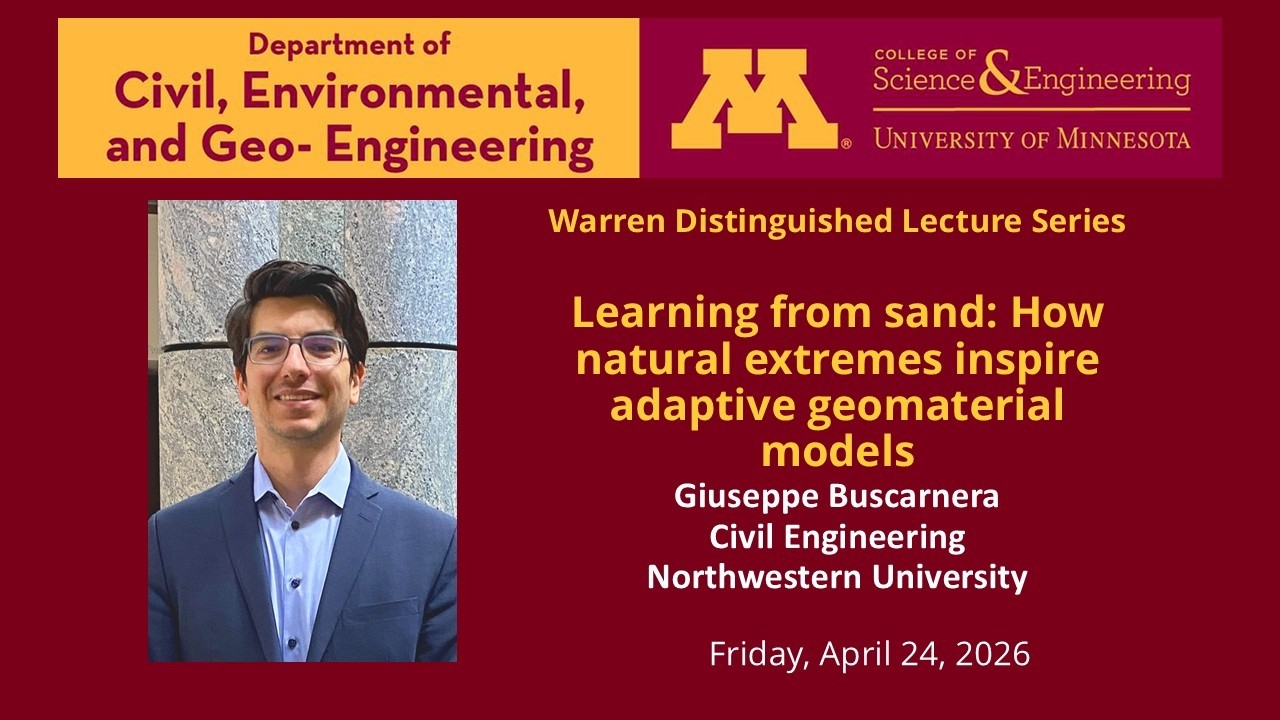
Learning from Sand: How natural extremes inspire adaptive geomaterial models
Keywords
Summary
167 words
Critical Evaluation
Value of the Information & Strength of the Argument
The lecture provides valuable insights into the state-of-the-art in constitutive modeling of granular materials. Buscarnera effectively argues for the importance of multi-scale approaches that connect particle-scale phenomena to continuum models. He supports his arguments with a combination of experimental data, numerical simulations, and theoretical frameworks. The presentation is well-structured, building from fundamental concepts to advanced applications. The argumentation is solid, with clear explanations of the physical mechanisms and their mathematical representations. The use of natural examples, such as fault gouges and asteroids, adds a compelling dimension to the discussion.
Scientific Rigor, Source Quality, Title Accuracy
The lecture demonstrates a high level of scientific rigor. Buscarnera references his own published work and that of others, and he presents validation against experimental data. The sources are credible, and the methodology is transparent. The title accurately reflects the content, which draws inspiration from natural granular systems to develop adaptive models. The talk is well-organized and the technical depth is appropriate for an expert audience.
170 words
Title / Content Match
The title accurately reflects the content, which draws inspiration from natural granular systems to develop adaptive models.
Quality & Reliability
8/10
Presentation by a recognized expert in geomechanics, based on peer-reviewed research and experimental validation, though it is a lecture rather than a formal publication.
Key Moments
Markers derived by PSI from the transcript: the creator did not define chapters.
- Introduction and overview of the talk's focus on granular materials and adaptive models.
- Discussion of Archimedes' Sand Reckoner and the relevance of granular materials.
- Introduction of breakage mechanics and its energy-based framework.
- Presentation of X-ray tomography experiments and digital image analysis to track particle breakage.
- Explanation of shape heritability and the silver ratio in particle fragmentation.
- Extension of breakage mechanics to include shape effects and validation against DEM simulations.
- Discussion of fabric anisotropy and its role in elastic and plastic behavior.
- Presentation of virtual experiments using DEM to study fabric effects on elasticity.
- Comparison of model predictions with experimental data on anisotropic elasticity.
- Concluding remarks on the potential of these models for engineering applications.
Cited Sources
- Breakage mechanics — Framework proposed by I. Einav (2007) for modeling particle breakage.
- Pestana and Whittle (1995) — Data on sand compression up to high stress levels.
- Asao and Di Benedetto — Triaxial tests with piezometric sensors to measure stiffness anisotropy.
Concurring Sources
- Einav, I. (2007). Breakage mechanics—Part I: Theory — Foundational paper for breakage mechanics.
- Buscarnera, G., & Einav, I. (2012). The mechanics of brittle granular materials — Related work by the speaker.
Contribution & Novelties
The lecture presents an original contribution by integrating insights from natural granular systems (fault gouges, asteroids) into constitutive models for geomaterials. The key novelty is the extension of breakage mechanics to include particle shape effects, particularly the silver ratio as an attractor for shape evolution. This provides a more physically-based link between grain-scale processes and macroscopic behavior. The discussion on fabric anisotropy and its role in elastic and plastic behavior also offers a fresh perspective on rotational hardening.
Pour aller plus loin :
- Breakage mechanics — Overview of the framework.
- Discrete element method — Numerical method used for validation.
- Silver ratio — Geometric concept relevant to shape heritability.
108 words
Radar Profile
The radar profile shows high scores across all dimensions, indicating a well-rounded and technically rigorous presentation. The balance between quantity, quality, and technical depth suggests a comprehensive and reliable source of information.
💬 No comments were provided for analysis.