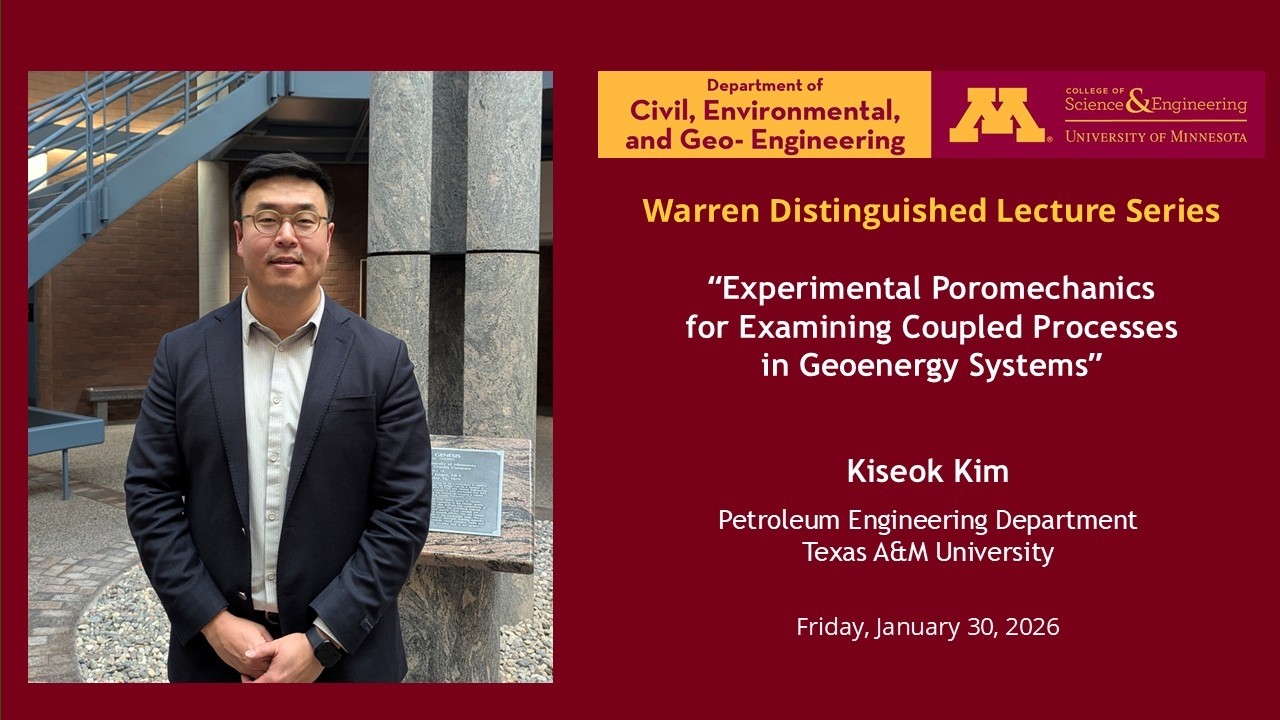
Experimental Poromechanics for Examining Coupled Processes in Geoenergy Systems
Keywords
Summary
177 words
Critical Evaluation
Value of the Information & Strength of the Argument
The lecture provides valuable insights into experimental methods for studying coupled processes in geomaterials. The speaker demonstrates a strong command of the subject, presenting original research with clear methodology and results. The argumentation is solid, supported by experimental data and references to published work. The presentation effectively highlights the importance of considering chemical effects and stress history in poromechanical models. The novel concepts, such as the precipitation-induced geo-barrier, are intriguing and well-motivated. The speaker also acknowledges limitations and ongoing work, which adds credibility.
92 words
Title / Content Match
The title accurately reflects the content, which focuses on experimental poromechanics applied to geoenergy systems.
Quality & Reliability
8/10
The lecture presents original experimental research from a recognized academic, with detailed methodology and references to published work. The speaker is an assistant professor with relevant expertise. The content is technical and appears scientifically sound, though not peer-reviewed in this format.
Key Moments
Markers derived by PSI from the transcript: the creator did not define chapters.
- Introduction and speaker introduction by Joe Leas.
- Kiseok Kim begins presentation, acknowledges collaborators.
- Overview of geoenergy systems and common porous media foundation.
- Introduction to coupled THMC processes and research outline.
- Reservoir rock studies: CO2 injection effects on compressibility and creep.
- Development of chemo-poroviscoelastic model and importance of chemical coupling.
- Multiphase flow behavior and relative permeability measurements.
- Caprock behavior: stress history and CO2 breakthrough experiments.
- Fracture self-sealing in mudrocks: effects of saturation and pore fluid.
- Precipitation-induced geo-barrier concept and ongoing research.
Cited Sources
- Kim, H., et al. (2022). Chemo-poro-viscoelastic model for CO2 storage. — Referenced during discussion of reservoir rock behavior and constitutive modeling.
- Kim, K., et al. (2023). Experimental poromechanics of caprocks. — Referenced during discussion of caprock studies and stress history.
Concurring Sources
- Coussy, O. (2004). Poromechanics. — Standard reference for poromechanics theory.
- Rutqvist, J. (2012). The geomechanics of CO2 storage in deep sedimentary formations. — Related work on geomechanical aspects of CO2 storage.
Dissenting Sources
- No discordant sources identified. — The presentation aligns with established literature in the field.
Contribution & Novelties
The presentation offers a comprehensive experimental framework for studying coupled processes in geomaterials, with novel contributions including a chemo-poroviscoelastic model that integrates chemical effects, systematic investigation of stress history on caprock behavior, and a novel precipitation-induced geo-barrier concept. The use of synthetic mudrocks with controlled properties is a methodological innovation.
Pour aller plus loin :
- Poromechanics — Foundational theory for coupled deformation and fluid flow in porous media.
- Carbon capture and storage — Context for geological CO2 storage.
- Underground hydrogen storage — Emerging application discussed in the talk.
- Biot coefficient — Key parameter in poroelasticity.
95 words
Radar Profile
The radar profile shows high scores across all dimensions, indicating a well-balanced and rigorous presentation. The technical depth is substantial, and the information is both quantitative and reliable. The presentation excels in providing original experimental insights and practical applications.
💬 No comments were provided for analysis.