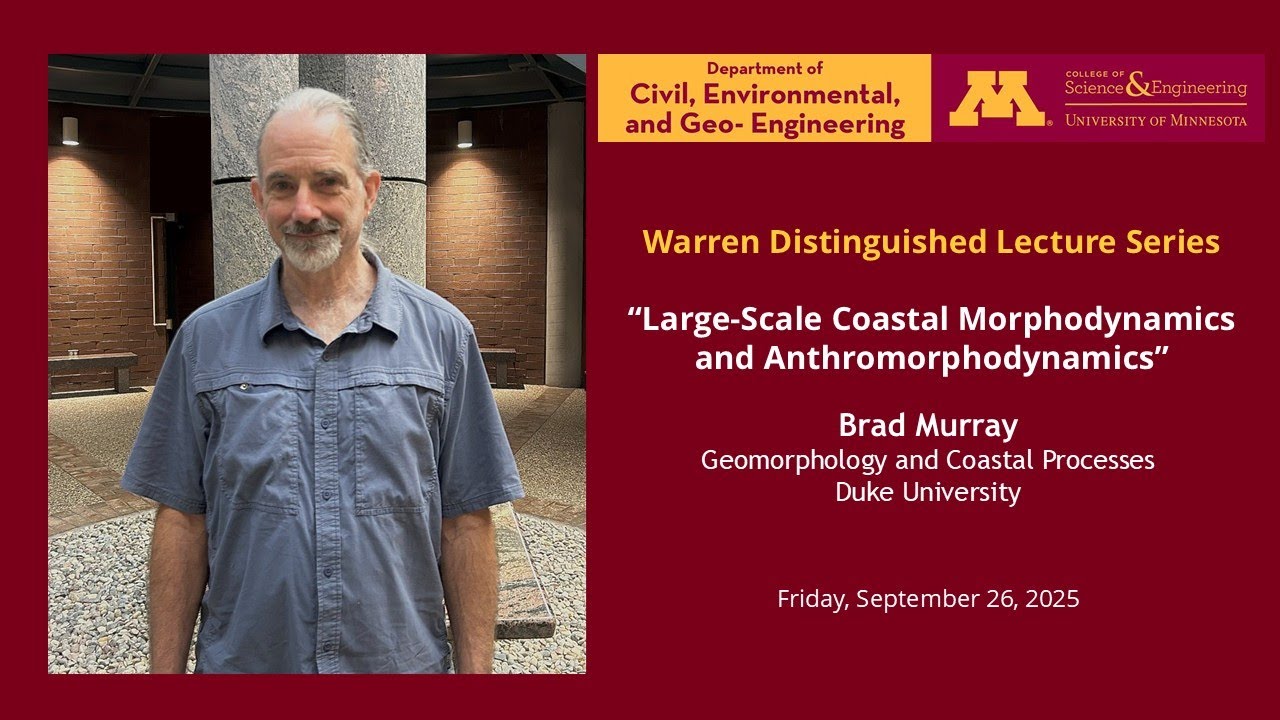
Large-Scale Coastal Morphodynamics and Anthromorphodynamics
Keywords
Summary
145 words
Critical Evaluation
Value of the Information & Strength of the Argument
The lecture provides valuable insights into the fundamental processes governing coastal morphology, supported by numerical models and historical data. Murray’s argumentation is logical and well-structured, building from basic principles to complex emergent behaviors. He effectively demonstrates the sensitivity of coastline shapes to wave climate and the potential for significant changes over decadal timescales. The inclusion of human interactions adds a crucial dimension, highlighting the need for sustainable coastal management.
Scientific Rigor, Source Quality, Title Accuracy
Murray’s presentation is scientifically rigorous, drawing on peer-reviewed research and established modeling techniques. He appropriately acknowledges uncertainties in sediment transport formulations. The title accurately reflects the content, covering both natural and human-influenced morphodynamics. The lecture is well-suited for an academic audience, with clear explanations and visual aids.
131 words
Title / Content Match
The title accurately reflects the content, covering both natural coastal morphodynamics and the influence of human activities.
Quality & Reliability
8/10
The talk is based on peer-reviewed research and numerical models, presented by a leading expert. The content is well-structured and grounded in established scientific principles, though some simplifications are inherent to the modeling approach.
Key Moments
Markers derived by PSI from the transcript: the creator did not define chapters.
- Introduction to coastal morphodynamics and the North Carolina case study.
- Explanation of longshore sediment transport and wave-driven currents.
- Discussion of curvature-driven flux gradients and coastline stability.
- Introduction of the numerical model and wave climate parameters.
- Emergent features: cuspate capes and flying spits under different wave climates.
- Application to North Carolina capes and historical wave climate reconstruction.
- Impact of changing storm climate on coastline shape and erosion patterns.
- Transition to barrier island dynamics and cross-shore processes.
- Role of sea-level rise and feedbacks in barrier island maintenance.
- Human interactions: shoreline stabilization and storm recovery, anthromorphodynamics.
Cited Sources
- Ashton, A., Murray, A.B., and Arnault, O. (2001) Formation of coastline features by large-scale instabilities induced by high-angle waves — Referenced as the basis for the numerical model and emergent coastline shapes.
- Murray, A.B., and Ashton, A. (2004) Extending a 1-line model to the finite-amplitude evolution of coastline shape — Referenced for the model's ability to simulate finite-amplitude coastline features.
Concurring Sources
- Ashton, A., Murray, A.B., and Arnault, O. (2001) Formation of coastline features by large-scale instabilities induced by high-angle waves — Supports the model's predictions of cuspate capes and flying spits.
- Murray, A.B., and Ashton, A. (2004) Extending a 1-line model to the finite-amplitude evolution of coastline shape — Supports the model's ability to simulate finite-amplitude coastline features.
Contribution & Novelties
The lecture synthesizes decades of research on coastal morphodynamics, highlighting the role of wave climate in shaping coastlines and the emerging field of anthromorphodynamics. It provides a framework for understanding how human actions interact with natural processes to drive coastal evolution.
Pour aller plus loin :
- Coastal morphodynamics - Wikipedia — Overview of the field.
- Longshore drift - Wikipedia — Explanation of the key transport process.
- Barrier island - Wikipedia — Background on barrier island dynamics.
76 words
Radar Profile
The radar profile shows high scores in information quality and reliability, with slightly lower scores in quantity and technical depth, reflecting a focused but comprehensive lecture.
💬 No comments were provided for analysis.