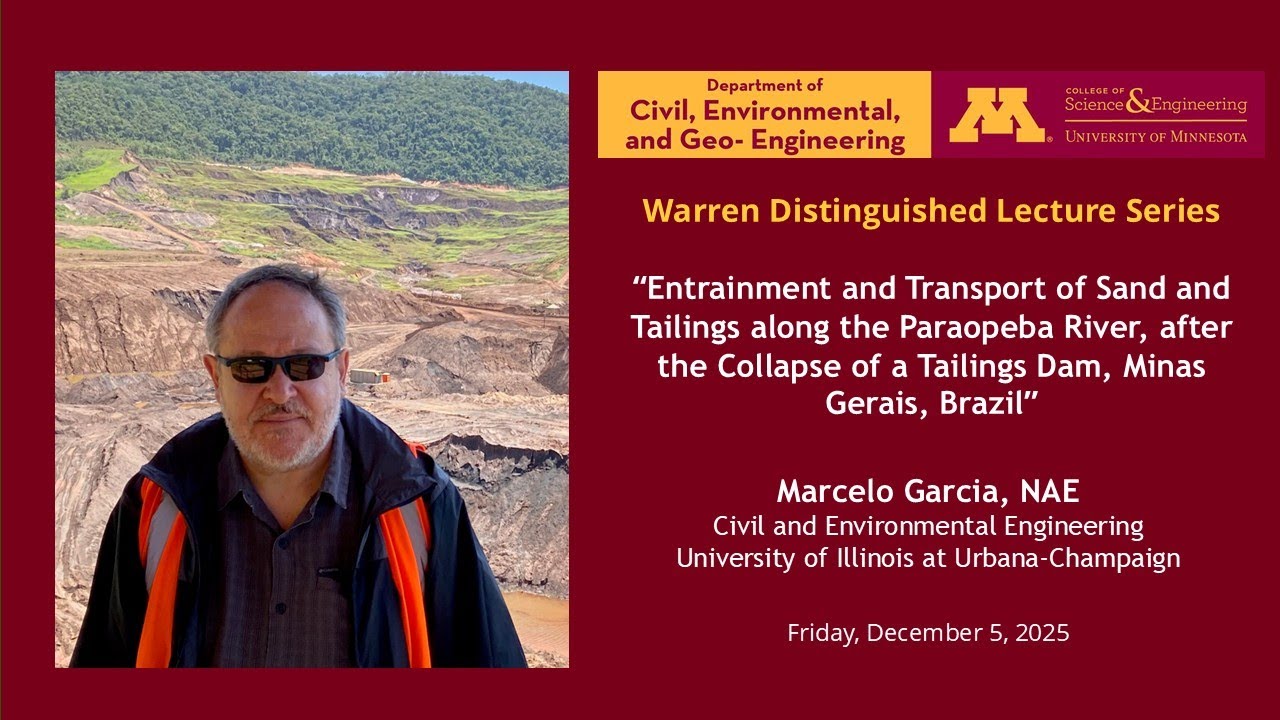
Entrainment and Transport of Sand and Tailings along the Paraopeba River in Brazil
Keywords
Summary
187 words
Critical Evaluation
Value of the Information & Strength of the Argument
The presentation provides significant value by addressing a critical environmental problem with a rigorous scientific approach. Garcia demonstrates the importance of combining field observations, laboratory experiments, and numerical modeling to understand and predict the behavior of tailings in river systems. The argumentation is solid, grounded in established sediment transport theory (e.g., Exner equation, active layer concept) and enhanced with novel adaptations for variable density. The speaker clearly explains the limitations of the model and the assumptions made, which strengthens the credibility of the findings. The use of real data from the Paraopeba River and the validation of entrainment equations with flume experiments add robustness to the conclusions. Overall, the presentation offers valuable insights for engineers and researchers dealing with tailings dam failures and river restoration.
Scientific Rigor, Source Quality, Title Accuracy
The scientific rigor is high, as the work is based on peer-reviewed research and presented by a leading expert in the field. The speaker references established theories and prior work (e.g., Hirano, Viparelli) and uses data from official Brazilian agencies (ANA) and monitoring programs. The quality of sources is excellent, with clear citations to relevant literature and data sources. The title accurately reflects the content, focusing on the entrainment and transport processes. The presentation is well-structured, with clear objectives, methodology, results, and discussion. No comments were provided, so no analysis of public reception is included.
235 words
Title / Content Match
The title accurately reflects the content, which focuses on the entrainment and transport of sand and tailings in the Paraopeba River after a dam collapse.
Quality & Reliability
9/10
Presentation by a highly distinguished expert (NAE member) based on peer-reviewed research, with detailed methodology and data from official sources. The content is technical and rigorous, with clear explanations of model assumptions and limitations.
Key Moments
Markers derived by PSI from the transcript: the creator did not define chapters.
- Introduction to tailings dam failures globally, including historical cases and the Brumadinho disaster.
- Explanation of what tailings are and the construction of tailings dams using the upstream method.
- Description of the Paraopeba River domain, data availability, and the impact of the dam collapse.
- Introduction of the density-based active-layer formulation for mass conservation, extending the Exner equation.
- Implementation of the 1D hydraulic and sediment transport model for the Paraopeba River, including boundary conditions and assumptions.
- Discussion of model results, including the filling of the pool upstream of the spillway and the trapping of tailings.
- Presentation of laboratory experiments in an annular flume to evaluate sediment entrainment equations.
- Analysis of entrainment rates for well-sorted and poorly-sorted tailings, highlighting the need for additional parameters.
- Conclusions and implications for river management and cleanup efforts.
Cited Sources
- Brazilian National Water Agency (ANA) data — Used for flow and sediment data along the Paraopeba River.
- Ballet and Arcadis contractor reports — Provided core samples and monitoring data for model calibration.
Concurring Sources
- Hirano, M. (1971) - River-bed degradation with armoring — Foundational work on active layer concept used in the model.
- Viparelli, E. et al. - Modeling sediment transport in rivers — Extended active layer formulations for multiple layers.
Contribution & Novelties
The presentation offers a novel approach to modeling sediment transport in rivers affected by tailings dam failures by incorporating sediment density as a tracer for iron tailings. This allows for the tracking of tailings mixing with ambient sand and the prediction of bed aggradation. The extension of the active-layer formulation to include variable density is a significant contribution. Additionally, the evaluation of existing entrainment equations for tailings provides practical guidance for future modeling efforts.
Pour aller plus loin :
- Exner equation — Fundamental equation for sediment mass conservation in rivers.
- Active layer concept in sediment transport — Overview of sediment transport processes and active layer.
- Tailings dam failures — General information on tailings dams and their risks.
117 words
Radar Profile
The radar profile shows high scores across all dimensions, indicating a well-balanced and rigorous presentation. The high technical level and reliability are complemented by substantial information content, making it an excellent resource for experts.