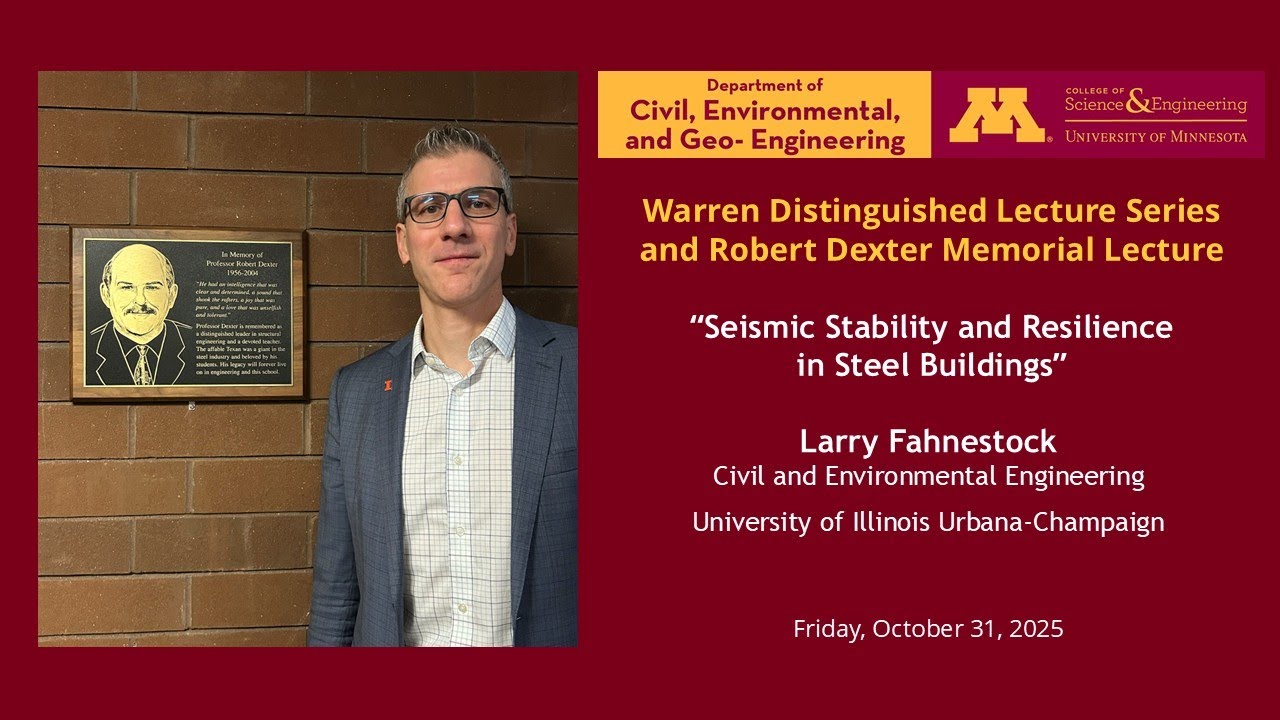
Seismic Stability and Resilience in Steel Buildings
Keywords
Summary
168 words
Critical Evaluation
Value of the Information & Strength of the Argument
The presentation provides valuable insights into seismic design, particularly the often-overlooked role of secondary stiffness in ensuring stability. Fahnestock’s argument is well-structured and supported by experimental and numerical evidence. He effectively challenges the conventional emphasis on ductility, showing that low-ductility systems can be stable if they possess sufficient secondary stiffness. The use of full-scale test results and calibrated numerical models strengthens the credibility of his claims. However, the argumentation is somewhat one-sided, as it primarily draws from his own research and does not extensively discuss alternative perspectives or potential limitations.
Scientific Rigor, Source Quality, Title Accuracy
The scientific rigor is high, as the presentation is based on peer-reviewed research projects funded by NSF and AISC, and includes detailed descriptions of experimental setups and numerical models. The speaker is a recognized expert in the field, with numerous awards and publications. The title accurately reflects the content, which focuses on seismic stability and resilience in steel buildings. The sources cited are primarily the speaker’s own research and general references to design codes, but specific citations are not provided in the video. The description mentions the funding sources and the speaker’s credentials, but no direct links to publications are given.
206 words
Title / Content Match
The title accurately reflects the content, which focuses on seismic stability and resilience in steel buildings, with emphasis on secondary stiffness.
Quality & Reliability
8/10
Presentation by a recognized expert in structural engineering, based on large-scale tests and numerical simulations, with clear methodology and references to research projects. However, it is a lecture, not a peer-reviewed publication, and some claims are based on the author's own research.
Key Moments
Markers derived by PSI from the transcript: the creator did not define chapters.
- Introduction and tribute to Robert Dexter
- Basic concepts of seismic design: base shear, roof drift, gravity load effects
- Introduction to low-ductility steel braced frames and their prevalence in moderate seismic regions
- Full-scale tests of R=3 chevron braced frame: sudden brace buckling and secondary stiffness from gusset plates
- Tests of OCBF split-X frame: ductile response followed by fractures, leading to low secondary stiffness
- Numerical simulations and parametric studies on brace frame configurations
- Proposal of R=4 brace frame design approach focusing on secondary stiffness
- Transition to high-ductility steel moment frames and the role of secondary stiffness
- Large-scale tests of moment frames and numerical simulations
- Conclusions and design implications: persistent positive stiffness as key parameter
Cited Sources
- NSF-funded research project on low-ductility braced frames — Mentioned as funding source for the research presented
- AISC-funded research project — Mentioned as funding source for the research presented
Concurring Sources
- Fahnestock, L.A., et al. (2016). Seismic response of low-ductility steel braced frames. — The speaker's own research, which forms the basis of the presentation
Contribution & Novelties
The presentation offers a novel perspective on seismic design by emphasizing the importance of persistent secondary stiffness over traditional ductility requirements. It provides experimental evidence from large-scale tests and numerical simulations to support this idea, and proposes a pragmatic design approach for incorporating secondary stiffness into seismic design. This could lead to more economical and resilient structures, especially in moderate seismic regions.
Pour aller plus loin :
- P-Delta Effect — Explains the destabilizing effect of gravity loads on structures.
- Seismic Performance — Overview of how buildings respond to earthquakes and performance objectives.
- Structural Resilience — Concept of resilience in engineering, relevant to the talk’s focus on recovery after earthquakes.
109 words
Radar Profile
The radar profile shows high scores in all dimensions, indicating a well-rounded and reliable presentation. The high technical level and information quality are balanced by a strong reliability score, reflecting the expert background and experimental basis. The overall assessment is very positive, with only minor limitations in the breadth of sources cited.