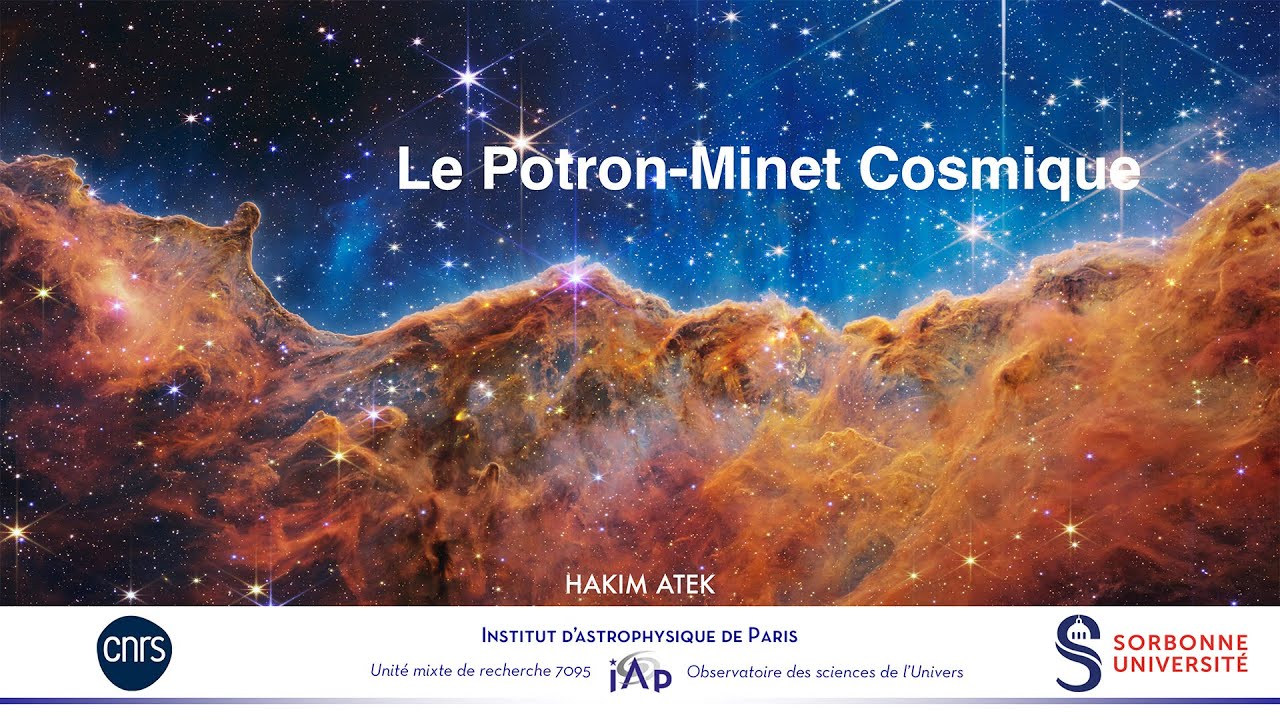
LE POTRON-MINET COSMIQUE
Keywords
Summary
188 words
Critical Evaluation
The presentation is scientifically rigorous and well-structured. Atek provides a clear overview of the theoretical framework of structure formation, emphasizing the importance of dark matter and the challenges of simulating galaxy formation across scales. He correctly notes that the standard cosmological model, with dark matter and dark energy, successfully reproduces the large-scale distribution of galaxies, but faces difficulties in explaining the details of galaxy formation. The historical context is well presented, acknowledging the contributions of Hubble, Leavitt, and Slipher, and correctly attributing the discovery of the expansion of the universe. The core of the talk focuses on the recent JWST observations, which have revealed an unexpected abundance of bright and massive galaxies at high redshifts. Atek presents these findings as a major surprise that challenges current theoretical models, which predicted a more gradual buildup of galaxies. He discusses the implications for the epoch of reionization and the need to revise our understanding of early galaxy formation. The talk is accessible to a general audience while maintaining scientific accuracy. The speaker does not overstate the significance of the findings, acknowledging that more data and theoretical work are needed. The sources cited are primarily the JWST mission and the Planck satellite, which are reliable and well-known. The presentation does not include any commercial or promotional content. The title, while metaphorical, is appropriate and does not mislead. Overall, this is an excellent scientific presentation that effectively communicates complex topics in cosmology.
238 words
Title / Content Match
The title is metaphorical and intriguing, but the content directly addresses the cosmic dawn and first galaxies, which matches the title's poetic reference.
Quality & Reliability
8/10
The speaker is a recognized astronomer at IAP, and the content is based on established cosmological models and recent JWST observations. The presentation is rigorous, with clear explanations and references to key missions and discoveries.
Key Moments
Markers derived by PSI from the transcript: the creator did not define chapters.
- Introduction to the cosmic dawn and the James Webb Space Telescope.
- Explanation of primordial fluctuations and the role of dark matter in structure formation.
- Discussion of large-scale structure and the cosmic web.
- Challenges in simulating galaxy formation across scales.
- Historical overview: from Hubble's discovery to modern observations.
- The epoch of reionization and the first sources of light.
- JWST observations of high-redshift galaxies and their surprising properties.
- Implications of JWST discoveries for galaxy formation models.
- Discussion of future observations and theoretical developments.
Cited Sources
- JWST - James Webb Space Telescope — Mentioned as the primary observatory for the new observations.
- Planck satellite — Mentioned for observations of the cosmic microwave background.
Concurring Sources
- JWST - James Webb Space Telescope — The JWST observations are the main source of new data.
Dissenting Sources
- No discordant sources — No conflicting sources were mentioned in the video.
Contribution & Novelties
The talk provides an up-to-date overview of the latest JWST discoveries on the first galaxies, highlighting the unexpected brightness and abundance of these objects. It emphasizes the need to revise theoretical models of galaxy formation and discusses the implications for the epoch of reionization.
Pour aller plus loin :
- James Webb Space Telescope — Official site with images and science results.
- Epoch of Reionization — Overview of the reionization process.
- Lambda-CDM model — The standard cosmological model.
77 words
Radar Profile
The radar profile shows high scores in information quantity, quality, and reliability, with a slightly lower technical level, indicating a well-balanced presentation accessible to a broad audience.