INFLATION 2025 - Denis Werth
Keywords
Summary
167 words
Critical Evaluation
The talk presents a clear and well-structured introduction to positive geometries and their potential application to cosmological correlators. The speaker demonstrates a deep understanding of the subject, providing precise mathematical definitions and illustrative examples. The argumentation is logical, progressing from simple one-dimensional examples to the more complex case of massive correlators. The main strength of the talk is its pedagogical clarity, making advanced concepts accessible to a specialized audience. However, the content is largely based on work in progress, and the speaker acknowledges that the short answer to the main question is ‘we don’t know yet.’ This limits the conclusiveness of the presentation. The sources cited are not explicitly mentioned in the talk, but the speaker references recent work by colleagues (Hayden Lee, Nat) and mentions the amplituhedron and associahedron, which are well-known in the literature. The talk does not provide a detailed literature review, but it situates the research within the broader context of positive geometries and scattering amplitudes. The technical level is high, assuming familiarity with concepts such as canonical forms, residues, and cosmological correlators. The title ‘INFLATION 2025’ is generic and does not accurately reflect the specific topic, which could be misleading. Overall, the talk is valuable for researchers in the field, offering a novel perspective and raising important open questions. The quality of the presentation is high, but the preliminary nature of the results prevents a higher score.
232 words
Title / Content Match
The title is generic and does not reflect the specific topic of positive geometries in cosmological correlators.
Quality & Reliability
8/10
Talk by a researcher presenting work in progress, with clear mathematical definitions and references to recent literature. The content is technical and appears rigorous, but the results are preliminary and not peer-reviewed in this context.
Key Moments
Markers derived by PSI from the transcript: the creator did not define chapters.
- Introduction and main question: Can massive cosmological correlators be described by positive geometries?
- Definition of positive geometries and examples from scattering amplitudes (amplituhedron, associahedron).
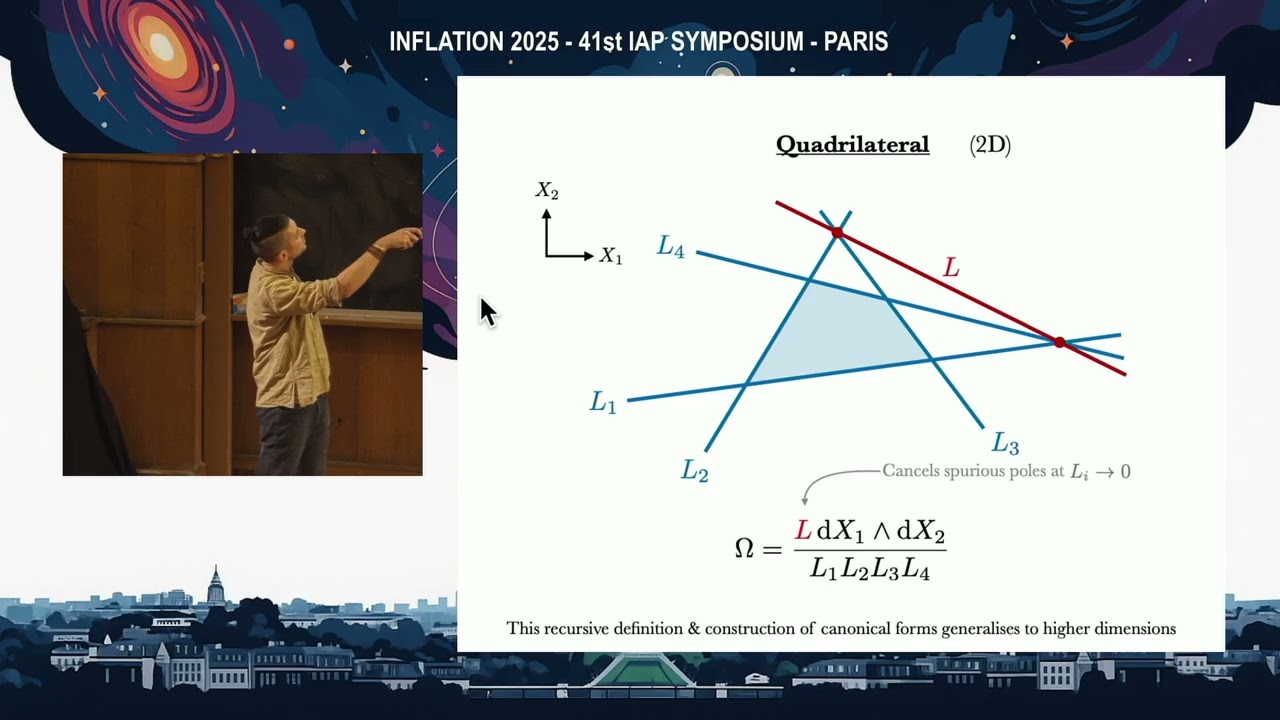
- Construction of canonical differential forms for simple geometries (interval, triangle).
- Application to conformally coupled scalar correlators: two-site chain diagram as a triangle.
- Massive correlators with hypergeometric kernels: rational integrands and failure in lambda space.
- Positive geometry found in projective kinematic space, but canonical form deformation needed.
- Open questions and conclusion.
- Q&A: role of symmetries and advantages of geometric approach.
Cited Sources
- Amplituhedron — Mentioned as an example of positive geometry describing scattering amplitudes.
- Associahedron — Mentioned as another example of positive geometry for scattering amplitudes.
Concurring Sources
- Positive Geometries and Canonical Forms — Provides the mathematical foundation for positive geometries and canonical forms used in the talk.
Contribution & Novelties
The talk presents a novel approach to studying cosmological correlators using positive geometries, extending techniques from scattering amplitudes. The main contribution is the identification of a positive geometry for massive correlators in a projective kinematic space, despite the failure in the lambda space. This suggests a potential new framework for understanding the analytic structure of cosmological correlators.
Pour aller plus loin :
- The Amplituhedron — Foundational paper on the amplituhedron, a key example of positive geometry.
- The Associahedron and its generalizations — Discusses associahedra in the context of scattering amplitudes.
- Cosmological Correlators — Review of cosmological correlators and their properties.
- Positive Geometries and Canonical Forms — Introduces the concept of positive geometries and canonical forms.
- Massive Correlators in de Sitter — Recent work on massive correlators, relevant to the talk’s topic.
131 words
Radar Profile
The radar profile shows high scores in technical level and information quality, reflecting the advanced and rigorous nature of the talk. The lower score in quantity of information is due to the short duration and focus on a specific research question. Overall, the talk is well-balanced and suitable for a specialized audience.