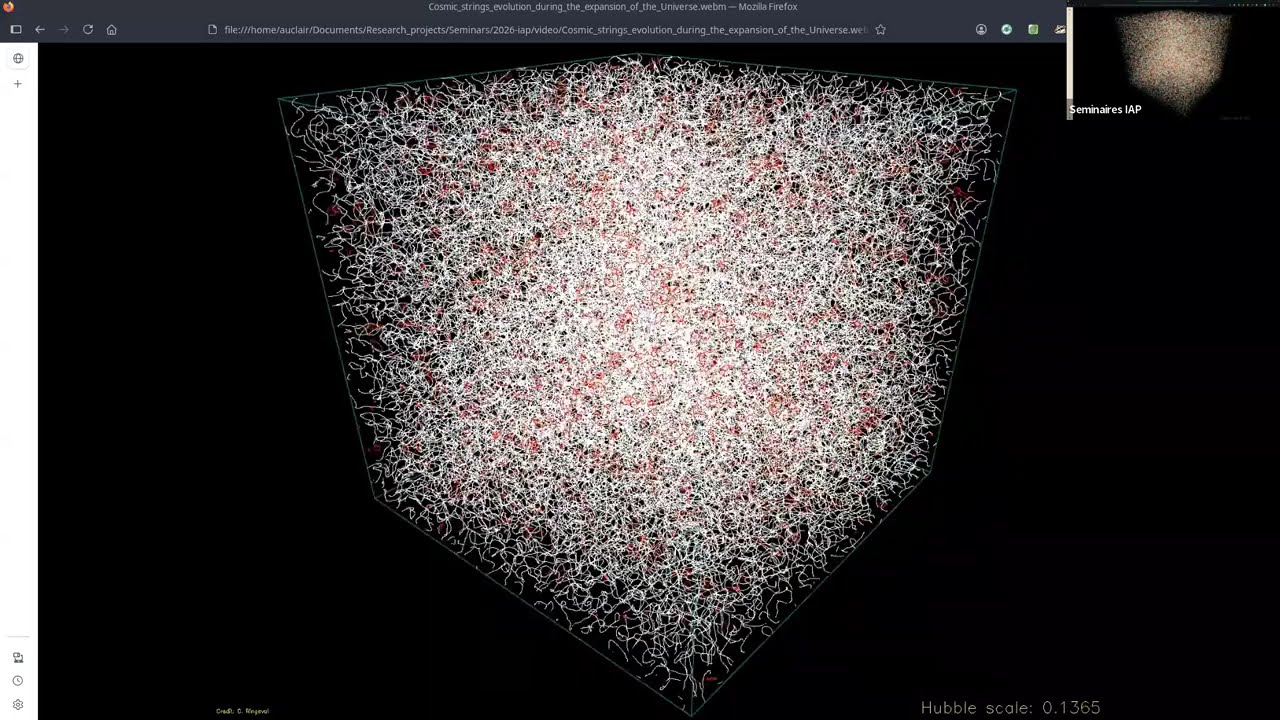
An introduction to cosmic strings, a decade into the gravitational wave era
Keywords
Summary
133 words
Critical Evaluation
The presentation is a well-structured and informative review of cosmic strings, suitable for an audience with a background in physics or astronomy. The speaker demonstrates a deep understanding of the subject, explaining complex concepts in a clear and accessible manner. The use of analogies, such as the vortex in hair and the liquid crystal example, helps to illustrate abstract ideas. The talk covers the theoretical foundations, including spontaneous symmetry breaking and topological defects, and connects them to observational signatures, particularly gravitational waves. The discussion of current constraints from pulsar timing arrays and future prospects with LISA is timely and relevant. The speaker also addresses points of contention within the community, such as the treatment of string networks and the interpretation of data, which adds critical depth. However, the presentation is primarily a review and does not present new original research. The reliance on a single speaker’s perspective and the lack of detailed citations in the description limit the ability to verify all claims independently. Nevertheless, the content is scientifically sound and aligns with established literature. The title accurately reflects the content, and the talk fulfills its promise of being pedagogical yet thorough. Overall, this is a high-quality presentation that provides a solid introduction to cosmic strings and their gravitational wave signatures.
211 words
Title / Content Match
The title accurately reflects the content: a comprehensive introduction to cosmic strings within the context of gravitational wave astronomy.
Quality & Reliability
8/10
The presentation is a pedagogical review by a CNRS researcher, based on established theoretical frameworks and recent observational constraints. It includes references to key literature and community debates, but lacks detailed citations in the description.
Key Moments
Markers derived by PSI from the transcript: the creator did not define chapters.
- Introduction and overview of the talk's structure
- Explanation of phase transitions and spontaneous symmetry breaking
- Introduction to topological defects and the kink solution
- Formation of cosmic strings and the Mexican hat potential analogy
- Properties of cosmic strings: energy per unit length and tension
- Nambu-Goto action and modeling string dynamics
- Gravitational wave emission from loops, cusps, and kinks
- Observational signatures and current constraints from pulsar timing arrays
- Future prospects with LISA and ground-based detectors
- Open questions and community debates
Cited Sources
- Cosmic strings and the origin of structure — Referenced in the talk as a study on the formation of cosmic strings in grand unified theories.
Concurring Sources
- Cosmic strings and the origin of structure — Referenced in the talk as a study on the formation of cosmic strings in grand unified theories.
Contribution & Novelties
The talk provides a comprehensive and pedagogical overview of cosmic strings, synthesizing theoretical concepts and observational constraints. It highlights current debates and open questions, offering a valuable resource for researchers entering the field.
Pour aller plus loin :
- Cosmic string - Wikipedia — General overview and background.
- Nambu-Goto action - Wikipedia — Mathematical framework for string dynamics.
- Pulsar timing array - Wikipedia — Observational technique for detecting gravitational waves.
69 words
Radar Profile
The radar profile shows high scores in quantity and quality of information, with a strong technical level and reliability, indicating a well-balanced and informative presentation.