INFLATION 2025 - Arthur Poisson
Keywords
Summary
167 words
Critical Evaluation
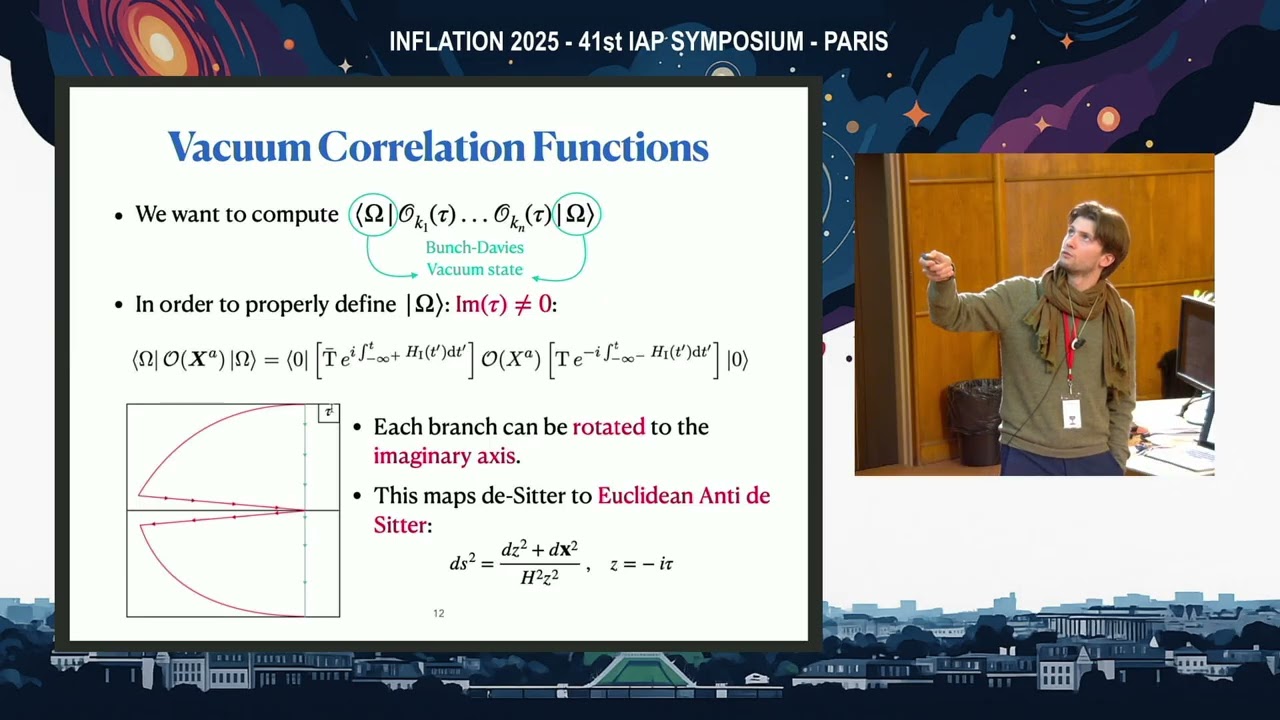
The talk presents a novel and mathematically rigorous approach to handling quantum field theory in de Sitter spacetime, which is of significant interest for early universe cosmology. The speaker clearly explains the motivation: the lack of time translation invariance in de Sitter prevents the use of standard energy-momentum conservation, complicating the computation of cosmological correlators. By constructing a new momentum space based on the contour lab transform, he offers a framework that mirrors flat space techniques, potentially simplifying calculations and providing new insights.
The argumentation is solid, grounded in established mathematical tools such as representation theory and integral transforms. The speaker carefully outlines the steps: from the geometry of de Sitter, to the classification of fields via the Casimir operator, to the definition of the new momentum space and its application to propagators. The recovery of known spectral representations for the propagator serves as a validation of the approach, lending credibility to the framework.
The technical level is high, assuming familiarity with QFT, group theory, and cosmology. The presentation is concise, fitting within a 17-minute talk, which may leave some details underexplored, but the speaker offers to discuss further and mentions an upcoming paper.
The sources cited are limited to two papers mentioned in the talk (by Melville and others), and the description provides no additional links. This is typical for a conference talk, but it limits the ability to verify claims independently. The speaker does not provide a list of references, which is a minor weakness.
The title ‘INFLATION 2025 - Arthur Poisson’ is generic and does not convey the specific content, but it is not misleading. The talk is well-structured and the speaker is engaging, handling questions competently.
Overall, the talk offers a promising new tool for de Sitter QFT, with potential applications in computing cosmological correlators and understanding non-perturbative aspects. The mathematical foundation appears sound, and the validation against known results is reassuring. However, the lack of detailed references and the preliminary nature of the work (as indicated by the upcoming paper) warrant a slightly cautious assessment. The talk is of high quality for a specialist audience, but its impact will depend on the forthcoming publication and further applications.
362 words
Title / Content Match
The title is generic but accurately reflects the topic of inflation and the speaker's name.
Quality & Reliability
7/10
The talk presents original research in theoretical cosmology, with a clear mathematical framework and references to known results. The speaker is a PhD student, and the content is technical and consistent with established physics. However, the video is a conference talk without peer-reviewed publication details, and the presentation is concise, limiting depth.
Key Moments
Markers derived by PSI from the transcript: the creator did not define chapters.
- Introduction and motivation for cosmological correlators
- Review of de Sitter geometry and symmetries
- Representation theory and classification of fields
- Construction of the new momentum space using contour lab transform
- Application to the propagator and spectral representation
- Conclusion and summary
- Q&A session begins
Cited Sources
- Scott Melville and G. Mentasti (paper on spectral representation) — Mentioned as a source for the known spectral representation of the propagator.
- D. (paper on spectral representation) — Mentioned as another source for the known spectral representation.
Concurring Sources
- Scott Melville and G. Mentasti (paper on spectral representation) — The speaker's result matches the spectral representation derived in this work.
- D. (paper on spectral representation) — Another independent derivation of the same spectral representation.
Contribution & Novelties
The talk introduces a novel momentum space for quantum field theory in de Sitter spacetime, based on the contour lab transform, which allows a decomposition of fields analogous to flat space Fourier transforms. This provides a new language for computing cosmological correlators and may simplify perturbative calculations. The framework is validated by recovering known spectral representations for the propagator.
Pour aller plus loin :
- De Sitter space — Provides background on the geometry and properties of de Sitter spacetime.
- Representation theory of the Lorentz group — Relevant to the classification of fields via irreducible representations.
- Mellin transform — Related integral transform that may be useful for further exploration.
108 words
Radar Profile
The radar profile shows high scores in technical level and information quality, reflecting the advanced mathematical content and the speaker's expertise. The quantity of information is moderate due to the short talk, and reliability is solid but not perfect given the lack of published details.