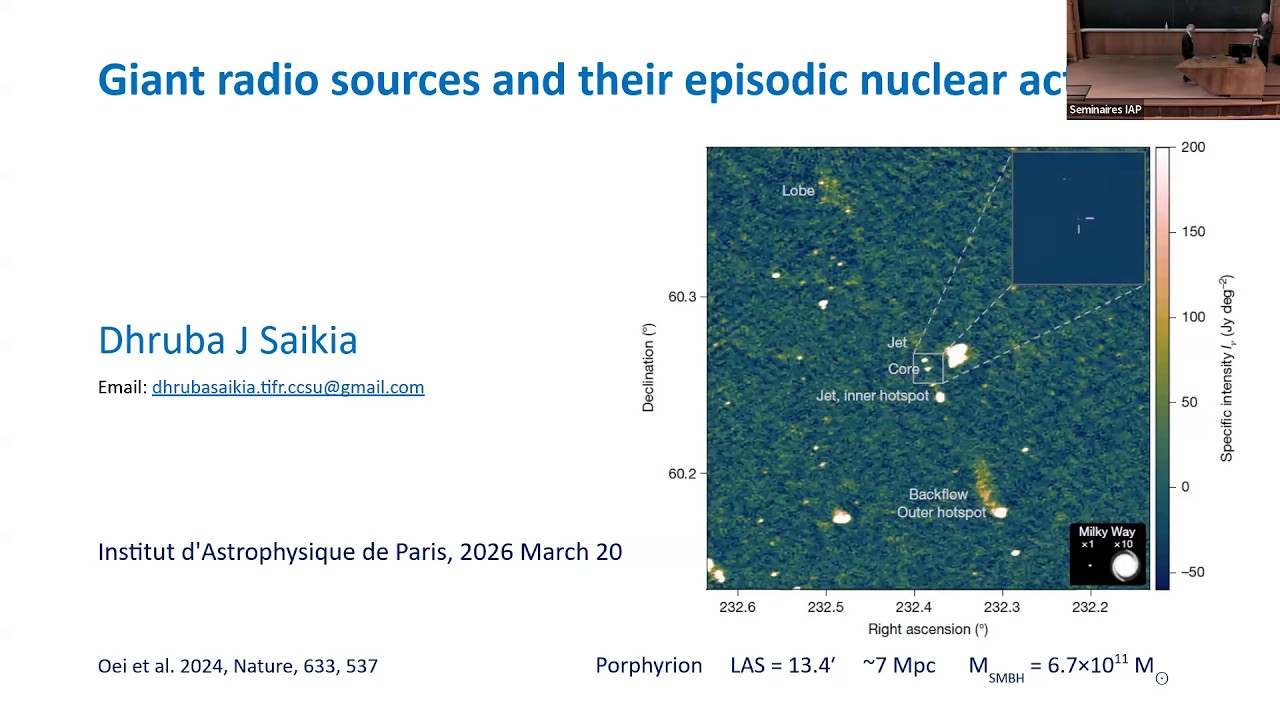
Giant radio sources and their episodic nuclear activity
Keywords
Summary
149 words
Critical Evaluation
The seminar provides a thorough and up-to-date review of giant radio sources, drawing on the speaker’s extensive research experience. The presentation is well-structured, starting with definitions and historical context, then moving to recent discoveries and physical interpretations. The speaker critically examines different formation scenarios, including episodic activity, and presents evidence from multi-wavelength observations. The use of LOFAR data is highlighted as a key driver of recent progress, and the potential of SKA is discussed. The argumentation is solid, with references to specific sources and surveys. However, as a seminar, it is not a peer-reviewed publication, and some claims may be based on preliminary results. The speaker’s expertise lends credibility, but the content is primarily a synthesis of existing knowledge rather than presenting new original research. The title accurately reflects the content, and the presentation is accessible to an audience with some background in astrophysics. Overall, the seminar is informative and reliable, though it does not break new ground.
158 words
Title / Content Match
The title accurately reflects the content, focusing on giant radio sources and their episodic nuclear activity, which is the central theme of the seminar.
Quality & Reliability
8/10
The speaker is a recognized expert in the field, presenting a well-structured seminar with references to recent discoveries and surveys. The content is based on established astrophysical concepts and recent observational results, though it is a review/expert opinion rather than a peer-reviewed publication.
Key Moments
Markers derived by PSI from the transcript: the creator did not define chapters.
- Introduction to giant radio sources, definition and largest known example (Alcyoneus).
- Historical overview: first discoveries in 1974, 3C236, and slow progress until recent LOFAR surveys.
- Discussion of Fanaroff-Riley classes and the luminosity-size diagram for radio source evolution.
- Young radio sources and their connection to giants; evidence for episodic activity.
- Double-double radio galaxies as examples of episodic nuclear activity.
- Misaligned gamma-ray emitting AGN and their significance for GRS studies.
- Role of LOFAR and future prospects with SKA.
Cited Sources
- LOFAR Surveys — Mentioned as the primary source for recent discoveries of giant radio sources.
- SKA Observatory — Discussed as the future facility for advancing studies of giant radio sources.
Concurring Sources
- LOFAR Surveys — Recent surveys have identified thousands of giant radio sources, consistent with the talk.
- SKA Observatory — Future observations with SKA are expected to further increase the sample, as discussed.
Contribution & Novelties
The seminar provides a comprehensive synthesis of current knowledge on giant radio sources, emphasizing the role of episodic nuclear activity and recent discoveries from LOFAR. It highlights the speaker’s own contributions, including the identification of misaligned gamma-ray emitting AGN and the discovery of a large GRS with GMRT. The presentation offers a critical examination of formation scenarios and underscores the importance of future facilities like SKA.
Pour aller plus loin :
- Giant radio galaxies — Overview of radio galaxies and their properties.
- LOFAR — The Low-Frequency Array telescope and its role in radio astronomy.
- Active galactic nucleus — Background on AGN and their emission mechanisms.
105 words
Radar Profile
The radar profile shows high scores across all dimensions, indicating a well-rounded and reliable presentation. The speaker demonstrates deep expertise and provides a balanced view of the subject, with strong emphasis on recent observational results and future prospects.