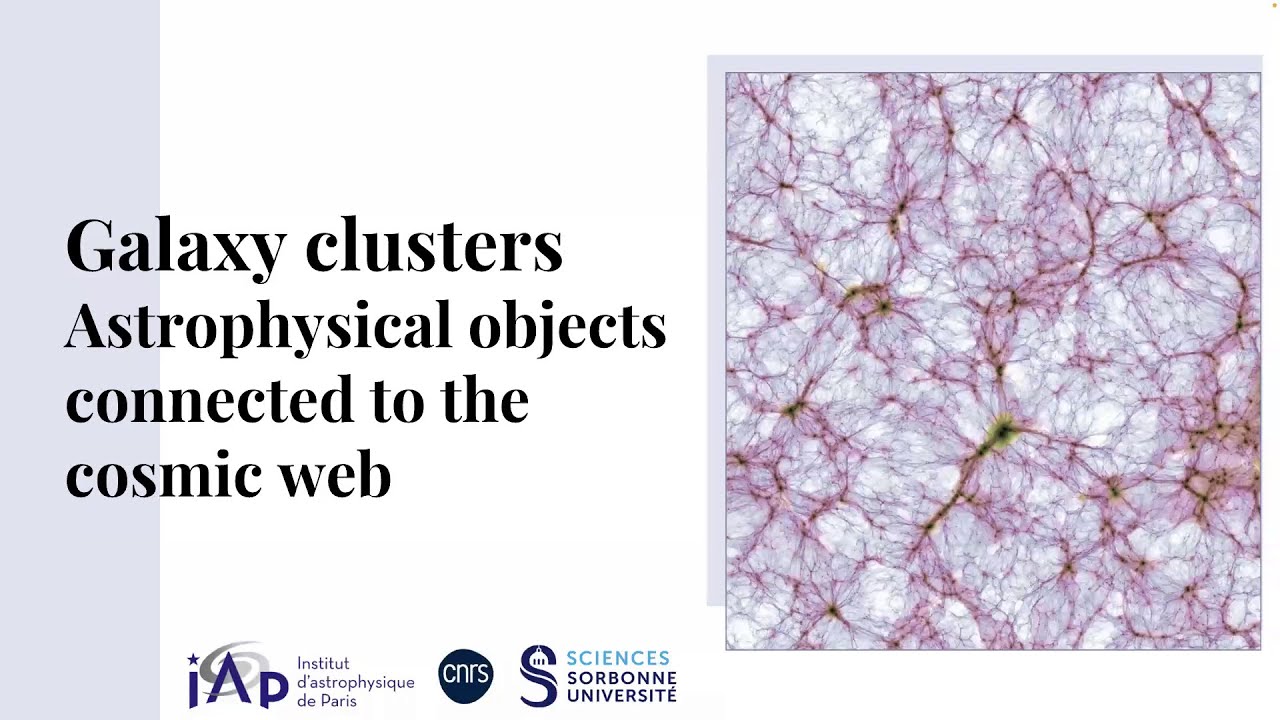
Probing the galaxy clusters in the cosmic web
Keywords
Summary
182 words
Critical Evaluation
The presentation is a comprehensive overview of current research on galaxy clusters and their connection to the cosmic web. The speaker demonstrates a strong command of the subject, integrating theoretical concepts, simulations, and observational data. The argumentation is solid, with clear logical progression from defining clusters to discussing their role in the cosmic web and the implications for cosmology and baryon physics. The use of simulations (IllustrisTNG, Horizon-AGN) and observational data (Euclid Q1, eROSITA, XMM) adds credibility. The speaker acknowledges limitations, such as the cluster tension and missing baryons, and discusses how future missions will address them. The content is technically detailed, suitable for an audience with background in astrophysics. The title accurately reflects the content. The sources cited are primarily the speaker’s own work and well-known simulations, but specific references are not provided in the description. The presentation is a valuable resource for researchers and advanced students interested in large-scale structure and cluster physics.
155 words
Title / Content Match
The title accurately reflects the content, which focuses on probing galaxy clusters and their connection to the cosmic web.
Quality & Reliability
8/10
The presentation is based on established astrophysical research, including simulations (IllustrisTNG, Horizon-AGN) and observational data (Euclid Q1, eROSITA, XMM). The speaker is a researcher at IAP with a PhD and postdoctoral experience. The content is consistent with current knowledge in cosmology and galaxy cluster studies.
Key Moments
Markers derived by PSI from the transcript: the creator did not define chapters.
- Introduction and speaker background
- Definition of galaxy clusters and their components
- Clusters as cosmological probes and scaling relations
- Cluster tension and missing baryons problem
- Clusters as nodes of the cosmic web and anisotropic accretion
- Connectivity of clusters and its relation to mass and dynamical state
- Gas in filaments and the WHIM
- Observations of filaments in X-ray and SZ
- Euclid Q1 data and cosmic web influence on galaxy properties
- Future missions and outlook
Cited Sources
- IllustrisTNG simulation — Used to study cluster connectivity and dynamical states.
- Euclid mission — Used for Q1 data to study cosmic web influence on galaxies.
- eROSITA — X-ray survey for detecting clusters and filaments.
- XRISM — Future X-ray mission for spectroscopy of hot gas.
- NewAthena — Future X-ray observatory for probing the WHIM.
Concurring Sources
- IllustrisTNG — Simulation results support the relationship between connectivity and cluster mass.
- Euclid — Preliminary data show cosmic web influence on galaxy morphology.
Contribution & Novelties
The presentation provides an overview of recent research on the connection between galaxy clusters and the cosmic web, emphasizing the role of connectivity in cluster evolution and the missing baryons problem. It highlights the use of simulations and upcoming observations to address these issues.
Pour aller plus loin :
- Cosmic web — Overview of the large-scale structure of the universe.
- Warm–hot intergalactic medium — The diffuse gas phase thought to contain missing baryons.
- Galaxy cluster — Basic properties and importance in cosmology.
- Euclid (spacecraft) — Mission details and objectives.
89 words
Radar Profile
The radar profile shows high scores in quantity and quality of information, with a slightly lower but still solid technical level and reliability. This indicates a well-balanced presentation that is both informative and credible.