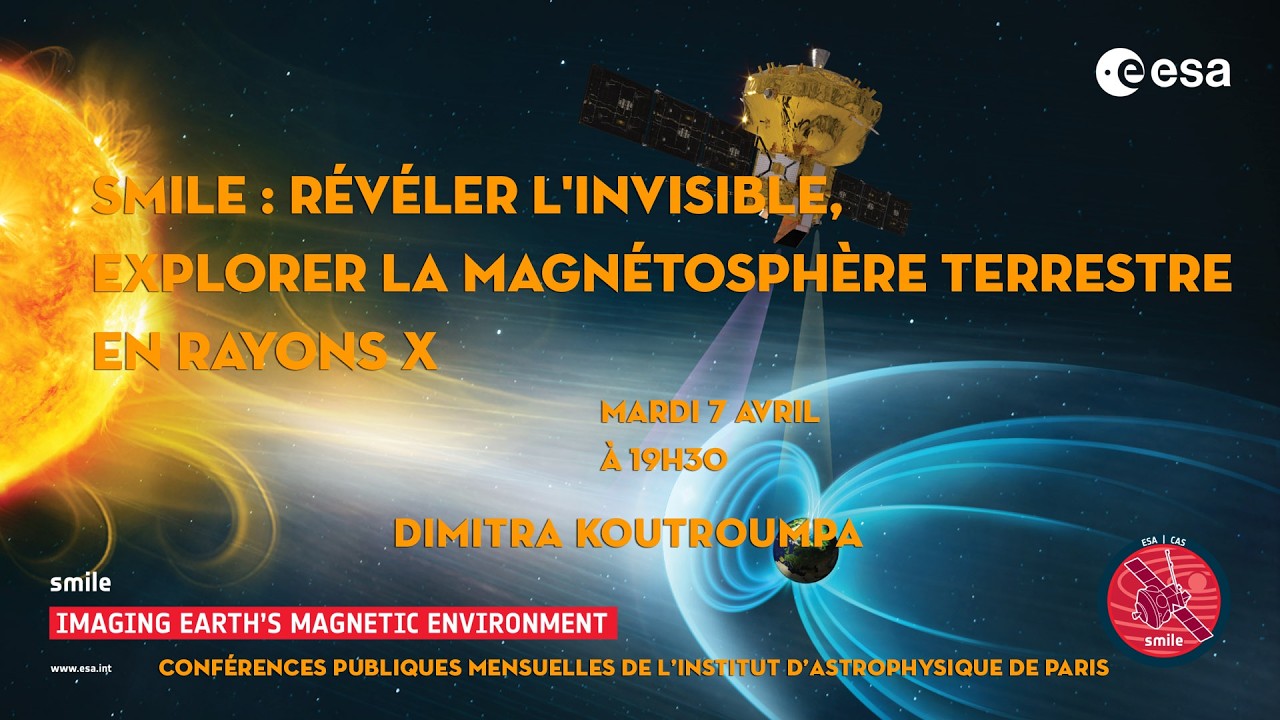
SMILE : RÉVÉLER L'INVISIBLE - EXPLORER LA MAGNÉTOSPHÈRE TERRESTRE EN RAYONS X
Keywords
Summary
162 words
Critical Evaluation
The presentation is a comprehensive and authoritative overview of the SMILE mission and space weather. The speaker, Dimitra Koutroumpa, is a researcher directly involved in the mission, lending high credibility to the information. The talk is well-structured, starting with the Sun’s activity and solar wind, then explaining the magnetosphere and its dynamics, and finally detailing the SMILE mission’s objectives and technology. The scientific content is accurate and up-to-date, with references to real events like the Carrington Event and the May 2024 geomagnetic storm. The use of X-ray imaging to observe the magnetosphere is a novel approach, and the speaker explains its advantages over previous methods. The presentation is accessible to a general audience while still providing technical details, making it suitable for both laypeople and those with some scientific background. The speaker’s expertise is evident in her clear explanations and ability to answer questions. The only minor weakness is that the talk is a public lecture, so some complex concepts are simplified, and detailed citations are not provided during the talk. However, the description includes links to the IAP conference page and the video itself, which may contain additional resources. Overall, the presentation is of high quality, with strong scientific rigor and clear communication.
204 words
Title / Content Match
The title accurately reflects the content, which focuses on the SMILE mission and its use of X-ray imaging to study Earth's magnetosphere.
Quality & Reliability
8/10
The presentation is given by a researcher directly involved in the SMILE mission, providing authoritative and up-to-date information. The content is well-structured, based on established scientific knowledge, and includes references to real events and missions. However, the talk is a public lecture, so some simplifications are made, and no detailed citations are provided during the talk.
Key Moments
Markers derived by PSI from the transcript: the creator did not define chapters.
- Introduction to the conference and speaker.
- Explanation of the Sun's structure and activity cycle.
- Description of the solar wind and its components.
- Historical context: Carrington Event and its effects.
- Introduction to space weather and its impacts on technology.
- Explanation of the magnetosphere and magnetic reconnection.
- Overview of the SMILE mission and its objectives.
- Details of the X-ray imaging technique used by SMILE.
- Discussion of the mission's orbit and instruments.
- Expected scientific outcomes and future implications.
Cited Sources
- IAP monthly conferences page — Official page for the conference series, providing information about upcoming talks and registration.
- Video link — Direct link to the recorded conference on YouTube.
Concurring Sources
- ESA SMILE mission page — Official ESA page confirming mission details and objectives.
- NASA Space Weather — NASA's space weather resources, consistent with the talk's content.
Contribution & Novelties
The presentation provides an up-to-date overview of the SMILE mission, which is a pioneering effort to use X-ray imaging to observe Earth’s magnetosphere globally. This approach offers a new perspective on space weather phenomena and could significantly improve our understanding and forecasting capabilities. The talk also highlights the importance of international collaboration in space science.
Pour aller plus loin :
- SMILE mission official page — Official ESA page with mission details and updates.
- Magnetosphere article on Wikipedia — Overview of Earth’s magnetosphere and its dynamics.
- Space weather on NOAA — NOAA Space Weather Prediction Center, providing real-time data and forecasts.
- X-ray astronomy on Wikipedia — Background on X-ray astronomy techniques and missions.
112 words
Radar Profile
The radar profile shows high scores in quantity and quality of information, with a moderate technical level, indicating a well-balanced presentation that is both informative and accessible. The reliability score is high, reflecting the speaker's expertise and the use of established scientific knowledge.