COMPRENDRE LA PHYSIQUE DES CELLULES PAR LA MATIÈRE ACTIVE
Keywords
Summary
154 words
Critical Evaluation
The lecture is an excellent example of science communication, presenting complex concepts in a clear and engaging manner. Jean-François Joanny, a leading expert in biophysics, demonstrates a deep understanding of both theoretical physics and biological systems. The content is scientifically rigorous, with a logical progression from historical context to fundamental principles and then to specific applications. The use of examples, such as the aggregation of earthworms and bacterial turbulence, effectively illustrates abstract concepts. The speaker emphasizes the importance of energy consumption and non-equilibrium thermodynamics, which are crucial for understanding active matter. The discussion of topological defects and active turbulence is particularly insightful, showing how these concepts can be used to describe collective cell behavior. The lecture also highlights the interdisciplinary nature of biophysics, bridging physics and biology. The sources cited, such as the work of Hodgkin and Huxley and Purcell, are seminal and well-chosen. The only minor limitation is the lack of detailed references for some specific studies mentioned, but this is understandable given the format. Overall, the lecture is highly informative and provides a solid foundation for understanding the physics of cells through active matter.
186 words
Title / Content Match
The title accurately reflects the content, which focuses on using active matter physics to understand cell behavior.
Quality & Reliability
9/10
Lecture by a renowned professor (Collège de France) with deep expertise in biophysics and active matter. The content is well-structured, rigorous, and based on established scientific concepts. The speaker is a leading researcher in the field, ensuring high reliability.
Key Moments
Markers derived by PSI from the transcript: the creator did not define chapters.
- Introduction to the lecture and the speaker's background.
- Historical examples: Robert Hooke and Erwin Schrödinger.
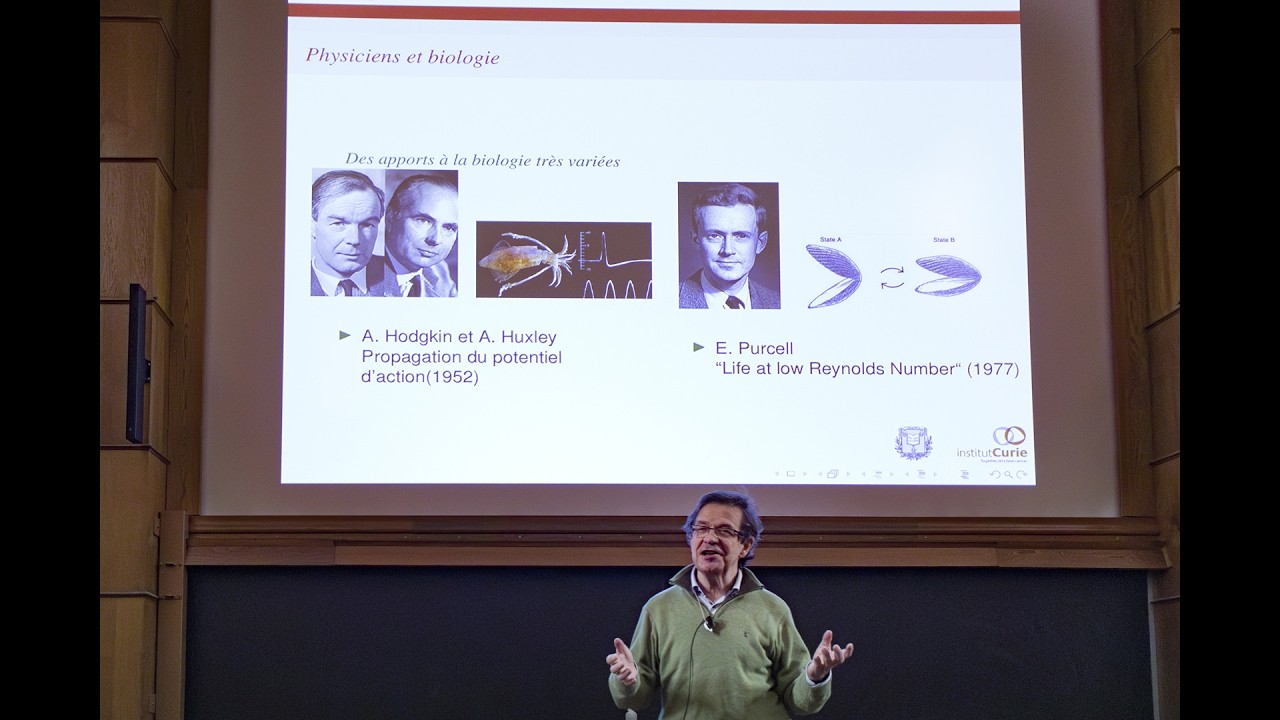
- Hodgkin and Huxley's work on action potentials and Purcell's life at low Reynolds number.
- Definition of active matter and examples: earthworms and bacteria.
- Key properties of active matter: energy consumption and non-equilibrium.
- Introduction to active turbulence and topological defects.
- Active phase transitions and their relevance to biological systems.
- Application to multicellular spheroids and cell monolayers.
- Discussion of intracellular phase transitions and biological condensates.
- Conclusion and outlook on future research directions.
Cited Sources
- Conférence Joanny 2026 - Société Mathématique de France — Official page for the lecture series 'Une question, un chercheur'.
Concurring Sources
- Active matter — General reference on active matter, consistent with the lecture's content.
- Topological defect — Reference for defects in ordered media, relevant to the discussion of active nematics.
Contribution & Novelties
The lecture provides a comprehensive introduction to active matter physics and its applications to cell biology, synthesizing theoretical concepts with experimental observations. It highlights the importance of non-equilibrium thermodynamics and collective behavior in biological systems. The speaker’s expertise adds depth to the discussion, making it a valuable resource for students and researchers.
Pour aller plus loin :
- Active matter — Overview of active matter systems and their theoretical framework.
- Topological defect — Explanation of defects in ordered media, relevant to active nematics.
- Biological condensates — Introduction to phase-separated structures in cells, a key topic in the lecture.
97 words
Radar Profile
The radar profile shows high scores in quantity and quality of information, with a strong technical level and high reliability. This indicates a well-balanced and authoritative presentation, suitable for an audience with some scientific background.