INFLATION 2025 - Lennart Balkenhol
Keywords
Summary
193 words
Critical Evaluation
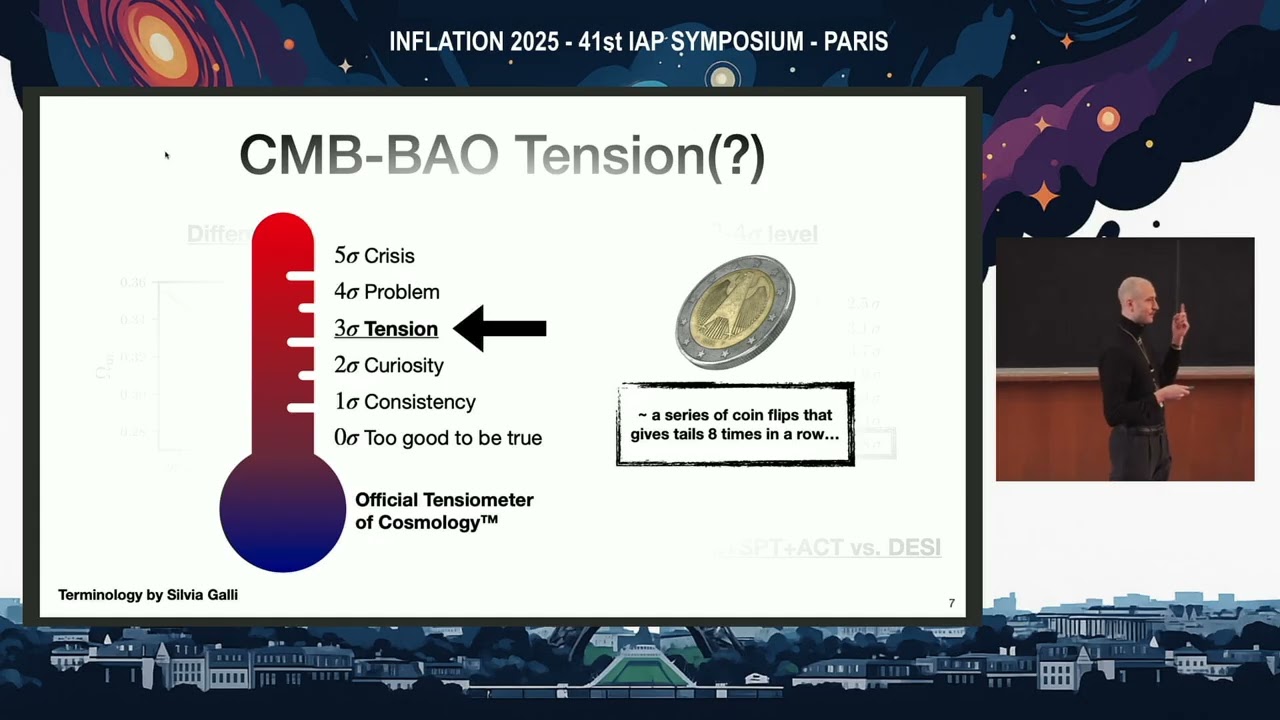
The talk provides a clear and rigorous overview of the current state of the CMB-BAO tension and its implications for inflation. Balkenhol demonstrates a solid understanding of the observational data and statistical methods, presenting results from multiple experiments (Planck, SPT, ACT, DESI) and their combinations. He appropriately emphasizes the consistency of CMB measurements and the borderline significance of the tension (2.8σ), using the analogy of coin flips to convey the uncertainty. The argumentation is well-structured: he first establishes the CMB constraints on ns, then introduces BAO, and finally shows the tension and its consequences for inflationary models. He is careful to mention caveats, such as potential systematics and the assumption of ΛCDM, and does not overstate the findings. The sources cited are primarily the experiments themselves (Planck, SPT, ACT, DESI) and the collaborative paper, which are reliable. The Q&A session adds depth, with audience members raising valid concerns about DESI systematics and the inclusion of supernovae data, which Balkenhol acknowledges. The title is somewhat generic but accurately reflects the content. Overall, this is a high-quality presentation suitable for a specialized audience, with a balanced and critical perspective.
187 words
Title / Content Match
The title is generic but the content matches the conference theme 'Inflation 2025' and the speaker's topic.
Quality & Reliability
8/10
Presentation by a postdoctoral researcher at IAP, based on a collaborative paper, with clear methodology and caveats. Data from established experiments (Planck, SPT, ACT, DESI) and statistical interpretation. No overclaiming; acknowledges uncertainties.
Key Moments
Markers derived by PSI from the transcript: the creator did not define chapters.
- Introduction: speaker introduces himself and the topic of CMB-BAO tension.
- Discussion of CMB constraints on scalar spectral index ns from Planck, SPT, ACT.
- Introduction to BAO and its sensitivity to Ωm and Hrd.
- Comparison of CMB and DESI BAO data, showing 2-3σ offsets.
- Interpretation of the tension: implications for inflation models, shift in ns.
- Caveats and caution: borderline significance, potential systematics, need for better data.
- Q&A: discussion of DESI systematics and supernovae data.
Cited Sources
- The CMB-BAO tension — Paper by the speaker and collaborators, basis of the talk.
- Planck satellite — CMB data used for ns constraints.
- South Pole Telescope (SPT) — CMB data used for ns constraints.
- Atacama Cosmology Telescope (ACT) — CMB data used for ns constraints.
- DESI (Dark Energy Spectroscopic Instrument) — BAO data used for comparison.
Concurring Sources
- Planck 2018 results — Planck satellite measurements of ns and other cosmological parameters.
- DESI 2024 results — DESI BAO measurements used in the comparison.
Dissenting Sources
- Supernovae data — Some audience members suggest that combining BAO with supernovae data may reduce the tension, implying a potential discordance.
Contribution & Novelties
The talk presents the emerging CMB-BAO tension and its implications for inflationary models, highlighting how the combination of CMB and BAO data shifts the inferred scalar spectral index, potentially disfavoring certain inflation models. This is a novel perspective from an observational data analysis standpoint.
Pour aller plus loin :
- Cosmic microwave background — Provides background on CMB and its role in cosmology.
- Baryon acoustic oscillations — Explains BAO and their use as a standard ruler.
- Scalar spectral index — Defines ns and its significance for inflation.
- Starobinsky inflation — A specific inflation model mentioned in the talk.
- DESI (Dark Energy Spectroscopic Instrument) — Provides information on the DESI survey.
109 words
Radar Profile
The radar profile shows high scores in quality of information, technical level, and reliability, with a slightly lower score in quantity of information, reflecting the focused scope of the talk. This indicates a technically rigorous presentation with reliable data, though not exhaustive in breadth.
💬 No comments were provided for analysis.