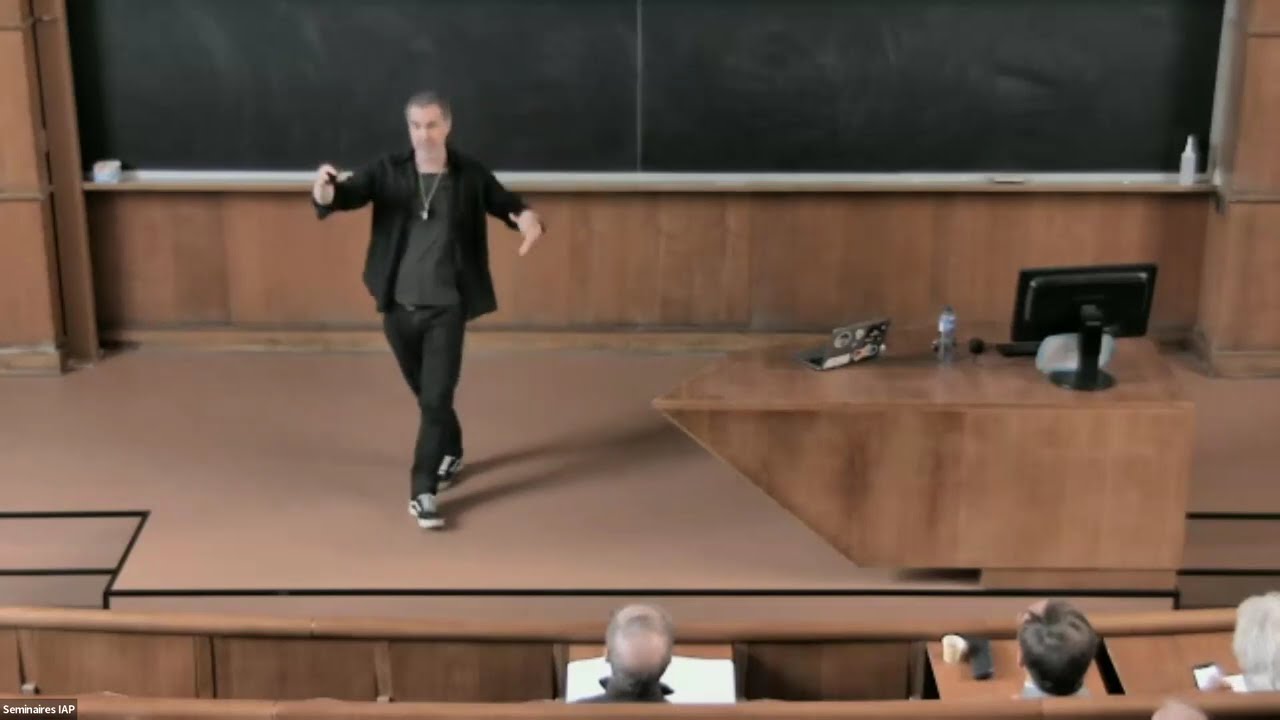
Updates from Cosmic Dawn and Cosmic Reionization
Keywords
Summary
170 words
Critical Evaluation
The talk provides a comprehensive and up-to-date overview of recent observational results in the field of cosmic dawn and reionization. Hayes effectively communicates complex concepts and highlights the most significant discoveries from JWST, such as the overabundance of bright galaxies and the unexpected presence of strong Lyman alpha emitters at very high redshifts. The argumentation is solid, grounded in observational data and comparisons with theoretical models. However, as a seminar, the talk is somewhat informal and does not delve into the statistical uncertainties or alternative interpretations in depth. The speaker acknowledges the preliminary nature of some results and the ongoing debates. The sources cited are primarily the speaker’s own research and collaborative efforts, which are appropriate for a specialized seminar. The title accurately reflects the content. Overall, the talk is scientifically rigorous and provides valuable insights, though it assumes a certain level of background knowledge. The presence of a brief sponsor segment does not detract from the scientific content.
159 words
Title / Content Match
The title accurately reflects the content, which covers recent observational updates on galaxies at cosmic dawn and the reionization epoch.
Quality & Reliability
8/10
The talk is given by a recognized researcher in the field, presenting recent observational results from JWST and other facilities. The content is based on peer-reviewed research and collaborations, but as a seminar, it reflects the speaker's perspective and ongoing work, with some results still preliminary.
Key Moments
Markers derived by PSI from the transcript: the creator did not define chapters.
- Introduction and overview of the talk's structure.
- Discussion of the theoretical framework of galaxy formation and the role of simulations.
- Presentation of JWST's first surprises: overabundance of bright galaxies at high redshift.
- Discovery of overmassive black holes and AGN at early times.
- Unusual abundance patterns in early galaxies, particularly high nitrogen-to-oxygen ratios.
- Lyman alpha emission as a probe of reionization and the surprising detection at z~11 and z~13.
- Measurements of ionized bubble sizes and implications for reionization models.
Cited Sources
- JWST observations of high-redshift galaxies — Mentioned as the primary instrument providing new data.
- Lyman alpha emitter at z=13 — Referenced as a recent discovery of a Lyman alpha emitting galaxy at redshift 13.
Concurring Sources
- JWST observations of high-redshift galaxies — The speaker's results align with the broader JWST program findings.
Dissenting Sources
- Theoretical models of galaxy formation
Contribution & Novelties
The talk synthesizes recent JWST findings that challenge existing models of galaxy formation and reionization. It highlights the unexpected abundance of bright galaxies and AGN at early times, and the surprising detection of Lyman alpha emission at very high redshifts, which suggests that reionization may be more complex than previously thought. The speaker also presents new measurements of ionized bubble sizes, providing direct constraints on the progress of reionization.
Pour aller plus loin :
- James Webb Space Telescope — Official mission site with details on capabilities and discoveries.
- Epoch of Reionization — Overview of the reionization process and its significance.
- Lyman-alpha emitter — Explanation of Lyman alpha emitters and their use as probes of the early universe.
117 words
Radar Profile
The radar profile shows high scores in information quantity, quality, and technical level, with a slightly lower but still strong reliability score. This indicates a dense, well-presented seminar with robust scientific content, though some results are preliminary.