INFLATION 2025 - Emanuele Fondi
Keywords
Summary
172 words
Critical Evaluation
The talk presents a significant technical contribution to the field of cosmological simulations. The speaker clearly identifies a computational bottleneck in generating initial conditions with primordial non-Gaussianity and proposes an elegant solution. The use of a Schwinger trick to render the universal kernel separable is a clever mathematical insight that enables practical implementation. The benchmarking against existing codes (e.g., LPT-PNG) demonstrates the superiority of GENGARS in terms of suppressing spurious power spectrum contributions and reducing noise, which is crucial for accurate predictions. The application to oscillatory features showcases the code’s versatility and provides insights into the nonlinear evolution of such features, including the damping by bulk flows and the potential of reconstruction techniques. The speaker is knowledgeable and handles questions well, clarifying technical details. However, the talk is highly specialized and assumes a strong background in cosmology and perturbation theory. The presentation could have benefited from more context on the physical motivation for studying specific bispectrum shapes. The Q&A session raises an important point about the consistency of the chosen FNL values with CMB constraints, which the speaker acknowledges but does not fully address. Overall, the work is rigorous and well-presented, representing a valuable tool for future cosmological analyses.
199 words
Title / Content Match
The title accurately reflects the content, focusing on inflationary cosmology and the simulation of primordial features.
Quality & Reliability
8/10
The talk presents a novel computational method (GENGARS) for generating initial conditions with primordial non-Gaussianity, benchmarked against existing codes. The methodology is clearly explained, and the results are consistent with theoretical expectations. The speaker is a PhD graduate, and the work is presented at a reputable institution.
Key Moments
Markers derived by PSI from the transcript: the creator did not define chapters.
- Introduction and overview of the talk
- Primordial non-Gaussianity and bispectrum templates
- Constraints from CMB and large-scale structure
- Generating initial conditions with PNG
- The universal kernel and computational challenges
- Schwinger trick and GENGARS implementation
- Benchmarking against existing codes
- Simulating oscillatory features
- Results and damping of oscillations
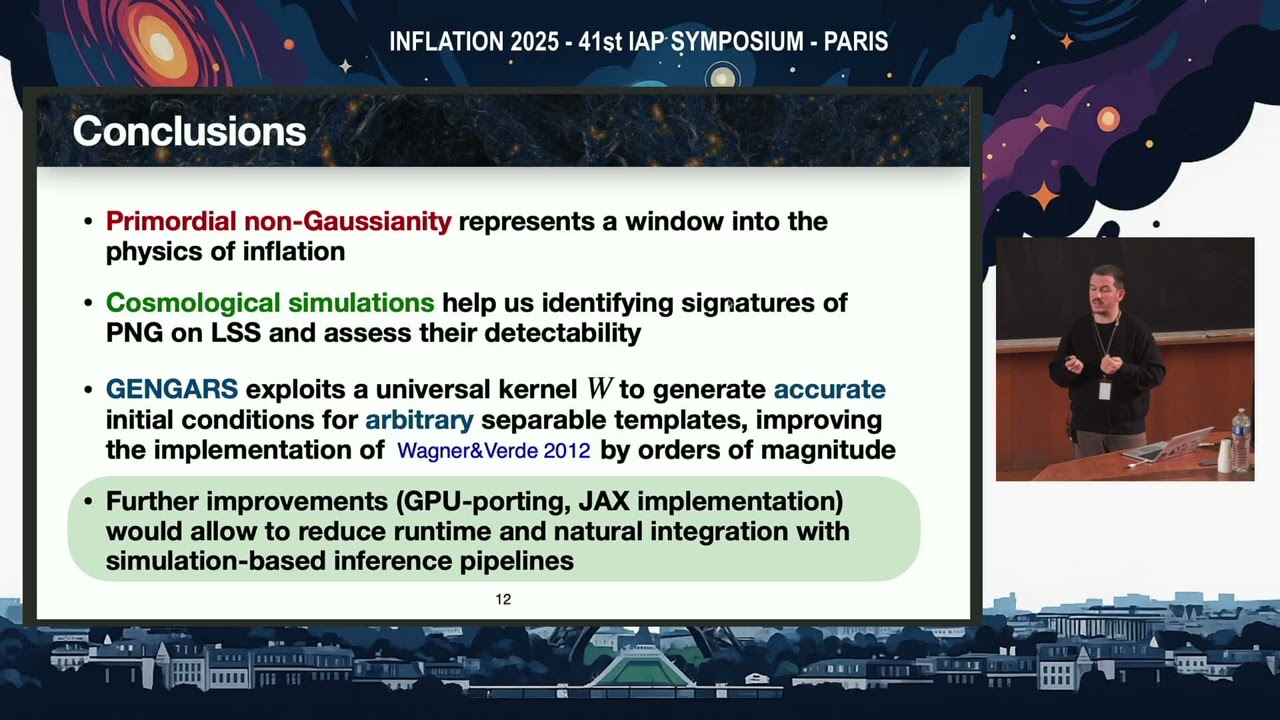
- Conclusions and future plans
- Q&A session
Cited Sources
- GENGARS: A code for generating initial conditions with primordial non-Gaussianity — The speaker mentions developing the GENGARS code during his PhD, but no specific URL is provided in the video description.
Concurring Sources
- Planck 2018 results. IX. Constraints on primordial non-Gaussianity — Provides current constraints on primordial non-Gaussianity from CMB observations, which are consistent with the talk's discussion of CMB constraints.
Dissenting Sources
- No discordant sources identified — No sources explicitly contradicting the talk's claims were found.
Contribution & Novelties
The talk introduces GENGARS, a novel code that efficiently generates initial conditions for N-body simulations with arbitrary separable bispectrum templates. The key innovation is the use of a Schwinger trick to make the universal kernel separable, enabling fast Fourier transform techniques and reducing computational cost from O(N^2) to O(N log N). This allows for simulations of primordial features that were previously computationally prohibitive.
Pour aller plus loin :
- Primordial non-Gaussianity — Overview of the concept and its cosmological implications.
- Bispectrum — Mathematical definition and applications in cosmology.
- N-body simulation — General background on the simulation technique used.
97 words
Radar Profile
The radar profile shows high scores in technical level and information quality, reflecting the specialized and rigorous nature of the talk. The moderate score in information quantity suggests the talk is focused and does not cover a broad range of topics. Overall, the profile indicates a high-quality, technically advanced presentation.