At the dawn of galaxies: dust enrichment and rise of early black holes
Keywords
Summary
139 words
Critical Evaluation
The talk provides a comprehensive and rigorous overview of current research on high-redshift galaxies, dust enrichment, and black hole growth. Schneider demonstrates deep expertise, presenting complex theoretical models and simulations with clarity. The argumentation is solid, building from observational evidence to theoretical explanations. She acknowledges uncertainties and limitations, such as the simplified treatment of supernova reverse shocks and the reliance on photometric candidates. The sources cited are relevant and recent, including works by Castellano, Topping, and others. The talk is well-structured, with clear transitions between topics. The only minor weakness is the lack of detailed discussion on alternative explanations, such as AGN feedback or variations in star formation efficiency. Overall, the content is highly valuable for researchers and advanced students in astrophysics.
122 words
Title / Content Match
The title accurately reflects the content, focusing on early galaxy evolution, dust enrichment, and black hole growth at high redshift.
Quality & Reliability
8/10
The talk is given by a recognized expert in the field, presenting results from peer-reviewed studies and simulations. The content is based on established theoretical models and recent observations from JWST and ALMA. Some simplifications are acknowledged, but overall the information is reliable and up-to-date.
Key Moments
Markers derived by PSI from the transcript: the creator did not define chapters.
- Introduction to the puzzle of early galaxies and black holes.
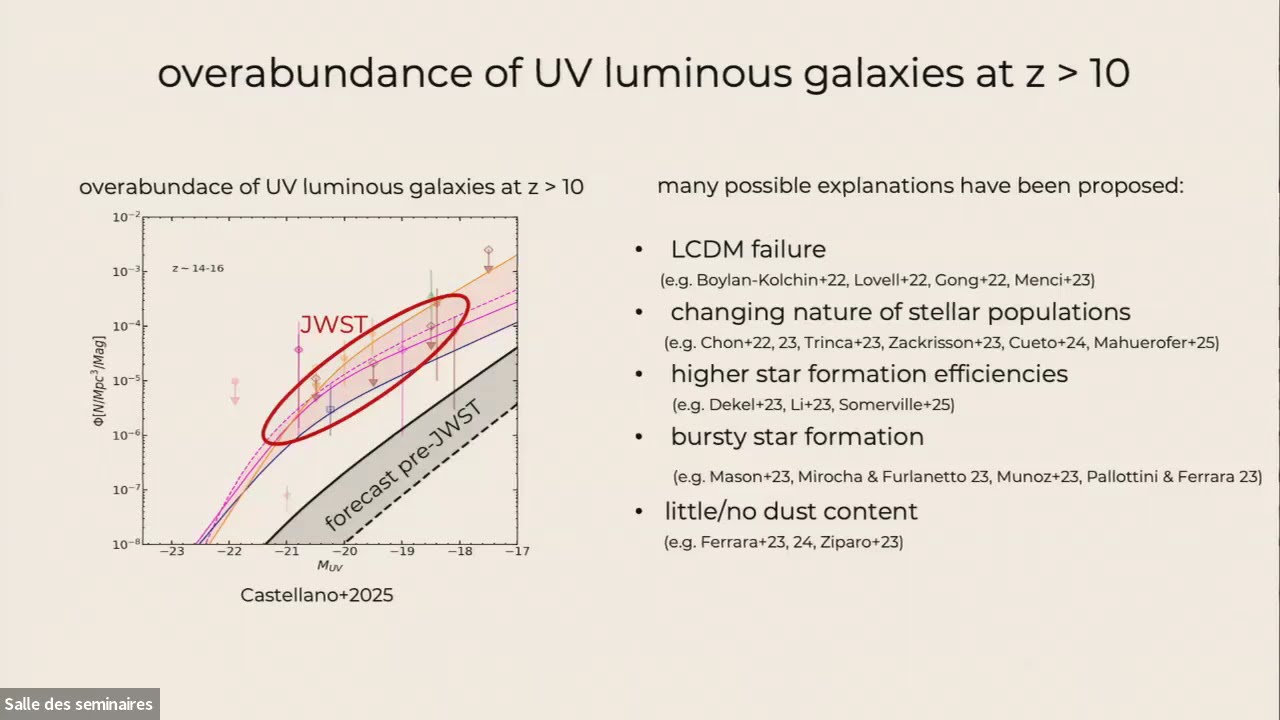
- Discussion of UV luminosity function and the need for extra boost.
- Presentation of simulations showing IMF variation with metallicity and redshift.
- Comparison of model predictions with JWST observations.
- Analysis of dust production from supernovae and AGB stars.
- Discussion of black hole growth and accretion modes.
- Conclusions and future prospects.
Cited Sources
- Mayolino et al. (2023) - Black hole scaling relations at high redshift — Referenced for the position of high-redshift black holes in the BH-stellar mass plane.
- Castellano et al. (2024) - Photometric candidates at z>15 — Referenced for the comparison of UV luminosity function at high redshift.
- Topping et al. (2024) - Evolution of UV beta slope — Referenced for the trend of bluer galaxies at higher redshift.
- Schneider & Maiolino (2024) - Review on dust sources at high redshift — Referenced for the summary of dust production mechanisms.
- Chon et al. (2024) - Simulations of star cluster formation at high redshift — Referenced for the IMF variation with metallicity and redshift.
Concurring Sources
- JWST observations of high-redshift galaxies — Support the existence of mature galaxies at early times.
- ALMA observations of dust in early galaxies — Provide evidence for dust enrichment at high redshift.
Dissenting Sources
- Alternative explanations for UV luminosity excess — Some studies propose AGN contribution or variations in star formation efficiency as alternatives to a non-universal IMF.
Contribution & Novelties
The talk synthesizes recent theoretical and observational advances, highlighting the need for a non-universal IMF and efficient dust production to explain early galaxy properties. It also underscores the role of black hole growth in shaping the UV luminosity function.
Pour aller plus loin :
- James Webb Space Telescope — Official mission site for JWST observations.
- ALMA Observatory — Official site for ALMA, crucial for dust and gas observations.
- Initial mass function — Overview of the IMF and its variations.
- Supernova dust formation — Discussion of dust production in supernovae.
- Semi-analytic galaxy formation models — Explanation of semi-analytic models used in the talk.
102 words
Radar Profile
The radar profile shows high scores in quality and quantity of information, with a strong technical level, indicating a dense and reliable presentation. The overall reliability is high, reflecting the speaker's expertise and the use of peer-reviewed sources.