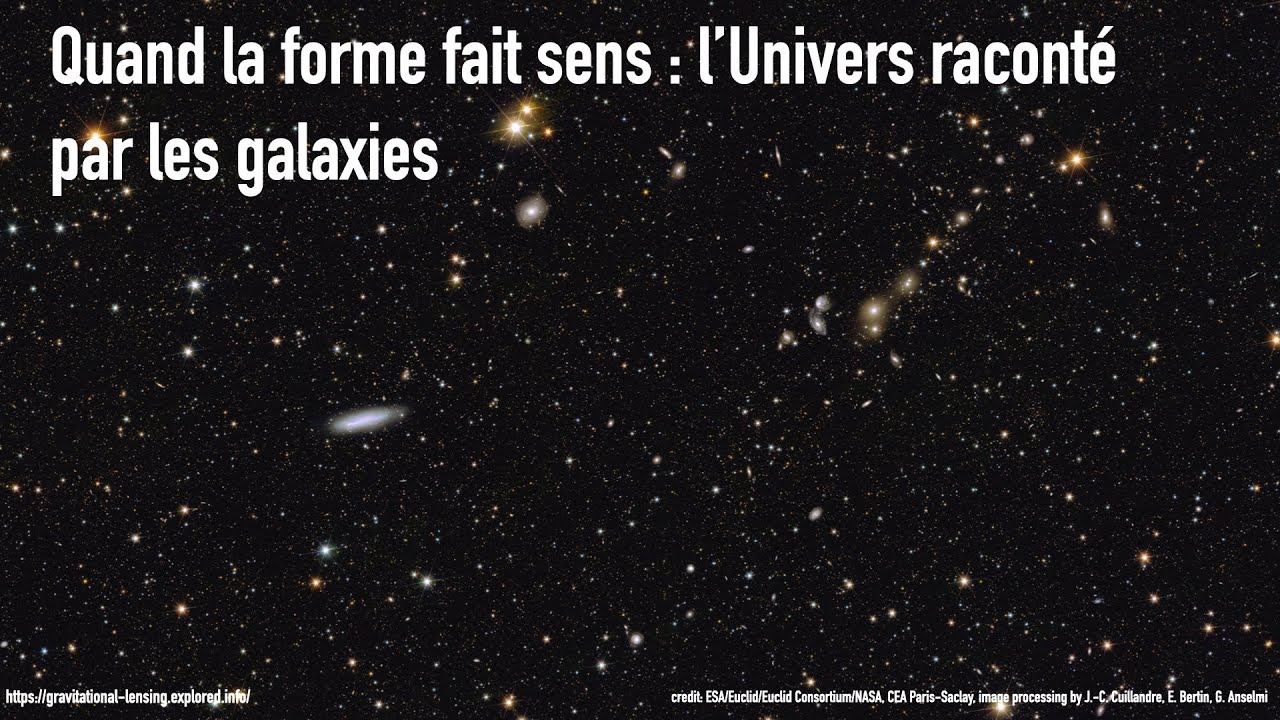
QUAND LA FORME FAIT SENS : L'UNIVERS SE RACONTE PAR LES GALAXIES
Keywords
Summary
130 words
Critical Evaluation
The lecture provides a comprehensive and engaging overview of how galaxy shapes are used to understand the universe. Clotilde Laigle, an expert in galaxy evolution, presents the material with clarity and enthusiasm. The scientific content is accurate and up-to-date, referencing recent missions like JWST and Euclid. The argumentation is logical: starting from the historical discovery of galaxies, moving to the interpretation of their forms, and then to their role as tracers of dark matter and dark energy. The use of simulations effectively illustrates complex processes like galaxy mergers. The talk is well-structured, with clear sections and a coherent narrative. The sources cited are primarily the speaker’s own expertise and the missions mentioned, which are reliable. The title accurately reflects the content. One minor weakness is that the talk does not delve deeply into the statistical methods used in weak lensing, but this is appropriate for a public lecture. Overall, the lecture is scientifically rigorous and accessible, making it a valuable resource for anyone interested in modern cosmology.
167 words
Title / Content Match
The title accurately reflects the content: the talk explores how galaxy shapes encode information about their history and the universe's large-scale structure, including dark matter and dark energy.
Quality & Reliability
8/10
The presentation is given by a professional astronomer (Clotilde Laigle) at a recognized institution (IAP). The content is up-to-date, referencing recent surveys (JWST, Euclid) and established cosmological models. The speaker explains complex concepts clearly and uses simulations to illustrate galaxy formation. No major errors or misleading claims were identified. The talk is a public lecture, so it simplifies some details, but the core science is accurate.
Key Moments
Markers derived by PSI from the transcript: the creator did not define chapters.
- Introduction: the speaker presents the topic and outlines the four parts of the talk.
- Discovery of galaxies: Hubble's observations and Leavitt's Cepheid method.
- Galaxy morphology: spiral vs. elliptical, and the role of stellar orbits.
- Simulations of galaxy formation: mergers and gas accretion.
- Galaxies as tracers of dark matter: distribution and weak lensing.
- Dark energy and the expansion of the universe.
- The Euclid mission: objectives and expected impact.
- Conclusion and Q&A session.
Cited Sources
- Euclid mission — Mentioned as a space telescope launched to map the universe and study dark matter and dark energy.
- James Webb Space Telescope — Referenced as a telescope providing deep images of distant galaxies.
Concurring Sources
- Euclid mission — The mission's goals align with the talk's description of using galaxy shapes to study dark matter and dark energy.
Contribution & Novelties
The lecture provides an accessible synthesis of how galaxy shapes are used to probe the universe’s history and composition. It highlights the connection between galaxy morphology and assembly history, and explains how statistical alignments of galaxies reveal dark matter and dark energy. The talk also presents the Euclid mission as a key tool for advancing this research.
Pour aller plus loin :
- Galaxy formation and evolution — Overview of the processes shaping galaxies.
- Weak gravitational lensing — Technique used to map dark matter.
- Dark energy — Concept explaining the accelerated expansion of the universe.
94 words
Radar Profile
The radar profile shows high scores in information quantity, quality, and technical level, with a slightly lower but still strong reliability score. This indicates a well-balanced, informative, and technically sound presentation.