INFLATION 2025 - Kai Hei Trevor Cheung
Keywords
Summary
159 words
Critical Evaluation
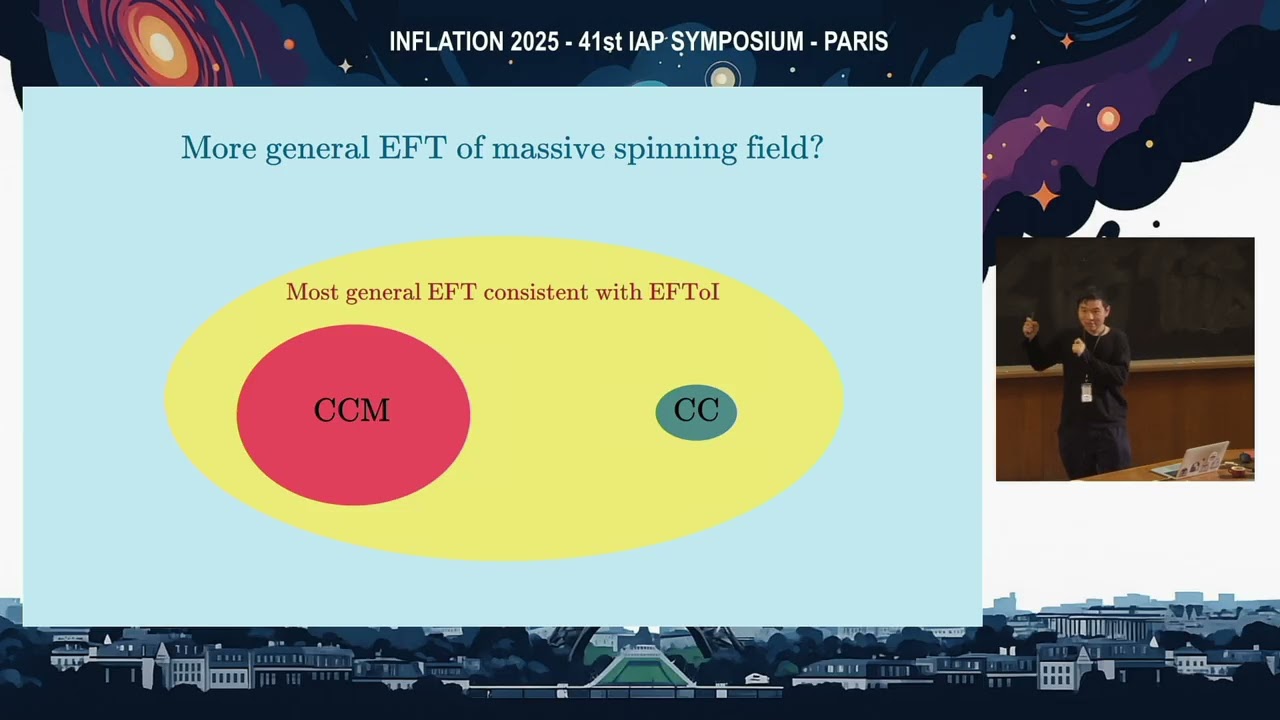
The talk presents original research on the equivalence and distinction between two approaches to massive spinning fields during inflation: the cosmological collider (CC) and the cosmological condensed matter (CCM) frameworks. The speaker, Kai Hei Trevor Cheung, demonstrates a deep understanding of the subject, and the technical content is rigorous. The argumentation is logically structured: it starts with the EFT of inflation, introduces the two frameworks, and then shows that for three-point functions, they are equivalent, but for higher-point functions, they differ. This is a significant result, as it clarifies the observational implications of these models. The speaker then proposes a more general EFT that encompasses both CC and CCM, imposing physical conditions such as Bunch-Davies vacuum and microcausality. This leads to new constraints on the parameter space, which is a valuable contribution. However, the talk is highly technical and assumes a strong background in cosmology and quantum field theory. The lack of references and the brevity of the presentation may limit its accessibility. The Q&A session addresses some important questions, such as the extension to fermions and higher spins, but the answers are brief. Overall, the talk is scientifically sound and presents novel insights, but its narrow focus and technical nature may limit its audience. The title accurately reflects the content, and the presentation is well-organized despite the complexity.
219 words
Title / Content Match
The title accurately reflects the content: a talk on inflation, specifically on massive spinning fields, presented by Kai Hei Trevor Cheung.
Quality & Reliability
8/10
Talk presents original research on massive spinning fields during inflation, grounded in established EFT framework. Technical depth is high, but limited context and lack of references in the talk reduce accessibility. The speaker is a researcher presenting at a specialized conference, indicating expertise.
Key Moments
Markers derived by PSI from the transcript: the creator did not define chapters.
- Introduction and overview of the talk on massive spinning fields during inflation.
- Introduction to the EFT of inflation and the unitary gauge.
- Discussion of two ways to incorporate massive spinning fields: cosmological collider and cosmological condensed matter.
- Computation of correlators and introduction of Feynman rules.
- Equivalence of CC and CCM for three-point functions, and distinction for higher-point functions.
- Proposal of a more general EFT and imposition of physical conditions.
- Results and constraints on the theory parameters.
- Q&A session addressing questions about fermions and higher spins.
Contribution & Novelties
The talk presents a novel analysis of massive spinning fields during inflation, showing that the cosmological collider and cosmological condensed matter approaches are equivalent for three-point functions but differ for higher-point functions. It also proposes a more general EFT that interpolates between these two frameworks, constrained by physical conditions like microcausality. This provides a unified framework for studying such fields.
Pour aller plus loin :
- Effective Field Theory of Inflation — Foundational paper on the EFT of inflation.
- Cosmological Collider Physics — Key reference for the cosmological collider approach.
- Microcausality in Quantum Field Theory — Overview of the microcausality condition.
100 words
Radar Profile
The radar profile shows high scores in technical level and information quality, reflecting the advanced and rigorous nature of the talk. The quantity of information is moderate, and the overall reliability is high, consistent with a specialized research presentation.