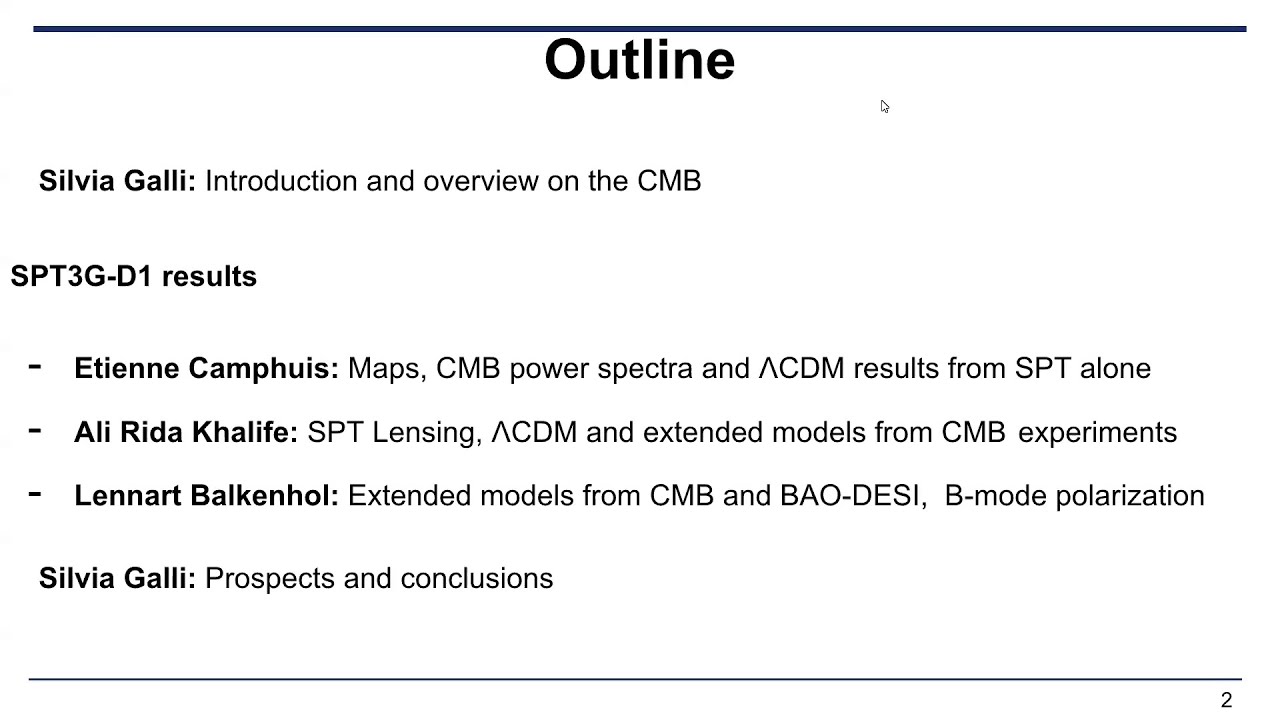
Cosmology from the SPT-3G D1 T&E CMB power spectra
Keywords
Summary
146 words
Critical Evaluation
The seminar provides a detailed and rigorous presentation of the SPT-3G power spectrum measurements and their cosmological implications. The speakers demonstrate a strong command of the methodology, including map-making, power spectrum estimation, and validation tests. The emphasis on blind analysis and systematic checks is commendable and enhances the credibility of the results. The comparison with Planck and ACT is valuable, showing the complementary strengths of different experiments. The cosmological parameter estimation follows standard procedures, and the consistency with ΛCDM is reassuring. However, the talk is a seminar, and the results are likely preliminary; they have not yet undergone full peer review. The presentation assumes a high level of familiarity with CMB analysis, which may limit accessibility. The title accurately reflects the content, and the talk delivers on its promise. Overall, the information is of high quality and scientifically sound, with minor caveats regarding the preliminary nature of the results and the technical depth.
153 words
Title / Content Match
The title accurately reflects the content: the presentation focuses on the cosmological analysis of the SPT-3G D1 temperature and E-mode polarization power spectra.
Quality & Reliability
8/10
Presentation of original results from the SPT-3G experiment, with rigorous validation tests and comparison to Planck and ACT. The methodology is standard in CMB cosmology, and the speakers are experts from a recognized institution. However, the talk is a seminar and not a peer-reviewed publication, and the results are preliminary.
Key Moments
Markers derived by PSI from the transcript: the creator did not define chapters.
- Introduction to the CMB and its importance in cosmology
- Overview of the SPT-3G experiment and its capabilities
- Presentation of the maps and noise properties
- Validation tests: null tests and cross-frequency checks
- Power spectrum measurements and comparison with Planck and ACT
- Cosmological parameter estimation and results
- Combination with other CMB and BAO data
- Ongoing analyses and future prospects
Cited Sources
- SPT-3G: The Next Generation Receiver for the South Pole Telescope — Describes the SPT-3G camera and its capabilities.
- Planck 2018 results. VI. Cosmological parameters — Reference for Planck cosmological parameters and power spectra.
- The Atacama Cosmology Telescope: DR4 Maps and Cosmological Parameters — Reference for ACT power spectra and cosmological results.
Concurring Sources
- Planck 2018 results. VI. Cosmological parameters — Planck's cosmological parameters are consistent with the SPT-3G results.
- The Atacama Cosmology Telescope: DR4 Maps and Cosmological Parameters — ACT's power spectra and cosmological constraints are consistent with SPT-3G.
Contribution & Novelties
The presentation provides the most precise measurements of the lensed EE and TE power spectra at high multipoles (l=1800-4000 and l=2200-4000, respectively), improving on previous results from Planck and ACT. The rigorous validation pipeline and the combination with other datasets strengthen the cosmological constraints. The talk also highlights the potential of SPT-3G to probe new physics beyond the standard model.
Pour aller plus loin :
- CMB lensing — Provides background on gravitational lensing of the CMB, a key observable discussed.
- South Pole Telescope — Overview of the telescope and its instruments.
- Lambda-CDM model — The standard model of cosmology used in the analysis.
103 words
Radar Profile
The radar profile shows high scores in all dimensions, with a particularly strong level of technical detail and information quality. The presentation is highly specialized, targeting an expert audience, and provides rigorous scientific content.