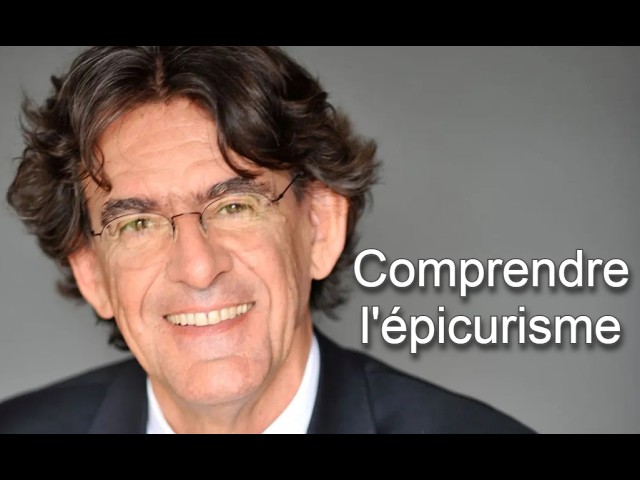
Luc Ferry - Comprendre l'épicurisme (conférence)
Keywords
Summary
197 words
Critical Evaluation
Luc Ferry’s lecture on Epicureanism is a masterful synthesis that balances accessibility with philosophical depth. As a prominent French philosopher, Ferry brings credibility and clarity to the subject. The lecture is well-structured, moving from historical context to theoretical foundations and then to ethical applications. Ferry’s explanation of Epicurean physics as a counterpoint to Stoicism is particularly effective, highlighting the radical difference in worldview and its implications for freedom. The ethical core is presented through the threefold structure of the fourfold remedy, the classification of desires, and the argument against the fear of death. Ferry correctly emphasizes that Epicureanism is not about indulgence but about achieving tranquility through simple pleasures and the elimination of fear. He draws on primary sources, such as Epicurus’s Letter to Menoeceus, and references Lucretius’s De Rerum Natura, providing a solid scholarly basis. The lecture’s strength lies in its ability to connect ancient philosophy to contemporary issues, particularly the critique of consumerism and addiction, which resonates today. Ferry’s interpretation of Lucretius’s insights on consumption as a form of addiction is insightful and well-argued. The use of the Danaids’ barrel metaphor effectively illustrates the futility of insatiable desire. However, the lecture is not without limitations. Ferry’s presentation is somewhat one-sided, presenting Epicureanism in a very positive light without engaging with potential criticisms or alternative interpretations. For instance, he does not address the potential passivity or withdrawal from social responsibilities that critics might associate with Epicureanism. Additionally, while he mentions the influence of Epicureanism on later thinkers like Pascal and Schopenhauer, he does not explore these connections in depth. The lecture is also relatively brief, and some concepts, such as the nature of the gods in Epicureanism, are treated superficially. Despite these minor shortcomings, the lecture is a valuable introduction to Epicureanism for a general audience, offering both historical context and philosophical analysis. It is a thought-provoking presentation that encourages reflection on the nature of happiness and the good life. The title accurately reflects the content, and the lecture fulfills its promise of helping viewers understand Epicureanism.
338 words
Title / Content Match
The title accurately reflects the content: a lecture on Epicureanism by Luc Ferry.
Quality & Reliability
8/10
The speaker is a well-known philosopher and former minister, providing a scholarly overview of Epicureanism. The content is based on established philosophical texts and historical knowledge, with references to primary sources. However, it is a lecture, not peer-reviewed research, and some interpretations may be debated.
Key Moments
Markers derived by PSI from the transcript: the creator did not define chapters.
- Introduction: Ferry sets the stage, mentioning Epicurus and Lucretius, and the scarcity of biographical information.
- Epicurean physics: atomism as a counter-culture to Stoicism, emphasizing chance and freedom.
- The fourfold remedy: gods not to be feared, death not to be dreaded, good easy to obtain, evil easy to endure.
- Classification of desires: natural and necessary, natural but not necessary, and vain desires.
- The argument against the fear of death: 'When we exist, death is not; when death exists, we do not.'
- Lucretius's depth: critique of consumer society as addiction, and the metaphor of the Danaids' barrel.
- The importance of living in the present, overcoming the past and future, and achieving wisdom.
- Conclusion: Epicureanism as a therapeutic philosophy, with emphasis on simplicity and the practice of wisdom.
Cited Sources
- L'odyssée d'une conscience: thérapeutique de l'adversité — Book by Luc Ferry, mentioned in the description as related to the lecture.
Concurring Sources
- Epicurus - Stanford Encyclopedia of Philosophy — Scholarly source that aligns with Ferry's presentation of Epicurean ethics and physics.
Dissenting Sources
Contribution & Novelties
The lecture provides a clear and engaging introduction to Epicurean ethics, emphasizing its relevance to modern issues like consumerism. It offers a structured overview of key concepts and highlights the philosophical depth of Lucretius’s poem. The lecture is particularly valuable for its accessible explanation of the classification of desires and the argument against the fear of death.
Pour aller plus loin :
- Epicureanism - Stanford Encyclopedia of Philosophy — Comprehensive academic overview of Epicurean philosophy.
- De Rerum Natura - Wikipedia — Background on Lucretius’s poem and its themes.
- Tetrapharmakos - Wikipedia — The fourfold remedy in Epicureanism.
97 words
Radar Profile
The radar profile shows high scores in information quantity, quality, technical level, and reliability, indicating a well-rounded and trustworthy lecture. The balance suggests a comprehensive and accessible presentation suitable for a general audience.
💬 No comments were provided for analysis.