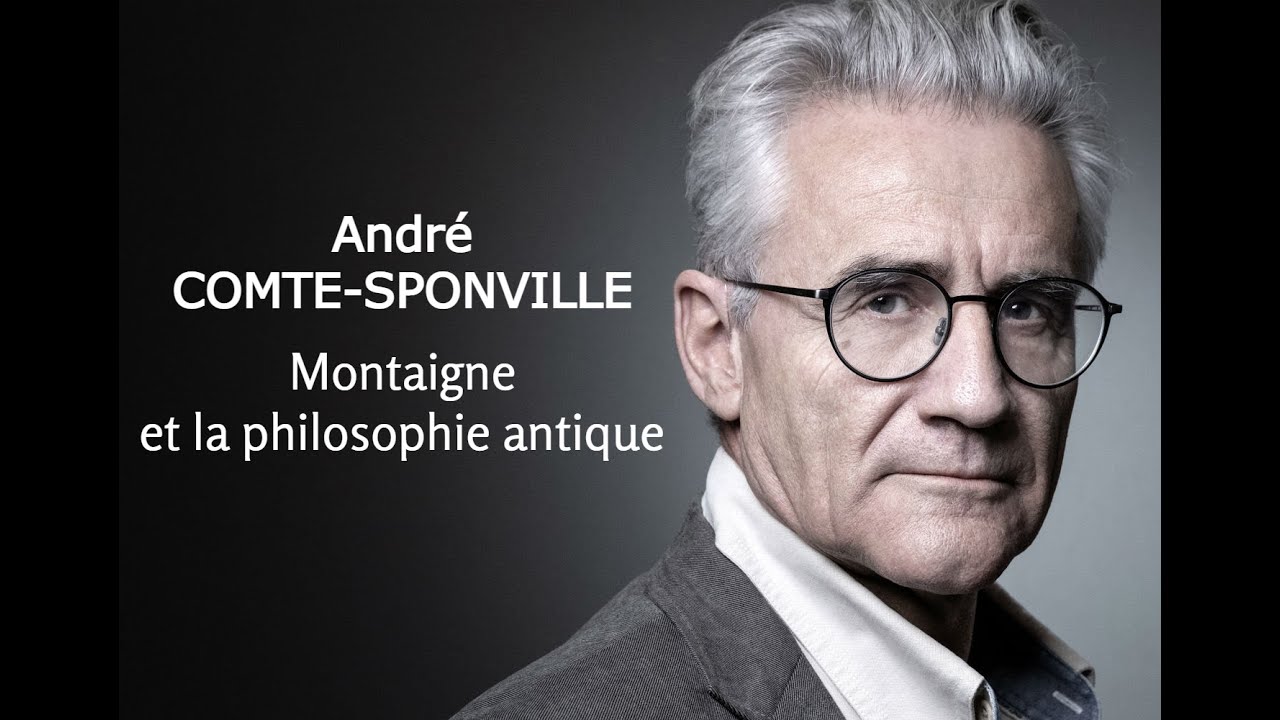
2016 - André Comte-Sponville - Montaigne et la philosophie antique (conférence)
Keywords
Summary
116 words
Critical Evaluation
André Comte-Sponville’s lecture offers a sophisticated and well-informed analysis of Montaigne’s engagement with ancient philosophy, particularly Epicureanism. The speaker demonstrates deep familiarity with Montaigne’s Essais, citing numerous passages and tracing the evolution of his thought. He challenges the simplistic tripartite periodization of Montaigne’s intellectual development, arguing that Montaigne’s relationship with Epicureanism is more complex and critical than often assumed. Comte-Sponville’s argument is solidly grounded in textual evidence, and he carefully distinguishes between Montaigne’s personal temperament and his philosophical commitments. He also highlights Montaigne’s selective appropriation of Epicurean ideas, such as the classification of desires and the negative conception of pleasure, while rejecting other aspects like atomism and the canonical. The lecture is rigorous in its scholarship, though it is primarily an interpretive essay rather than a systematic review of all relevant literature. The speaker’s expertise is evident, and his points are well-articulated. However, the lecture is not without limitations: it is a single perspective, and some claims could benefit from more explicit engagement with secondary literature. Additionally, the discussion of sources is somewhat brief, though it acknowledges the indirect transmission of Epicurean texts. Overall, the lecture provides valuable insights into Montaigne’s philosophy and its relation to ancient schools, making it a worthwhile resource for students and scholars alike.
208 words
Title / Content Match
The title accurately reflects the content: a conference by André Comte-Sponville on Montaigne's relationship with ancient philosophy, focusing on Epicureanism and Stoicism.
Quality & Reliability
8/10
The speaker is a renowned philosopher and specialist in Montaigne, providing a well-structured and nuanced analysis based on extensive knowledge of primary sources. The lecture is part of an academic colloquium, indicating scholarly context. However, it is a single perspective without direct citations to specific works beyond Montaigne's Essais and classical authors.
Key Moments
Markers derived by PSI from the transcript: the creator did not define chapters.
- Introduction to the topic and the traditional tripartite periodization of Montaigne's thought.
- Discussion of Montaigne's sources: Diogenes Laertius, Cicero, Seneca, and Lucretius.
- Analysis of Montaigne's critique of Epicurean canonics and physics.
- Examination of Montaigne's hedonism and its relation to Epicurean ethics.
- Discussion of Montaigne's views on pain and the limits of Pyrrhonian indifference.
- Montaigne's agreement with Epicurean ideas on death and the gods.
- Montaigne's adoption of the classification of desires and the concept of 'volupté'.
- Conclusion: Montaigne's philosophy as a unique synthesis, not simply Epicurean.
Cited Sources
- Les Essais de Michel de Montaigne — Primary source extensively quoted and analyzed throughout the lecture.
- Lettre à Ménécée d'Épicure — Referenced as a key Epicurean text that Montaigne engages with.
- De rerum natura de Lucrèce — Mentioned as a major source for Montaigne's knowledge of Epicureanism.
- Vies et doctrines des philosophes illustres de Diogène Laërce — Cited as a source for Epicurean doctrines and anecdotes.
Concurring Sources
- Les Essais de Michel de Montaigne — Primary source that supports the lecture's claims about Montaigne's views.
Dissenting Sources
- Traditional tripartite periodization of Montaigne's thought — Comte-Sponville challenges the common scholarly view that Montaigne's thought evolved from Stoicism to Skepticism to Epicureanism, arguing for a more continuous and critical engagement.
Contribution & Novelties
This lecture provides a nuanced reassessment of Montaigne’s relationship with Epicureanism, arguing against the simplistic view that he became more Epicurean over time. Comte-Sponville shows that Montaigne maintained a critical distance from Epicurean doctrine while embracing a hedonistic ethic based on personal experience and natural inclination. The lecture offers a detailed analysis of Montaigne’s selective appropriation of Epicurean ideas, such as the classification of desires and the negative conception of pleasure, and highlights the influence of Lucretius. This contributes to a more sophisticated understanding of Montaigne’s philosophical position.
Pour aller plus loin :
- Montaigne’s Essays on Wikipedia — Provides background on the work and its philosophical context.
- Epicureanism on Stanford Encyclopedia of Philosophy — Detailed overview of Epicurean philosophy.
- Lucretius on Internet Encyclopedia of Philosophy — Information on Lucretius and his poem De rerum natura.
135 words
Radar Profile
The radar profile shows high scores in quality of information and reliability, reflecting the speaker's expertise and the scholarly nature of the lecture. The quantity of information is also high, but the technical level is moderate, making it accessible to a general audience. The overall balance indicates a valuable and trustworthy source.
💬 No comments were provided for analysis.