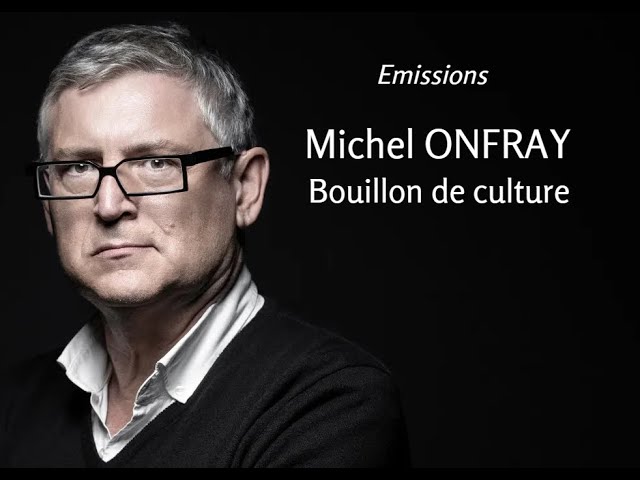
2000 - Michel Onfray - Bouillon de culture (émission)
Keywords
Summary
158 words
Critical Evaluation
The interview provides a concise overview of Michel Onfray’s philosophical stance on desire, pleasure, and libertinism. Onfray’s arguments are coherent and well-articulated, drawing on a wide range of historical references from ancient Greek philosophy to early Christian thought. His critique of the Judeo-Christian tradition’s influence on Western attitudes towards sexuality is provocative but not systematically developed in this short interview. The discussion is primarily opinion-based, reflecting Onfray’s personal philosophical views rather than presenting empirical evidence or a balanced academic analysis. The sources cited are his own book and other works, but no external references are provided. The interview’s strength lies in its accessibility and the clarity of Onfray’s exposition, making complex philosophical ideas understandable to a general audience. However, the lack of depth and the absence of counterarguments limit its scientific rigor. The title accurately reflects the content, and the interview format allows for a dynamic exchange, but the brevity prevents a thorough exploration of the topics. Overall, the content is valuable for those interested in contemporary philosophy and hedonistic ethics, but it should be complemented with more detailed academic sources for a comprehensive understanding.
185 words
Title / Content Match
The title accurately describes the content: an interview with Michel Onfray from the French TV show 'Bouillon de culture'.
Quality & Reliability
7/10
The interview features a recognized philosopher discussing his book and philosophical ideas. The content is opinion-based and lacks empirical evidence, but it is coherent and grounded in historical philosophical references. The source is a YouTube video with limited views and no external verification.
Key Moments
Markers derived by PSI from the transcript: the creator did not define chapters.
- Introduction of Michel Onfray and the topic of his book 'Théorie du corps amoureux'.
- Onfray explains why he focuses on ancient philosophers and stops at Christianity.
- Discussion on the Judeo-Christian tradition's impact on sexuality and pleasure.
- Onfray reinterprets the Genesis story, highlighting the woman's role in seeking knowledge.
- Use of animal metaphors (plaice, elephant) to explain desire and pleasure.
- Onfray redefines libertinism as an art of living and advocates for a 'libertarian feminism'.
- Rapid-fire questionnaire with personal preferences.
Cited Sources
- Théorie du corps amoureux — Onfray's book discussed in the interview.
- Les vertus de la foudre — Mentioned as a recent publication by Onfray.
Concurring Sources
- Théorie du corps amoureux — The book aligns with the interview's content.
Contribution & Novelties
The interview offers a concise presentation of Onfray’s hedonistic philosophy, emphasizing the value of ancient libertine traditions and proposing a redefinition of libertinism as a way of life focused on freedom and sensory appreciation. It also introduces a feminist perspective within libertinism, advocating for reconciliation between the sexes.
Pour aller plus loin :
- Hedonism — Overview of hedonistic philosophy.
- Cyrenaics — Ancient Greek school of philosophy focused on pleasure.
- Michel Onfray — Biography and philosophical ideas.
76 words
Radar Profile
The radar profile shows moderate scores across all dimensions, indicating a balanced but not deeply technical or highly reliable content. The interview is informative but relies on opinion and lacks empirical support.