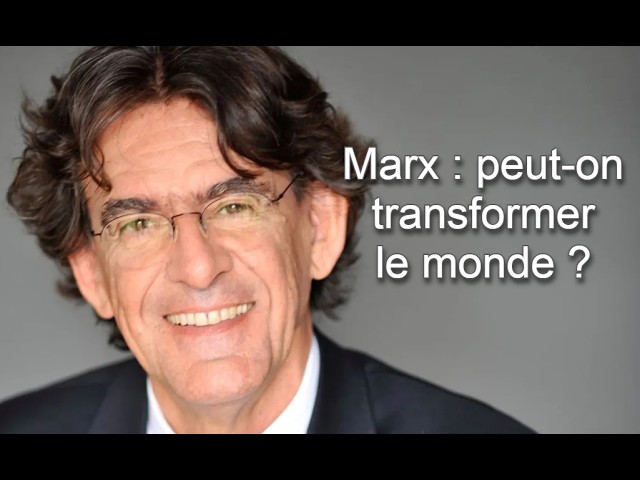
Marx : peut-on transformer le monde ? | Luc Ferry (conférence)
Keywords
Summary
172 words
Critical Evaluation
The lecture provides a clear and accessible overview of Marx’s core ideas, particularly his analysis of capitalism and historical materialism. Ferry’s explanation of the mode of production and its components is accurate and well-structured, making complex concepts understandable. He effectively highlights the revolutionary nature of capitalism and its tendency to constantly innovate, which resonates with modern economic dynamics. However, the lecture is primarily an opinion piece rather than a rigorous academic analysis. Ferry does not cite specific texts or provide references, and his interpretation is presented without critical engagement with alternative scholarly views. While he acknowledges potential disagreements with Marx’s political conclusions, he does not delve into the practical failures of Marxist regimes or the theoretical critiques of Marx’s predictions. The discussion of the five modes of production is simplified, and the treatment of the ‘Asiatic mode of production’ is brief and potentially misleading. Additionally, Ferry’s assertion that Marx’s analysis remains ’extremely precious’ for understanding contemporary capitalism is asserted rather than argued in depth. The lecture’s strength lies in its clarity and the speaker’s authority as a philosopher, but it lacks the depth and sourcing expected in a rigorous scientific or scholarly context. The title accurately reflects the content, and the lecture is well-suited for a general audience seeking an introduction to Marx’s thought, but it does not offer new insights for those already familiar with Marxist theory.
228 words
Title / Content Match
The title accurately reflects the content: a philosophical discussion on Marx's ideas about transforming the world.
Quality & Reliability
7/10
The speaker is a well-known philosopher, but the content is an opinion-based lecture without citations or references to specific texts beyond general mentions. The analysis is coherent and historically informed, but lacks verifiable sources.
Key Moments
Markers derived by PSI from the transcript: the creator did not define chapters.
- Introduction: Marx's relevance today, despite political disagreements.
- Marx's view of capitalism as permanent revolution and innovation.
- Explanation of the mode of production: forces of production and relations of production.
- The five modes of production in history, from primitive communism to capitalism.
- Marx's theory of crises and revolutions, with examples from 1789 and 1848.
- The inevitability of proletarian revolution and the transition to communism.
- Discussion of alienation and the role of the state in capitalist society.
- Conclusion: Marx's analysis remains valuable for understanding capitalism, despite political disagreements.
Cited Sources
- L'Odyssée d'une conscience (book by Luc Ferry) — Mentioned in the video description as a related work by the speaker.
Concurring Sources
- Karl Marx - Stanford Encyclopedia of Philosophy — Provides scholarly context for Marx's theories, consistent with the lecture's presentation.
Dissenting Sources
- Critiques of Marx's predictions — The lecture does not address the historical failures of Marxist regimes or the theoretical critiques of Marx's predictions, which are common in academic literature.
Contribution & Novelties
The lecture offers a clear and engaging synthesis of Marx’s key concepts, particularly the mode of production and the theory of historical materialism, making them accessible to a general audience. It emphasizes the continued relevance of Marx’s analysis of capitalism’s revolutionary dynamics. However, it does not present new research or original interpretations.
Pour aller plus loin :
- Karl Marx - Stanford Encyclopedia of Philosophy — Comprehensive academic overview of Marx’s philosophy.
- Das Kapital - Wikipedia — Overview of Marx’s major work.
- Historical Materialism - Wikipedia — Explanation of the theory of historical development.
93 words
Radar Profile
The radar profile shows moderate scores across all dimensions, indicating a balanced but not exceptional presentation. The lecture is informative and clear, but lacks depth in sourcing and critical engagement.