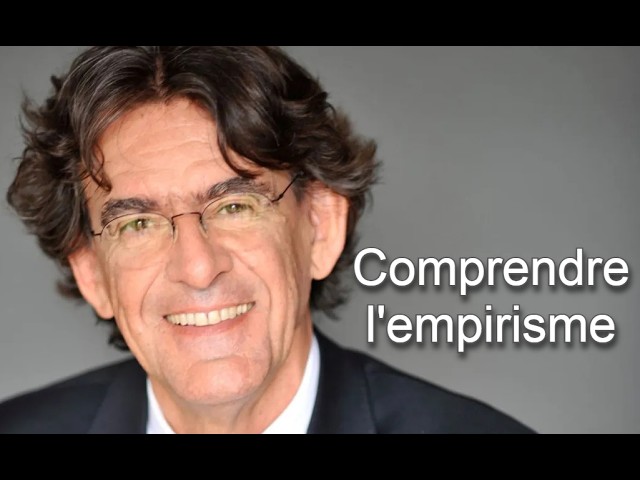
Luc Ferry - Comprendre l'empirisme (conférence)
Keywords
Summary
175 words
Critical Evaluation
The lecture provides a clear and engaging introduction to empiricism, suitable for a general audience with some background in philosophy. Ferry’s presentation is well-structured, using a typological approach to highlight the core tenets of empiricism. He effectively contrasts empiricism with rationalist traditions, particularly the philosophies of Plato, Descartes, and Kant. The discussion of Locke’s tabula rasa and the rejection of innate ideas is accurate and accessible. Ferry’s explanation of nominalism, using the example of a dog, is particularly effective in illustrating the abstract concept. However, the lecture is not without limitations. Ferry’s own philosophical stance is evident, as he admits he is not an empiricist, and this may color his presentation. He tends to emphasize the skeptical and idealist consequences of empiricism, which some might argue is a particular interpretation. The lecture lacks direct citations to primary sources, though it references key texts such as Locke’s ‘Essay Concerning Human Understanding’ and Hume’s ‘Treatise of Human Nature.’ The discussion of the third and fourth pillars of empiricism is incomplete in the transcript, leaving the structure somewhat unbalanced. Additionally, Ferry’s claim that empiricism leads to ‘delirious’ conclusions is a strong statement that may be seen as biased. Overall, the lecture is informative and thought-provoking, but it should be complemented with primary sources and alternative interpretations for a more comprehensive understanding.
218 words
Title / Content Match
The title accurately reflects the content, which is a lecture on empiricism.
Quality & Reliability
8/10
The speaker is a well-known philosopher, and the content is a structured lecture on empiricism, referencing key historical figures and texts. The presentation is clear and accurate, though it reflects the speaker's personal interpretation and does not include citations to primary sources.
Key Moments
Markers derived by PSI from the transcript: the creator did not define chapters.
- Introduction: Ferry sets the stage, contrasting empiricism with rationalism and correcting misconceptions.
- Ferry introduces the key figures of empiricism: Locke, Berkeley, and Hume, and their major works.
- Discussion of Locke's tabula rasa and the fundamental principle that all knowledge comes from experience.
- Explanation of the problem of how a passive mind becomes active, leading to the challenge of explaining scientific knowledge.
- Ferry outlines the first pillar: everything comes from experience, rejecting innate ideas and faculties.
- Introduction of the second pillar: nominalism, the denial of general ideas, with the example of a dog.
- Ferry explains the consequences of nominalism: all ideas are particular and temporal, leading to skepticism.
- Discussion of the influence of empiricism on analytic philosophy and its contrast with continental philosophy.
- Ferry addresses the counterintuitive nature of empiricism, emphasizing its idealist and skeptical outcomes.
- Conclusion: Ferry summarizes the key points and hints at the remaining pillars of empiricism.
Cited Sources
- L'odyssée d'une conscience — Book by Luc Ferry mentioned in the description, related to the theme of reconstruction through philosophy.
Concurring Sources
- Empiricism (Stanford Encyclopedia of Philosophy) — Supports the general characterization of empiricism as the view that all knowledge comes from experience.
- John Locke (Internet Encyclopedia of Philosophy) — Confirms Locke's tabula rasa and his empiricist theory of knowledge.
Dissenting Sources
- Kant's Critique of Pure Reason — Kant's transcendental idealism offers a critique of empiricism, arguing that some knowledge is a priori and not derived from experience.
Contribution & Novelties
This lecture offers a clear and accessible synthesis of empiricism, correcting common misconceptions and highlighting its counterintuitive consequences. Ferry’s typological approach helps to structure the complex ideas of Locke, Berkeley, and Hume. The lecture also connects empiricism to contemporary analytic philosophy, providing a bridge between historical and modern thought.
Pour aller plus loin :
- Empiricism (Stanford Encyclopedia of Philosophy) — Comprehensive overview of empiricism and its contrast with rationalism.
- John Locke (Internet Encyclopedia of Philosophy) — Detailed article on Locke’s philosophy, including his theory of knowledge.
- David Hume (Stanford Encyclopedia of Philosophy) — In-depth analysis of Hume’s empiricism and skepticism.
- George Berkeley (Stanford Encyclopedia of Philosophy) — Overview of Berkeley’s immaterialism and his critique of abstract ideas.
117 words
Radar Profile
The radar profile shows high scores in information quantity, quality, and technical level, with a slightly lower score in global reliability due to the lack of direct citations and the speaker's personal bias. This indicates a well-structured and informative lecture, but one that should be supplemented with primary sources for a more balanced view.