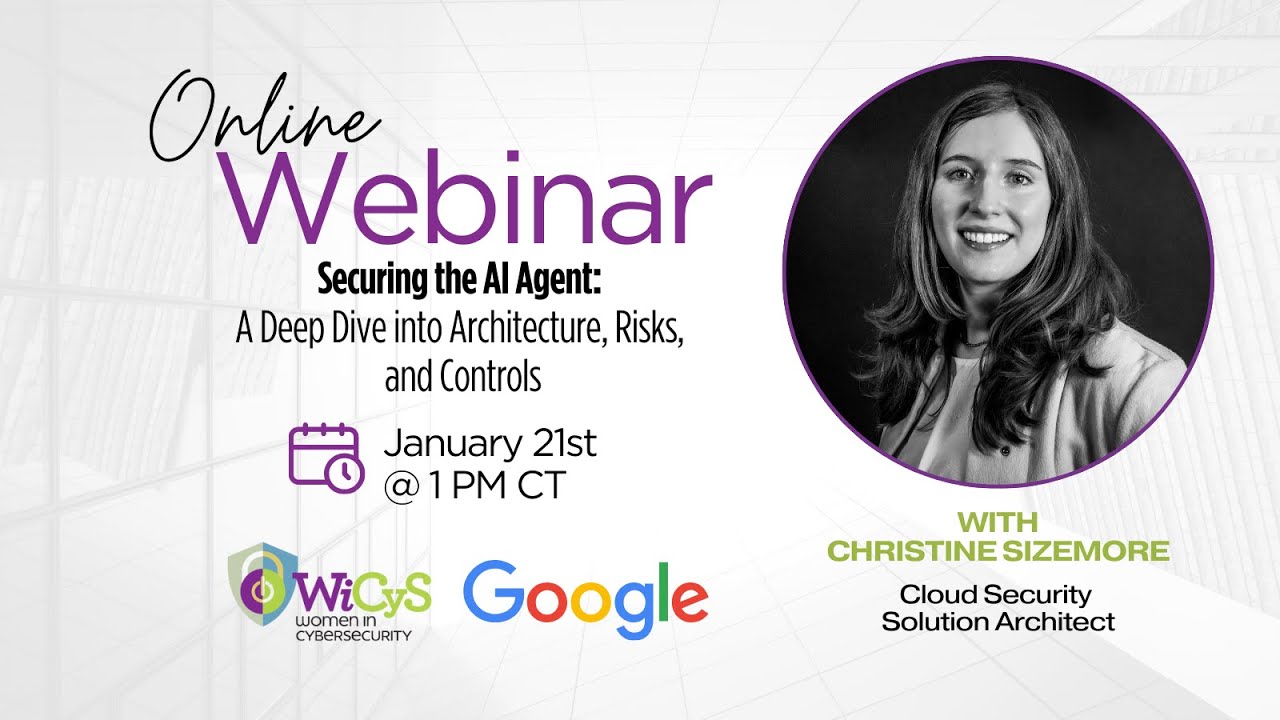
Google Webinar | Securing the AI Agent: A Deep Dive into Architecture, Risks, and Controls
Keywords
Summary
176 words
Critical Evaluation
Value of the Information & Strength of the Argument
The webinar provides a valuable overview of AI agent security, synthesizing common threats and controls from industry frameworks like OWASP and NIST. The argumentation is clear and logical, progressing from single-agent to multi-agent scenarios. The speaker uses concrete examples, such as the CSV vulnerability and memory poisoning attacks, to illustrate risks. However, the presentation is largely descriptive rather than analytical, and the controls are presented as best practices without deep justification or comparative analysis. The reliance on personal experience and industry trends adds practical insight but limits the depth of the argumentation.
Scientific Rigor, Source Quality, Title Accuracy
The webinar references several authoritative sources, including OWASP’s LLM Top 10 and Agent Top 10, NIST’s AI Risk Management Framework, and research papers on MCP and A2A threats. The speaker also mentions the Cloud Security Alliance’s MAESTRO framework. These references lend credibility, but they are not cited with specific URLs or detailed explanations. The title accurately reflects the content, and the presentation is well-structured. The speaker’s affiliation with Google is disclosed, and she notes that the views are her own, which is transparent. Overall, the scientific rigor is moderate, suitable for an introductory audience.
201 words
Title / Content Match
The title accurately reflects the content: a deep dive into AI agent architecture, risks, and controls, as presented in a Google webinar.
Quality & Reliability
7/10
The webinar provides a structured overview of AI agent security, drawing on established frameworks (OWASP, NIST) and real-world examples. The speaker is a Google Cloud security architect, lending credibility. However, it is a high-level overview without deep technical detail or original research, and some claims lack specific citations.
Key Moments
Markers derived by PSI from the transcript: the creator did not define chapters.
- Introduction to the webinar and WiCyS organization.
- Overview of the current landscape: everyone wants to build AI agents, but they are non-deterministic.
- Definition of AI agents and their use cases in security.
- Explanation of agent architecture: model, tools, orchestration, and runtime.
- Live demonstration of a simple weather agent using Google's ADK.
- Discussion of risks and controls for agent orchestration and memory, including prompt injection and memory poisoning.
- Agent identity and access: spoofing, impersonation, and privilege escalation.
- Agent tools and runtime: CSV vulnerability, tool misuse, and resource overload.
- Introduction to multi-agent systems and protocols A2A and MCP.
- Security considerations for multi-agent architectures and Q&A session.
Cited Sources
- WiCyS Strategic Partner Webinars — The description links to this channel for more webinars from WiCyS strategic partners.
Concurring Sources
- OWASP Top 10 for LLM Applications — The webinar references OWASP's LLM Top 10, which aligns with the risks discussed.
- NIST AI Risk Management Framework — The webinar mentions NIST's framework as a resource for AI risk management.
Contribution & Novelties
This webinar provides a structured overview of AI agent security, synthesizing common threats and controls from industry frameworks. It is valuable for practitioners new to the field, offering a clear taxonomy of risks and mitigations. The speaker’s practical examples, such as the weather agent demo and the CSV vulnerability, make abstract concepts tangible. However, it does not introduce novel research or deep technical insights, serving more as a comprehensive introduction.
Pour aller plus loin :
- OWASP Top 10 for LLM Applications — The foundational list of LLM vulnerabilities, directly relevant to the risks discussed.
- NIST AI Risk Management Framework — A framework for managing AI risks, referenced in the webinar.
- Model Context Protocol (MCP) - Anthropic — The official announcement of MCP, a key protocol for agent interoperability.
- Agent-to-Agent (A2A) Protocol - Google — Google’s open-source protocol for agent communication, discussed in the webinar.
144 words
Radar Profile
The radar profile shows balanced scores across all dimensions, with slightly higher marks for information quantity and reliability, reflecting the webinar's comprehensive yet introductory nature. The technical depth is moderate, suitable for a broad audience.