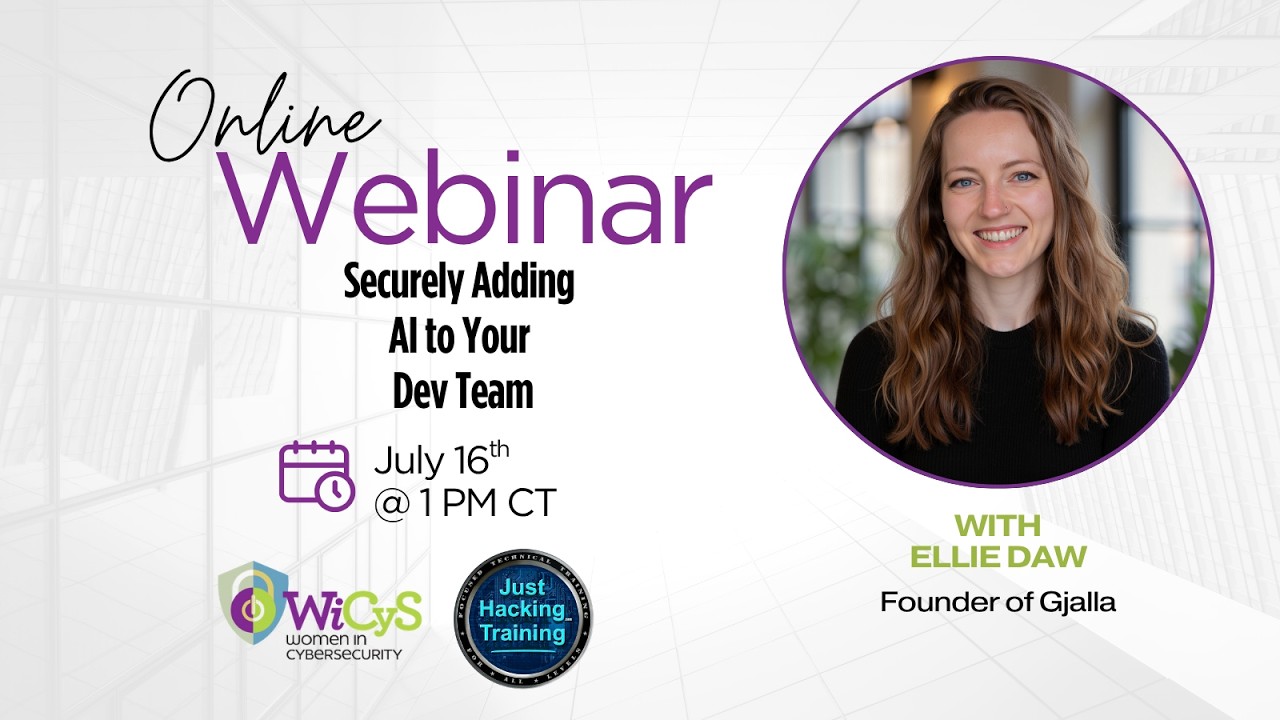
Just Hacking Training Webinar | Securely Adding AI to Your Dev Team
Keywords
Summary
173 words
Critical Evaluation
Value of the Information & Strength of the Argument
The webinar provides valuable, actionable insights for teams at various stages of AI adoption, particularly those in regulated industries. The argumentation is coherent and grounded in practical experience, with clear examples of common pitfalls (e.g., state management issues in vibe-coded apps). The emphasis on making processes explicit and deterministic is a strong point, as it addresses the core challenge of agent behavior. The presentation is well-structured, moving from risk identification to a practical framework. However, some claims lack empirical evidence, and the reliance on anecdotal examples may limit generalizability. The discussion of less obvious risks (e.g., loss of understanding, traceability) adds depth and encourages a holistic view of security.
Scientific Rigor, Source Quality, Title Accuracy
The webinar demonstrates a reasonable level of scientific rigor, though it is primarily based on expert opinion and industry experience rather than formal research. The speakers reference a few blog posts and industry statistics, but these are not systematically cited or verified. The title accurately reflects the content, and the presentation is well-organized. The lack of detailed citations and the absence of peer-reviewed sources slightly weaken the overall reliability. The audience polls provide some insight into the participants’ context, but the sample size is small and not representative. Overall, the content is credible for a practitioner audience, but it should be complemented with more rigorous sources for a fully scientific evaluation.
235 words
Title / Content Match
The title accurately reflects the content: a training webinar focused on securely integrating AI into development teams.
Quality & Reliability
7/10
The webinar provides a practical, experience-based overview of risks and best practices for adopting AI coding agents, with a clear framework and actionable advice. While it is not a peer-reviewed study, the content aligns with known industry concerns and offers a structured approach. The lack of detailed citations and reliance on anecdotal evidence slightly reduce its scientific rigor.
Key Moments
Markers derived by PSI from the transcript: the creator did not define chapters.
- Introduction and overview of WiCyS organization
- Speaker introductions and audience polls on regulated industry
- Poll results on coding agent adoption and top concerns
- Discussion of familiar risks: secrets, over-permissioned agents, insecure infrastructure
- Less obvious risks: loss of code understanding, unmaintainable code, traceability
- Why agents are different: intelligence without context, incentive to finish quickly
- Four key themes: zoom out, make implicit explicit, context and planning, process
- Practical tips for starting: strengthen existing security practices, write specs, document
- Q&A session begins
Cited Sources
- WiCyS Strategic Partners Webinar Channel — Referenced in the video description as a source for more webinars from WiCyS strategic partners.
Concurring Sources
- OWASP Top 10 for LLM Applications — Aligns with the webinar's discussion of risks like over-permissioned agents and data exposure.
- GitHub Copilot Security Best Practices — Provides practical guidance on securing AI coding tools, complementing the webinar's recommendations.
Dissenting Sources
- AI Code Generation: A Double-Edged Sword — This article argues that AI-generated code can be more secure in some cases, contrasting with the webinar's emphasis on increased risks.
Contribution & Novelties
The webinar offers a practical, beginner-friendly framework for securely adopting AI coding agents, emphasizing the need to make implicit processes explicit and to maintain human oversight. It highlights less-discussed risks such as loss of code understanding and traceability, and provides actionable tips for teams at different adoption stages. The focus on deterministic checks and documentation as a dual-purpose tool (for humans and agents) is a valuable contribution.
Pour aller plus loin :
- AI and Software Engineering: A Systematic Literature Review — Provides a comprehensive overview of AI applications in software engineering, relevant to understanding the broader context.
- Threat Modeling — OWASP’s guide on threat modeling, a key practice mentioned in the webinar for securing AI-generated code.
- Secure Software Development Life Cycle (SSDLC) — NIST’s Cybersecurity Framework, which can help teams align their security practices with industry standards.
137 words
Radar Profile
The radar profile shows a balanced distribution across all dimensions, with slightly higher scores in information quantity and reliability, reflecting the webinar's practical and structured approach. The lower technical depth suggests it is accessible to a broad audience, while the strong reliability indicates a trustworthy presentation of industry best practices.
💬 No comments were provided for analysis.