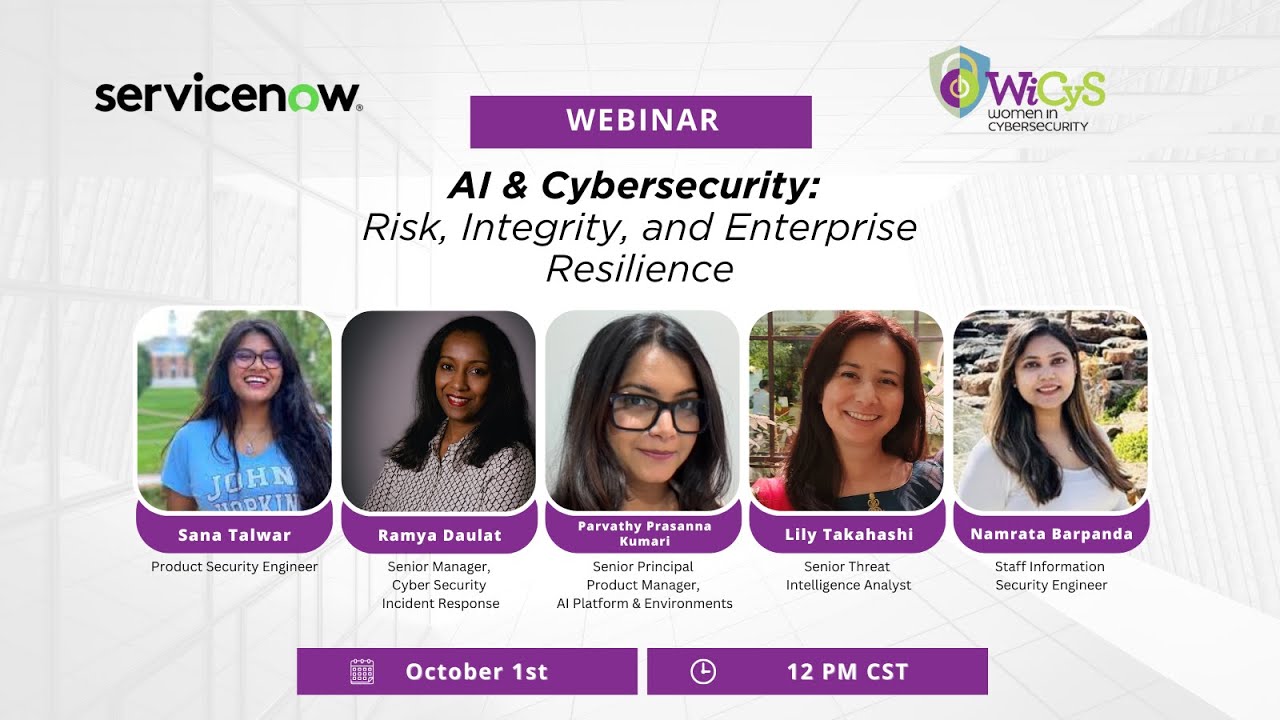
ServiceNow Webinar | AI & Cybersecurity: Risk, Integrity, and Enterprise Resilience
Keywords
Summary
162 words
Critical Evaluation
Value of the Information & Strength of the Argument
The webinar offers practical, experience-based advice on managing imposter syndrome, which is valuable for professionals in cybersecurity and tech. Annie’s personal anecdotes and actionable strategies (e.g., confidence file, growth mindset) are relatable and easy to implement. However, the argumentation relies heavily on personal experience and anecdotal evidence rather than rigorous scientific research. While she references concepts like growth mindset and self-compassion, she does not provide detailed scientific backing or citations. The presentation is engaging and motivational, but the lack of empirical data weakens its scientific rigor.
Scientific Rigor, Source Quality, Title Accuracy
The webinar’s scientific rigor is moderate. Annie mentions Carol Dweck’s growth mindset and Dr. Kristen Neff’s self-compassion, but does not provide specific references or studies. The title is misleading: it suggests a focus on AI and cybersecurity risk, but the content is primarily about imposter syndrome. This discrepancy may disappoint viewers expecting a technical discussion. The description also mentions ServiceNow, but the actual presentation is by Adobe, indicating a potential mismatch in branding. No comments were provided for analysis.
180 words
Title / Content Match
The title mentions AI & Cybersecurity, but the actual content focuses on imposter syndrome in cybersecurity, which is a mismatch. The title is misleading as it suggests a technical discussion on AI and cyber risks.
Quality & Reliability
6/10
The webinar is an expert opinion and personal narrative on imposter syndrome, not a scientific study. It references established concepts (growth mindset, self-compassion) but lacks rigorous sourcing and empirical data. The speaker's experience adds practical value but the scientific basis is limited.
Key Moments
Markers derived by PSI from the transcript: the creator did not define chapters.
- Introduction by Rosalie Olmstead, WiCyS strategic partner coordinator, overview of WiCyS organization and partners.
- Annie introduces herself, her role at Adobe, and her background, including her transition from psychology to tech.
- Definition of imposter syndrome and its prevalence; poll on how it manifests.
- Introduction of the five types of imposter syndrome by Dr. Valerie Young.
- Discussion on why imposter syndrome is common in cybersecurity, including constant change and lack of representation.
- Personal story about mentorship with Florian, principal security architect at Adobe, and its impact.
- Presentation of five science-based strategies: growth mindset, confidence file, find your people, self-advocacy, and regulation tools.
- Conclusion and Q&A session.
Cited Sources
- WiCyS Strategic Partner Webinars — Description link to more webinars from WiCyS strategic partners.
Concurring Sources
- Impostor syndrome — General reference on imposter syndrome, supporting the definition and prevalence mentioned.
Contribution & Novelties
The webinar provides a personal and practical perspective on imposter syndrome in cybersecurity, offering actionable strategies that are often missing from academic discussions. It emphasizes the role of mentorship and community support, which is valuable for career development. The speaker’s unique background (psychology to tech) adds a fresh angle.
Pour aller plus loin :
- Growth Mindset — Carol Dweck’s concept of fixed vs. growth mindset, foundational to the ‘yet’ strategy.
- Self-compassion — Kristen Neff’s research on treating oneself with kindness, relevant to the self-compassion strategy.
- Impostor syndrome — Overview of the phenomenon, including research and types.
- Mentorship — The role of mentorship in professional development, as highlighted in the webinar.
110 words
Radar Profile
The radar profile shows moderate scores across all dimensions, with slightly higher quality of information and reliability compared to quantity and technical level. This reflects a balanced but not deeply technical presentation, focusing on practical advice rather than in-depth scientific analysis.