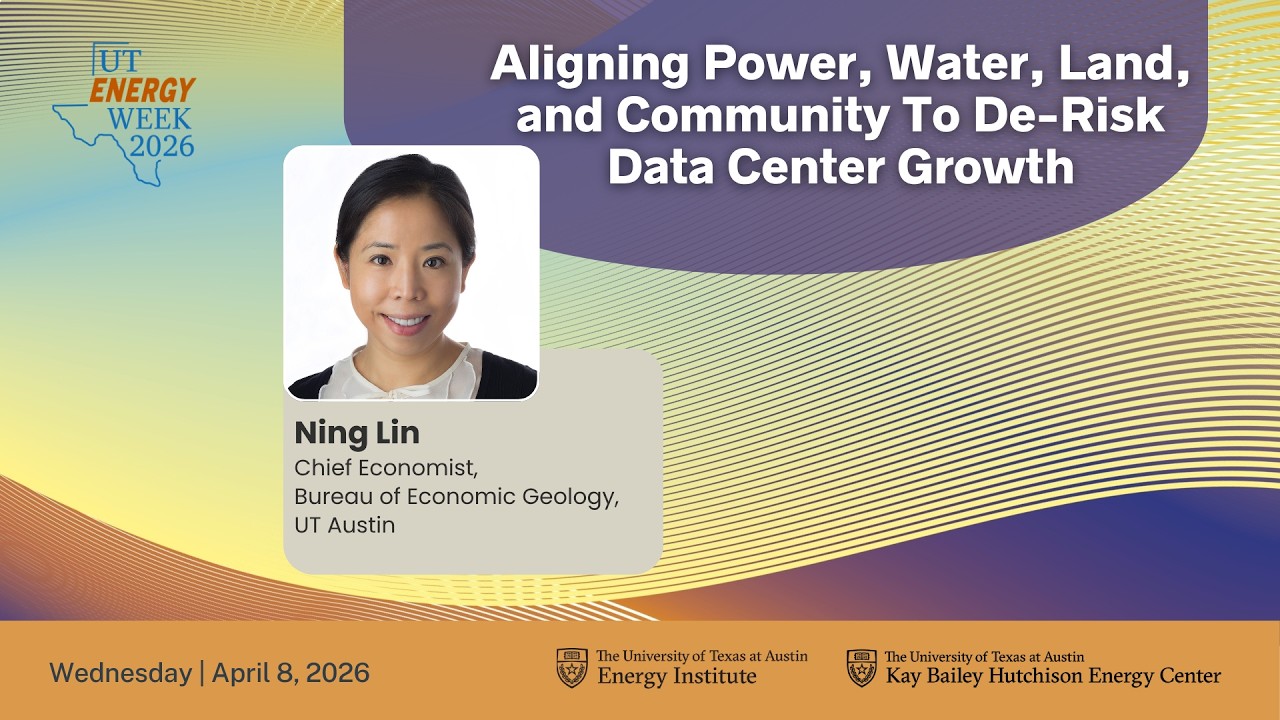
UT Energy Week 2026: Aligning Power, Water, Land, and Community To De-Risk Data Center Growth
Keywords
Summary
136 words
Critical Evaluation
Value of the Information & Strength of the Argument
The talk provides valuable insights into the multifaceted challenges of data center development, emphasizing the interconnectedness of power, water, land, and community. The argumentation is well-structured, using historical context and current data to support the need for a holistic approach. The speaker effectively argues that traditional load forecasting is insufficient, advocating for a project-level deliverability assessment. The presentation is persuasive, backed by the institute’s research and practical examples.
Scientific Rigor, Source Quality, Title Accuracy
The speaker references several publications from her team, including a peer-reviewed paper on geospatial suitability and a white paper on cooling technologies. However, specific citations are not provided in the talk. The title accurately reflects the content, focusing on aligning multiple factors to de-risk data center growth. The talk is based on expert opinion and ongoing research, which is appropriate for a conference presentation.
147 words
Title / Content Match
The title accurately reflects the content, which focuses on aligning power, water, land, and community considerations to mitigate risks in data center development.
Quality & Reliability
8/10
The talk is given by a chief economist at a reputable research institute, presenting a multi-disciplinary framework. It references specific data and publications, but lacks detailed citations and peer-reviewed evidence for some claims.
Key Moments
Markers derived by PSI from the transcript: the creator did not define chapters.
- Introduction to the Compass research group and its mission.
- Overview of the three eras of data centers and the current AI boom.
- Discussion of the two types of AI data centers: training and inferencing.
- Presentation of the US data center capacity map and Texas's position.
- Explanation of the forecasting deliverability approach and its importance.
- Introduction of the five research pillars: geospatial siting, permitting, water, onsite generation, and community.
- Details on geospatial suitability mapping and its findings.
- Discussion of permitting challenges and the trend toward unincorporated areas.
- Emphasis on community readiness as a strategic imperative and the goal of fast, clear, fair decisions.
Cited Sources
- Compass Research Group Publications — The speaker mentions that all papers are available on their website.
Concurring Sources
- Bureau of Economic Geology — The speaker's institution, providing credibility and additional resources.
Contribution & Novelties
The talk presents a novel framework for de-risking data center growth by integrating multiple dimensions (power, water, land, community) into a system-of-systems model. This approach goes beyond traditional load forecasting, offering a project-level deliverability assessment. The research provides practical tools like suitability maps and permitting guides, which are valuable for policymakers and communities.
Pour aller plus loin :
- Data center water usage — Background on water consumption in data centers.
- ERCOT — The Texas grid operator, relevant to power interconnection.
- Bureau of Economic Geology — The institute’s homepage for further research.
91 words
Radar Profile
The radar profile shows high scores in information quantity, quality, and reliability, with a slightly lower technical level, indicating a well-balanced presentation accessible to a broad audience.