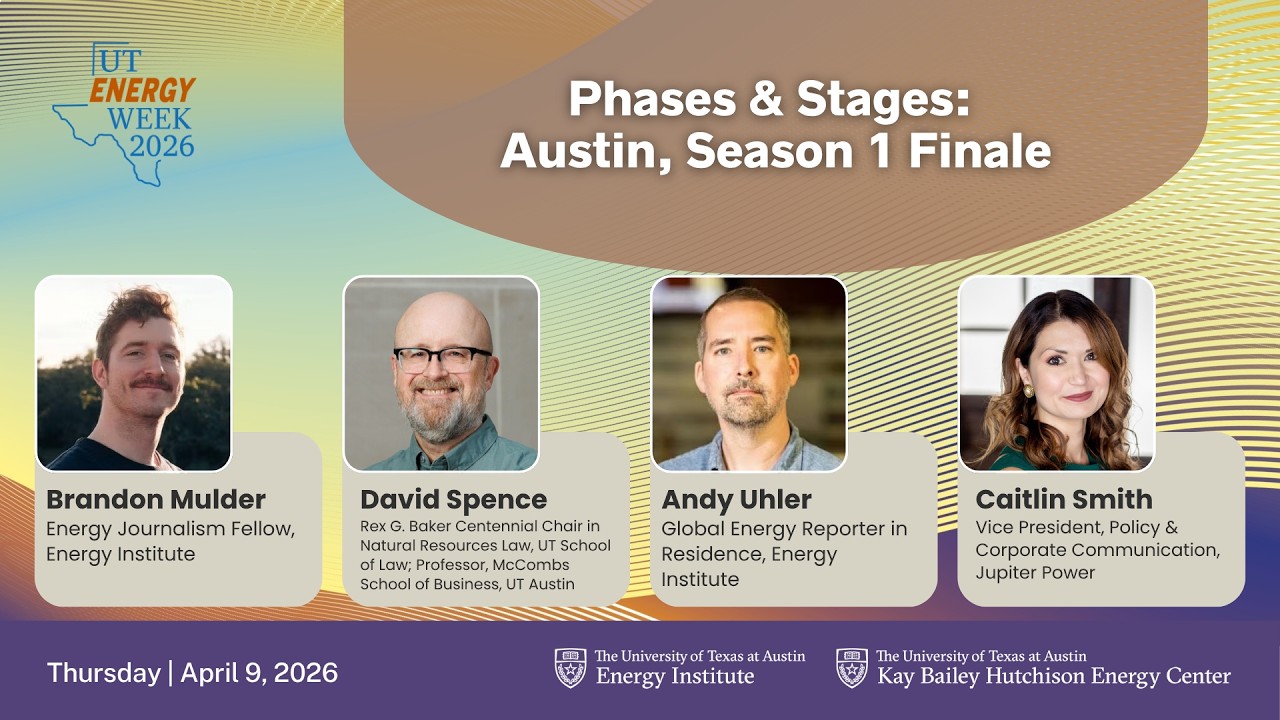
UT Energy Week 2026: Phases & Stages: Austin, Season 1 Finale
Keywords
Summary
169 words
Critical Evaluation
Value of the Information & Strength of the Argument
The discussion provides valuable insights into the real-world dynamics of energy infrastructure siting, drawing on concrete examples from the podcast’s reporting. The panelists offer diverse perspectives: a developer (Caitlin Smith) explains proactive community engagement strategies, an academic (David Spence) contextualizes the issues within political science and legal frameworks, and a journalist (Andy Uhler) shares on-the-ground observations. The argumentation is solid, with references to specific cases (Crest, Texas), academic studies (Josh Rhodes), and books (Mettler & Brown, Gazmarian). The panel effectively argues that local opposition often stems from unequal distribution of costs and benefits, and that community engagement must be tailored to local concerns. However, the discussion is largely anecdotal and lacks rigorous quantitative analysis, and some claims (e.g., about partisanship) are based on polling and personal observation rather than systematic evidence.
Scientific Rigor, Source Quality, Title Accuracy
The panel demonstrates scientific rigor through the expertise of the participants and references to academic work and studies. David Spence cites political science research on polarization and mentions books by Suzanne Mettler and Trevor Brown, and by Gazmarian, though without full citations. Andy Uhler references his reporting and interactions with community members, providing qualitative evidence. The title accurately reflects the content, as the panel is a season finale discussion centered on Austin and the podcast’s themes. The description provides clear context and identifies the panelists, enhancing credibility. However, the lack of explicit citations and reliance on anecdotal evidence limits the scientific rigor to some extent.
251 words
Title / Content Match
Title accurately reflects the content: a panel discussion concluding the first season of the podcast 'Phases & Stages', focusing on community impacts of energy projects and the role of Austin in energy policy.
Quality & Reliability
8/10
Panel of experts (academic, industry, journalist) provides nuanced discussion grounded in field reporting and academic research. No formal citations but references to studies and books. High credibility due to institutional affiliation and expertise.
Key Moments
Markers derived by PSI from the transcript: the creator did not define chapters.
- Introduction of panelists and overview of the podcast 'Phases & Stages'.
- Andy Uhler discusses the Crest, Texas solar farm and community reactions.
- David Spence explains the cost-benefit imbalance in energy siting and community benefit agreements.
- Caitlin Smith describes Jupiter Power's proactive community engagement process.
- Discussion on partisanship in renewable energy opposition, comparing Texas to other states.
- Andy Uhler shares stories from rural communities and the role of local history and identity.
- Panel discusses the impact of data centers and the rise of NIMBYism and BANANA.
- Discussion on the future of renewable energy growth in Texas after tax credit changes.
Cited Sources
- Phases & Stages: The Texas Energy Story (podcast) — The podcast series discussed in the panel, providing field reporting on energy communities.
- Chapter 313 Tax Abatement Program — Referenced as the tax abatement program used in Crest, Texas, that directed funds to school districts.
- Lazard's Levelized Cost of Energy Analysis — Referenced by David Spence to support the competitiveness of unsubsidized solar and wind.
Concurring Sources
- Josh Rhodes - UT Energy Institute — Referenced for studies showing economic benefits of renewable projects to local communities.
Contribution & Novelties
The panel provides a unique synthesis of journalistic field reporting and academic analysis on the social dimensions of energy infrastructure siting. It highlights the importance of community engagement and the challenges of distributing benefits equitably. The discussion offers practical insights for developers and policymakers, emphasizing the need to address local concerns beyond economic incentives.
Pour aller plus loin :
- Community Benefits Agreements — Overview of CBAs as a tool for mitigating local impacts.
- NIMBY — Concept of local opposition to development, relevant to the discussion.
- Rural-Urban Divide — Political science perspective on rural alienation, as mentioned by David Spence.
99 words
Radar Profile
The radar profile shows high scores in quality of information and reliability, reflecting the expertise of the panelists and the grounded nature of the discussion. The quantity of information is moderate, as the panel covers a broad range of topics but with limited depth. The technical level is moderate, accessible to a general audience while still providing expert insights.
💬 Sur les 0 commentaires analysés, aucune tendance n'est disponible.