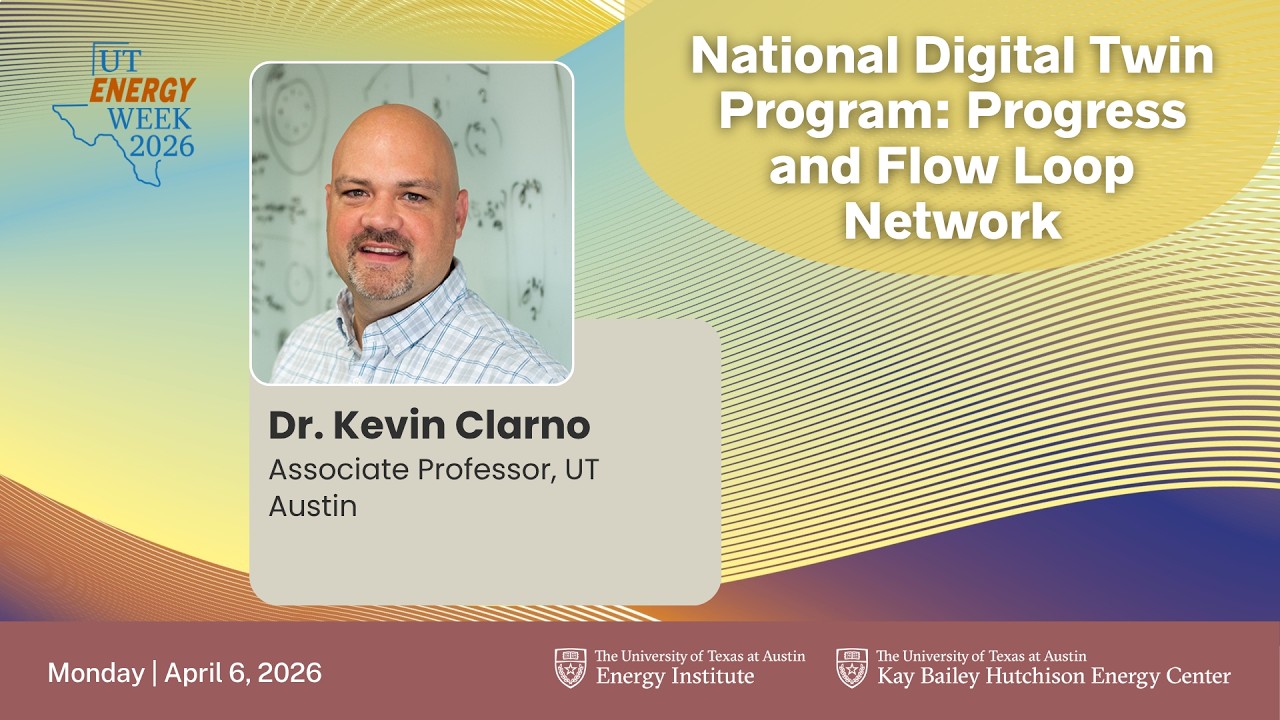
UT Energy Week 2026: Texas Nuclear Digital Twin Program-- Progress and Flow Loop Network
Keywords
Summary
131 words
Critical Evaluation
Value of the Information & Strength of the Argument
The presentation provides valuable insights into the practical challenges and progress of implementing digital twins in nuclear research. The speaker argues convincingly that current licensing processes are too slow and that digital twins can accelerate innovation. He supports his points with specific examples from the program’s collaborations, such as the MIT and Texas A&M loops, and explains the technical approach in detail. The argumentation is coherent and grounded in the speaker’s direct experience, though it lacks quantitative data or comparative analysis.
Scientific Rigor, Source Quality, Title Accuracy
The speaker is a credible expert, and the content is based on ongoing research. However, no external sources are cited, and the presentation is a progress report rather than a peer-reviewed study. The title accurately reflects the content, focusing on the program’s progress and flow loop network. The description provides a link to the Energy Week program, which is a relevant source for context.
160 words
Title / Content Match
The title accurately reflects the content, focusing on the program's progress and flow loop network.
Quality & Reliability
7/10
The speaker is an associate professor directly involved in the program, providing firsthand progress updates. The presentation is technical and specific, but lacks peer-reviewed citations and is a conference talk, so it is informative but not independently verified.
Key Moments
Markers derived by PSI from the transcript: the creator did not define chapters.
- Introduction and program overview
- Challenges in nuclear innovation and licensing
- Concept of multi-fidelity digital twin
- Digital shadow vs digital twin definition
- Application to UT's TRIGA reactor
- Collaborations with MIT and Texas A&M
- New partnerships with ACU and VCU
- Interdisciplinary team requirements
- Commercial integration and vendor discussions
- Q&A session on industry collaboration
Cited Sources
- UT Energy Week 2026 Program — Official program page for the event where this talk was given.
Concurring Sources
- Digital Twin for Nuclear Reactors — IAEA initiative on digital twins for nuclear reactors, supporting the relevance of the approach.
Contribution & Novelties
The presentation offers an insider’s perspective on the development of a nuclear digital twin program, detailing both successes and setbacks. It highlights the importance of integrating experimental and computational research and the need for interdisciplinary teams. The concept of using digital shadows to continuously improve high-fidelity codes is a notable contribution.
Pour aller plus loin :
- Digital twin — Overview of digital twin technology.
- Molten salt reactor — Background on molten salt reactors.
- Computational fluid dynamics — Relevant to the high-fidelity modeling discussed.
83 words
Radar Profile
The radar profile shows high scores in information quantity and technical level, indicating a detailed technical presentation. Quality and reliability are moderate, reflecting the lack of external citations. The overall profile suggests a solid but not exceptional scientific contribution.
💬 No comments were provided for analysis.