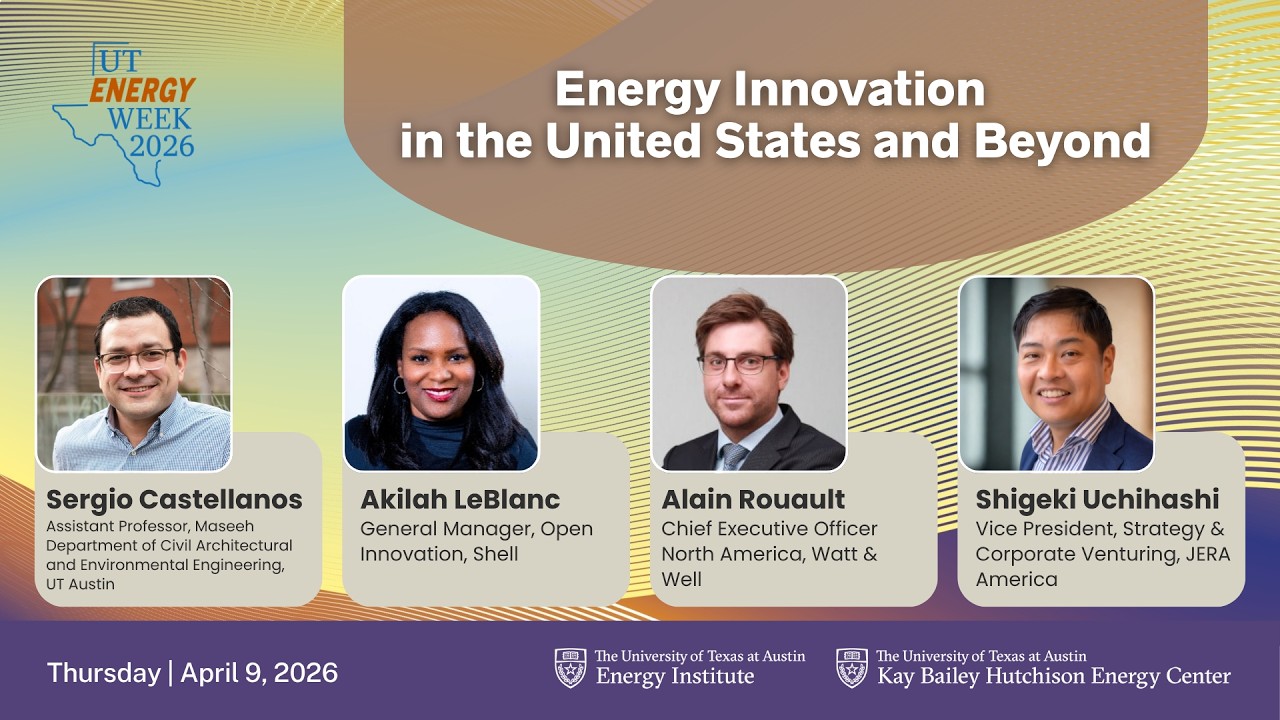
UT Energy Week: Energy Innovation in the United States and Beyond
Keywords
Summary
190 words
Critical Evaluation
Value of the Information & Strength of the Argument
The panel provides valuable insights into the practical realities of energy innovation from industry and academic perspectives. Rouault’s emphasis on solving problems rather than pursuing novelty for its own sake is a pragmatic counterpoint to hype. Uchihashi offers a clear explanation of JERA’s strategy, including the ammonia co-firing solution for coal plants, and highlights the importance of energy security in Asia. Korgel’s argument that universities are primarily talent magnets and that industry cannot replace federal research funding is well-articulated and grounded in his experience. The discussion is balanced, with speakers acknowledging both strengths and weaknesses of different innovation ecosystems. However, the argumentation is largely anecdotal and lacks rigorous data or citations, which limits its scientific depth.
Scientific Rigor, Source Quality, Title Accuracy
The panel is scientifically rigorous in the sense that it features experts with deep domain knowledge, and their statements are plausible and consistent with known trends. However, no specific sources are cited, and the discussion is not based on published research. The title accurately reflects the content, which is a high-level discussion of energy innovation across geographies. The lack of formal citations is typical for a panel discussion and does not detract significantly from the value of the expert opinions shared.
212 words
Title / Content Match
The title accurately reflects the panel's focus on energy innovation in the US and globally.
Quality & Reliability
7/10
Panel of industry and academic experts discussing energy innovation, with concrete examples and nuanced perspectives. However, it is a discussion without formal citations or data, and some claims are anecdotal.
Key Moments
Markers derived by PSI from the transcript: the creator did not define chapters.
- Introduction of panelists and their backgrounds.
- Alain Rouault describes Watt & Well's power electronics for oil and gas, EV charging, and grid storage.
- Brian Korgel discusses his background in nanomaterials and the role of universities in innovation.
- Shigeki Uchihashi explains JERA's history and its focus on energy security and ammonia co-firing.
- Discussion on how innovation is defined and implemented in each organization.
- Korgel emphasizes that universities are talent magnets and industry cannot replace federal funding.
- Comparison of innovation ecosystems in the US, Europe, and Asia, with Rouault noting the speed of the US market.
- Uchihashi discusses Japan's tight-knit government-industry-university links and the challenges for startups.
- Korgel shares his experience teaching in Japan and observations on startup culture differences.
- Concluding remarks on the future of energy innovation.
Contribution & Novelties
The panel offers a unique cross-regional perspective on energy innovation, combining insights from a French power electronics company, a Japanese utility, and a US university. It highlights the importance of problem-solving over pure technological novelty, the role of universities as talent magnets, and the differences in innovation ecosystems. The discussion on ammonia co-firing and V2G technology provides concrete examples of emerging solutions.
Pour aller plus loin :
- Vehicle-to-grid (V2G) — Relevant to the V2G technology discussed by Rouault.
- Ammonia as an energy carrier — Relevant to JERA’s ammonia co-firing strategy.
- Corporate venture capital — Relevant to Uchihashi’s role at JERA Americas.
- Energy Institute at UT Austin — The host institution and its research initiatives.
114 words
Radar Profile
The radar profile shows a balanced panel with strong scores in information quantity and quality, moderate technical depth, and good reliability. The discussion is accessible yet substantive, making it valuable for a broad audience interested in energy innovation.
💬 No comments were provided for analysis.