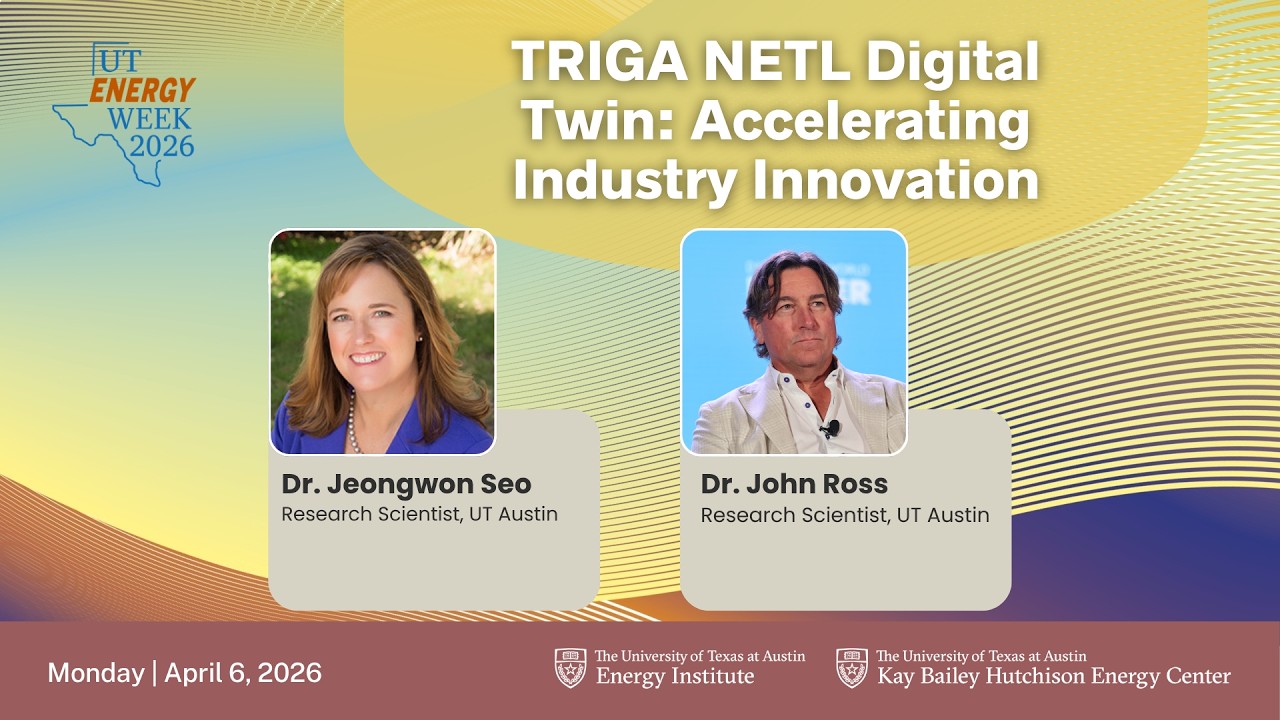
UT Energy Week 2026: TRIGA NETL Digital Twin-- Accelerating Industry Innovation
Keywords
Summary
218 words
Critical Evaluation
Value of the Information & Strength of the Argument
The presentation provides valuable insights into the practical implementation of a digital twin for a research reactor, covering data acquisition, simulation, and real-time visualization. The argumentation is solid, based on their own research and development, with clear explanations of methodologies and challenges. They demonstrate the value of the digital twin in improving operational efficiency and safety, and they present a compelling case for its broader application in the nuclear industry. However, the talk is more of a progress report than a rigorous scientific argument, with limited quantitative results and no formal validation against independent benchmarks.
Scientific Rigor, Source Quality, Title Accuracy
The scientific rigor is moderate; the presenters are experts directly involved in the project, lending credibility, but they do not cite external sources or provide peer-reviewed references. The quality of sources is limited to their own work and the conference program link. The title accurately reflects the content, focusing on the digital twin and its role in accelerating innovation. The presentation is well-structured and technically detailed, but the lack of external validation and the absence of a detailed methodology for some aspects (e.g., Cherenkov analysis) reduce the overall rigor.
199 words
Title / Content Match
The title accurately reflects the content, focusing on the TRIGA NETL digital twin and its role in accelerating innovation in the nuclear industry.
Quality & Reliability
7/10
The presentation is given by researchers directly involved in the project, providing credible firsthand information. However, it is a conference talk without peer-reviewed references, and some claims lack detailed evidence.
Key Moments
Markers derived by PSI from the transcript: the creator did not define chapters.
- Introduction to the talk and the digital twin concept.
- Explanation of the digital shadow and high-fidelity simulations using MCNP and IMPACT.
- Data acquisition and integration process: serial data, Python scripts, and web platform.
- Training a neural network surrogate model with 20,000 MCNP runs.
- Challenges with data quality and conservative safety margins.
- Cherenkov light analysis to improve power estimation.
- John Ross discusses reduced-order models and real-time dashboard.
- Plans for smoothing rod experiments and autonomous control.
- Conclusion and future directions.
Cited Sources
- UT Energy Week 2026 Program — Official program page for the conference where this talk was presented.
Concurring Sources
- UT Energy Week 2026 Program — Conference program listing the talk, supporting the event's existence.
Contribution & Novelties
The presentation offers a detailed case study of implementing a digital twin for a research reactor, showcasing the integration of high-fidelity simulations, real-time data, and machine learning surrogates. The use of Cherenkov light analysis for power estimation is a novel approach to address instrumentation limitations. The development of a real-time multi-physics dashboard for operators is a significant advancement in reactor monitoring.
Pour aller plus loin :
- Digital twin — Overview of digital twin concept and applications.
- MCNP — Monte Carlo N-Particle transport code used for nuclear simulations.
- TRIGA reactor — Information on TRIGA research reactors.
- Reduced-order modeling — Techniques for simplifying complex models.
- Cherenkov radiation — Physical phenomenon used for power estimation.
112 words
Radar Profile
The radar profile shows balanced scores across all dimensions, with slightly higher scores in technical level and reliability, reflecting the expert presentation and detailed technical content. The lower score in information quantity suggests the talk could have provided more in-depth data or comparisons.