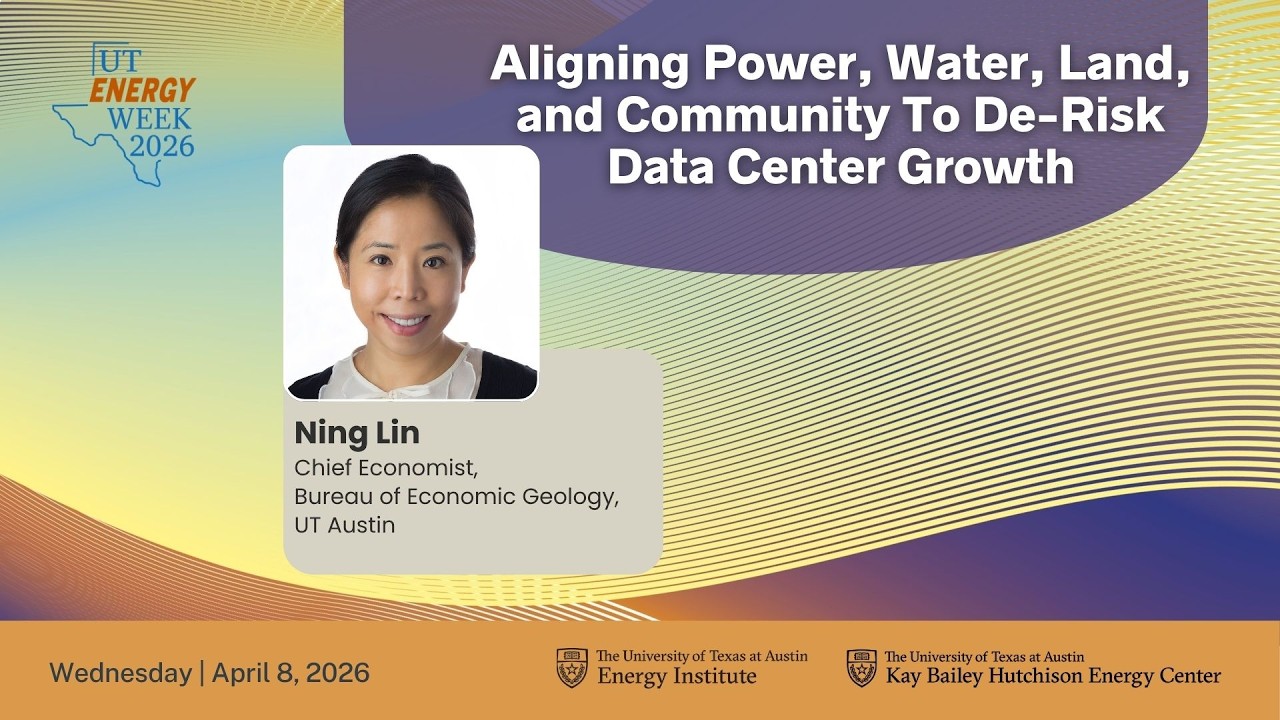
UT Energy Week 2026: Aligning Power, Water, Land, and Community To De-Risk Data Center Growth
Keywords
Summary
166 words
Critical Evaluation
Value of the Information & Strength of the Argument
The talk provides valuable insights into the multifaceted challenges of data center expansion, particularly in Texas. It argues that traditional load forecasting is insufficient because it ignores critical non-power factors such as water, permitting, and community opposition. The speaker supports this argument with specific examples, such as the 15x increase in rack power density since 2020 and the projected 100x increase by 2030, as well as the $64 billion in blocked projects due to community opposition. The argumentation is logical and well-structured, moving from the problem to the proposed solution (forecasting deliverability) and then detailing the five research pillars. However, the talk is an overview and does not delve into the specifics of the research methods or results, which limits the depth of the argumentation. The speaker also acknowledges the complexity and interconnectedness of the issues, which strengthens the case for a systems approach.
Scientific Rigor, Source Quality, Title Accuracy
The talk demonstrates scientific rigor through its reliance on the Bureau of Economic Geology’s extensive data and the Compass group’s published research. The speaker mentions specific papers and white papers, and the description includes a link to the Compass website where these are available. The title accurately reflects the content, focusing on aligning power, water, land, and community to de-risk data center growth. The talk is well-organized and the speaker is transparent about the limitations of traditional forecasting. However, the talk does not provide detailed citations for all claims, and some data points (e.g., the $64 billion figure) are not sourced within the talk. The speaker also notes that the maps are being updated, indicating ongoing research. Overall, the sources are credible and the title is appropriate.
286 words
Title / Content Match
The title accurately reflects the content, which focuses on aligning power, water, land, and community considerations to de-risk data center growth in Texas.
Quality & Reliability
8/10
The speaker is a chief economist at the Bureau of Economic Geology, with 15 years of private sector experience in natural gas and power. The talk is based on ongoing research from the Compass group, which has published peer-reviewed papers and white papers. The content is well-structured, data-driven, and transparent about the limitations of traditional forecasting. However, some claims lack specific citations within the talk, and the presentation is an overview rather than a detailed exposition of the research.
Key Moments
Markers derived by PSI from the transcript: the creator did not define chapters.
- Introduction: Ning Lin introduces the topic and the Compass research group.
- Overview of the three eras of data centers, from server closets to AI-driven hyperscale facilities.
- Discussion of the two types of AI data centers: training and inferencing, and the dramatic increase in rack power density.
- Map of US data center capacity, highlighting Texas as number two and its high planned capacity.
- Clustering of data centers along the I-35 corridor and the trend of AI training centers moving to West Texas.
- Introduction of the 'forecasting deliverability' concept and the system-of-systems approach.
- Pillar 1: Geospatial siting using machine learning and geological data, including the Pecos County example.
- Pillar 2: Permitting and regulatory mapping, highlighting zoning differences between incorporated and unincorporated areas.
- Pillar 3: Water use and cooling technologies, emphasizing the localized nature of water resources.
- Pillar 4: Onsite generation and grid modeling, and Pillar 5: Community readiness and engagement.
- Integration of the five pillars into a system-of-systems model and the goal of 'fast, clear, and fair' outcomes.
Cited Sources
- Compass Research Group — The speaker references the Compass group's website where published papers and white papers are available.
Concurring Sources
- Compass Research Group — The speaker's research group, which publishes papers and white papers on data center siting, permitting, water, and community engagement.
Contribution & Novelties
The talk presents a novel approach to forecasting data center load by focusing on ‘deliverability’ rather than just total demand. This involves modeling each project’s sequential constraints across power, water, permitting, finance, construction, and community engagement. The Compass group’s integration of geological data, machine learning, and community engagement provides a holistic framework for de-risking data center growth. The talk also highlights the importance of community readiness as a strategic imperative, citing $64 billion in blocked projects. This perspective is valuable for policymakers, developers, and communities.
Pour aller plus loin :
- Data center — Provides background on data center infrastructure and evolution.
- ERCOT — The Texas grid operator, relevant to the interconnection queue and large load definitions.
- Bureau of Economic Geology — The research institute where the speaker works, offering geological data and expertise.
- Machine learning — The technique used in geospatial siting analysis.
- Water cooling — Relevant to the discussion of cooling technologies in data centers.
156 words
Radar Profile
The radar profile shows high scores across all dimensions, indicating a well-rounded and informative presentation. The talk excels in providing substantial information and credible sources, with a strong technical level suitable for an informed audience. The overall reliability is high, reflecting the speaker's expertise and the research-based content.