Hydrogen Day 2025: Reciprocating Compressors for The Hydrogen Economy
Keywords
Summary
154 words
Critical Evaluation
Value of the Information & Strength of the Argument
The presentation offers valuable insights into the practical aspects of hydrogen compression, drawing on the speaker’s extensive experience and real project examples. The argumentation is solid, explaining the technical reasons why reciprocating compressors are preferred for many hydrogen applications, such as their efficiency and ability to handle high pressures. The speaker effectively addresses challenges like low gas density and leakage, and demonstrates how these are mitigated through design. However, the talk is inherently promotional, as it is given by a company representative, and the argumentation could be strengthened by acknowledging alternative technologies more thoroughly and discussing potential drawbacks in more depth.
Scientific Rigor, Source Quality, Title Accuracy
The talk is based on the speaker’s professional experience and company data, but no external sources are cited. The title accurately reflects the content, which is focused on reciprocating compressors for the hydrogen economy. The presentation adheres to industry standards, such as API 618, and references real projects, which adds credibility. However, the lack of independent sources and the promotional nature of the talk limit its scientific rigor.
184 words
Title / Content Match
The title accurately reflects the content, which focuses on reciprocating compressors in the hydrogen economy.
Quality & Reliability
7/10
The speaker is a sales and account manager with 13 years of experience in hydrogen compression, and the talk is based on real projects and industry practices. However, it is a company presentation with a promotional angle, and no independent sources or peer-reviewed references are cited.
Key Moments
Markers derived by PSI from the transcript: the creator did not define chapters.
- Introduction: speaker introduces himself and the topic of reciprocating compressors for hydrogen.
- Why compressors are essential in the hydrogen value chain.
- Overview of Neuman & Esser company and its hydrogen compressor portfolio.
- Challenges of hydrogen compression: low density, reverse Joule-Thomson effect, leakage, low energy content.
- Comparison of compressor technologies and application map for technology selection.
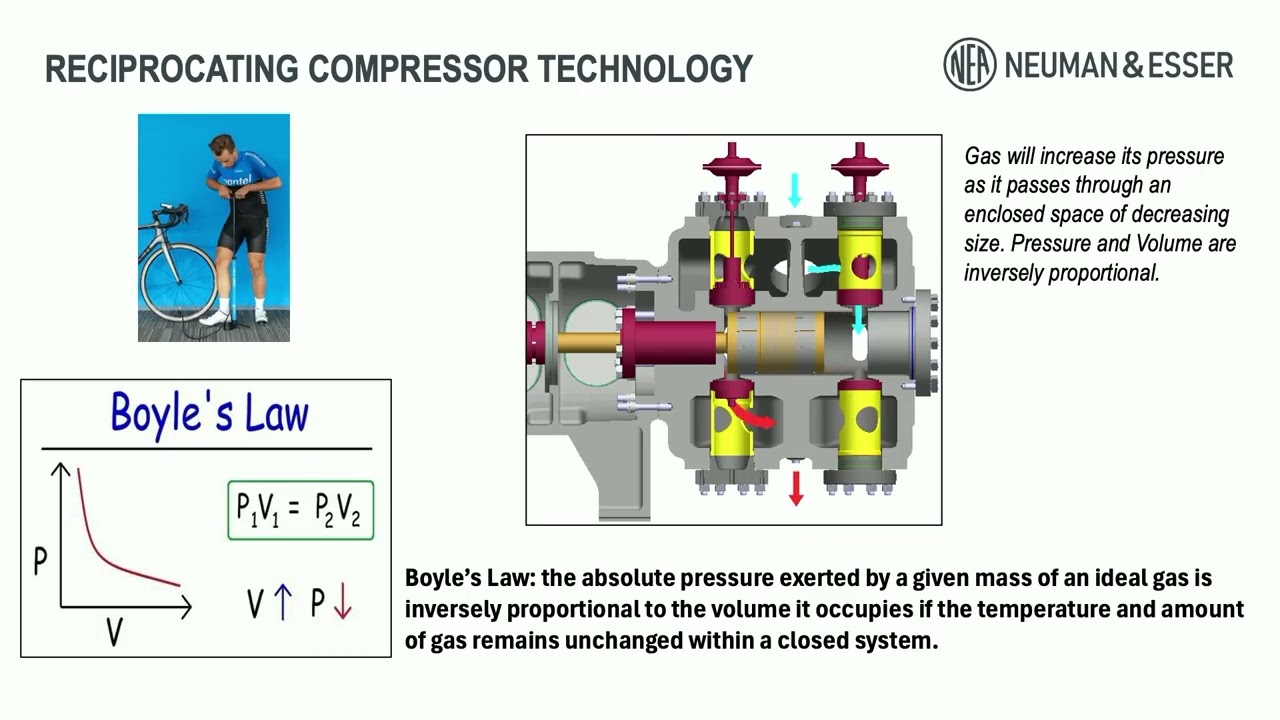
- How reciprocating compressors work: positive displacement principle, arrangements, and auxiliary systems.
- Advantages and disadvantages of reciprocating compressors for hydrogen.
- Case study: hydrogen liquefaction plant compressor with non-lubricated cylinders.
- Case study: hydrogen pipeline compressor with skid-mounted packaging.
- Latest technology developments: large-bore cylinders and 500-bar non-lubricated compressor.
Cited Sources
- Neuman & Esser Blog — Mentioned at the end of the presentation as a resource for more information on hydrogen compression.
Concurring Sources
- Hydrogen Compressors: A Review — Academic review of hydrogen compression technologies, supporting the technical challenges and solutions discussed.
Contribution & Novelties
The talk provides a practical, industry-focused overview of reciprocating compressors for hydrogen applications, highlighting recent developments such as large-bore cylinders and non-lubricated designs for high pressures. It offers valuable insights into real-world project requirements and design considerations.
Pour aller plus loin :
- API 618 Standard — The standard for reciprocating compressors for petroleum, chemical, and gas industry services, referenced in the talk.
- Hydrogen Economy — Overview of the hydrogen economy concept and its infrastructure needs.
- Reciprocating Compressor — General information on reciprocating compressor technology.
84 words
Radar Profile
The radar profile shows high scores in quantity of information and technical level, reflecting the detailed and specific content. The quality of information and global reliability are slightly lower due to the promotional nature and lack of independent sources.