UT Energy Week 2026: Power Project Case Study
Keywords
Summary
169 words
Critical Evaluation
Value of the Information & Strength of the Argument
The presentation provides valuable, practical insights into the complexities of developing battery storage projects, particularly in Texas. The speaker’s direct experience in project finance lends credibility to the details on interconnection, financing, and revenue contracting. The argumentation is coherent, using the Hearne Prairie project as a concrete example to illustrate each step. However, the talk is largely promotional for Jupiter Power and lacks critical analysis of potential drawbacks or alternative perspectives. The discussion on technology obsolescence and supply chain is somewhat superficial, but the Q&A adds depth on regulatory and manufacturing issues.
Scientific Rigor, Source Quality, Title Accuracy
The presentation is based on the speaker’s professional experience rather than cited scientific sources. No specific sources are mentioned, and the description contains no links. The title accurately reflects the content, which is a case study of a battery project. The talk is internally consistent and aligns with known facts about ERCOT and battery deployment, but it lacks external references for verification. The speaker’s claims about grid growth and battery capacity are plausible but not sourced.
183 words
Title / Content Match
The title accurately reflects the content: a case study of a battery power project presented during UT Energy Week.
Quality & Reliability
7/10
Presentation by an industry professional with direct experience in battery project finance, providing practical insights into project development. However, it is a single-company perspective with limited independent verification and some promotional elements.
Key Moments
Markers derived by PSI from the transcript: the creator did not define chapters.
- Introduction of Travis Cook and topic overview.
- Discussion on why battery storage is growing in Texas, including grid doubling and solar peak mismatch.
- Explanation of the project development timeline and key steps.
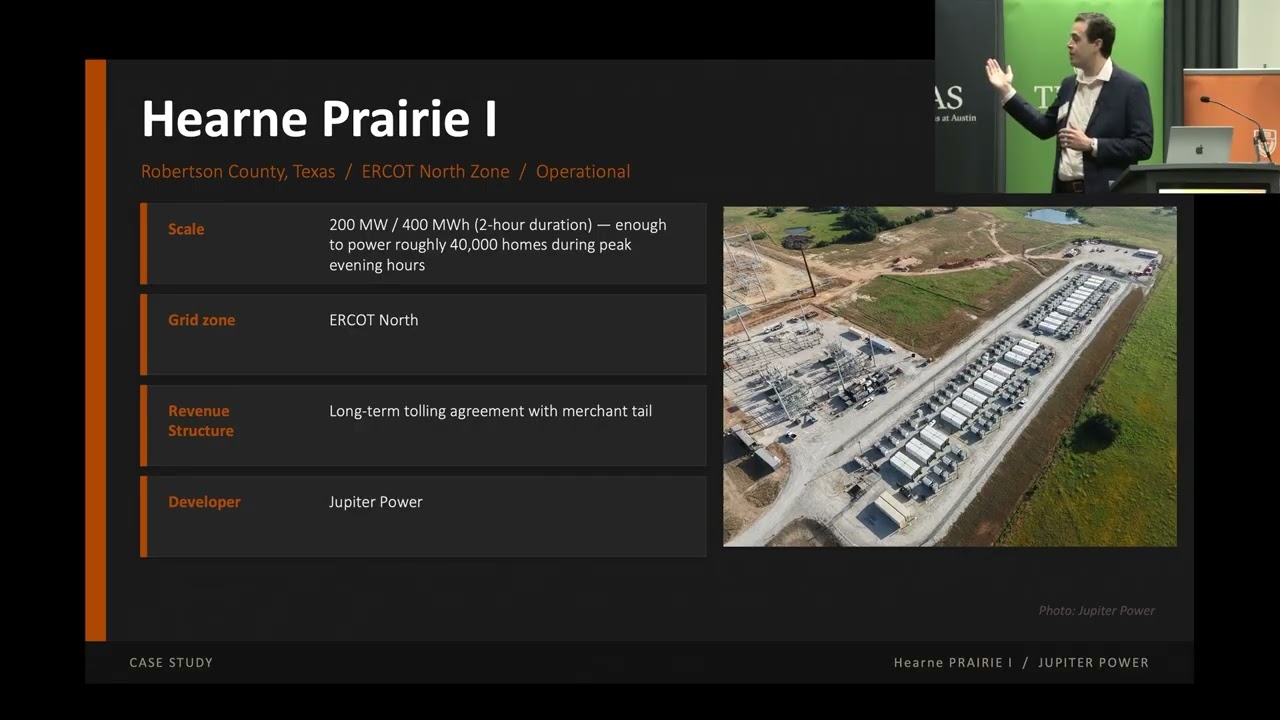
- Site selection criteria for battery projects, using Hearne Prairie as example.
- Interconnection process and challenges, including the 80% failure rate.
- Revenue contracting: tolling agreements vs. merchant projects.
- Procurement and construction considerations, including long lead times.
- Financing: why debt is used, and how contracts support bankability.
- Q&A: Jupiter's project portfolio and technology evolution.
- Q&A: Regulatory environment differences and competitive landscape.
Contribution & Novelties
The talk provides a rare, practitioner-level view of the entire lifecycle of a battery storage project, from site selection to financing, within the specific context of Texas’s ERCOT market. It demystifies the interconnection process and highlights the importance of revenue contracts in securing project finance. The discussion on domestic manufacturing and supply chain dynamics offers current insights into policy impacts.
Pour aller plus loin :
- ERCOT — Official grid operator for Texas, relevant for understanding market rules and interconnection.
- Battery storage in the United States — Overview of battery storage deployment and policy.
- Tolling agreement — Explanation of this contract type used in energy projects.
- Inflation Reduction Act — U.S. law providing incentives for domestic clean energy manufacturing.
118 words
Radar Profile
The radar profile shows a balanced performance across all dimensions, with slightly higher scores in information quantity and reliability, reflecting the speaker's practical expertise. The lower technical score indicates the content is accessible to a general audience, while the overall quality is solid but not exceptional.