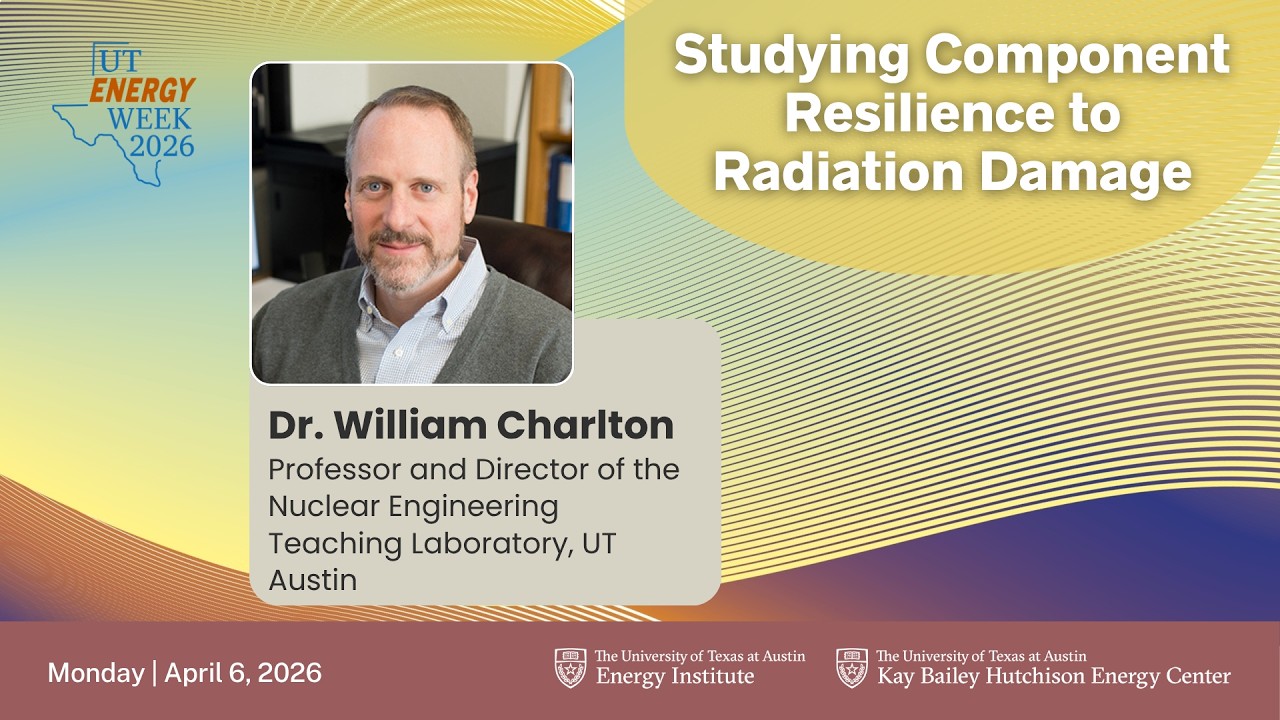
UT Energy Week 2026: Studying Component Resilience to Radiation Damage
Keywords
Summary
170 words
Critical Evaluation
Value of the Information & Strength of the Argument
The talk provides valuable insights into radiation damage mechanisms and their practical implications for nuclear and space systems. The speaker effectively argues for the importance of understanding synergistic effects, as demonstrated by the Sandia project where combined gamma and neutron irradiation caused earlier device failure than expected. He also highlights the trade-off between shielding and system size, which is crucial for microreactors and space reactors. The argumentation is solid, based on practical experience and specific research examples, though it lacks detailed quantitative data or references to peer-reviewed studies.
Scientific Rigor, Source Quality, Title Accuracy
The speaker demonstrates scientific rigor by explaining fundamental mechanisms and referencing specific research projects. However, he does not cite specific sources or publications, relying instead on his expertise and institutional work. The title accurately reflects the content, which is focused on studying component resilience to radiation damage. The talk is well-structured and technically sound, though it could benefit from more explicit citations.
165 words
Title / Content Match
The title accurately reflects the content, which focuses on studying component resilience to radiation damage.
Quality & Reliability
8/10
The speaker is a professor and director of a nuclear engineering teaching lab, providing expert insights. The talk is based on practical experience and specific research projects, but lacks detailed citations or peer-reviewed references.
Key Moments
Markers derived by PSI from the transcript: the creator did not define chapters.
- Introduction to the talk and context of radiation damage in strategic systems.
- Explanation of radiation effects on materials, including ionization and displacement damage.
- Discussion of total ionizing dose and displacement damage mechanisms.
- Case study on radiation damage to high explosives (PETN) and void formation.
- Synergistic radiation effects study with Sandia, showing combined gamma and neutron damage.
- Challenges for advanced reactors and space systems, including shielding considerations.
- Q&A session on industry engagement and shielding strategies.
Cited Sources
- UT Energy Week 2026 Program — Official program page for the event where this talk was presented.
Concurring Sources
- Radiation Effects on Electronics — General reference on radiation effects on electronic components, consistent with the talk's content.
Contribution & Novelties
The talk provides a practical overview of radiation damage testing for nuclear components, emphasizing the importance of synergistic effects and the challenges of modern electronics in high-radiation environments. It offers insights from hands-on experience at UT’s reactor facility.
Pour aller plus loin :
- Radiation damage - Wikipedia — Overview of radiation damage mechanisms.
- Total ionizing dose - Wikipedia — Detailed explanation of TID effects on electronics.
- Single event upset - Wikipedia — Explanation of single event effects in microelectronics.
79 words
Radar Profile
The radar profile shows high scores in quality of information and technical level, indicating a technically sound presentation. The quantity of information is moderate, and the global reliability is high due to the speaker's expertise.