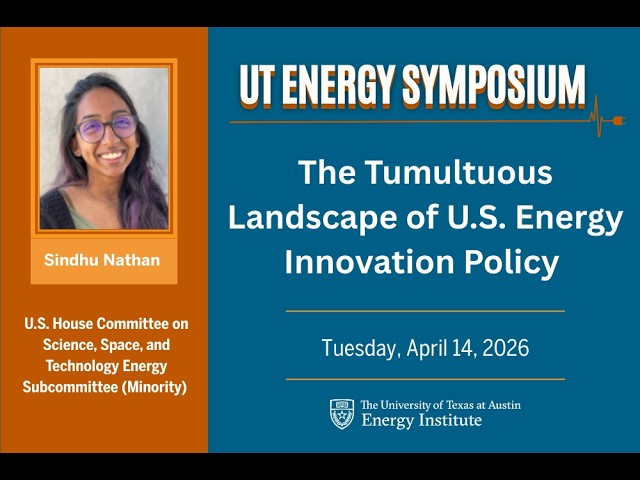
The Tumultuous Landscape of U.S. Energy Innovation Policy
Keywords
Summary
194 words
Critical Evaluation
Value of the Information & Strength of the Argument
The talk provides valuable insider insights into the legislative process and recent policy shifts, offering a clear explanation of how budget reconciliation works and its implications for energy policy. The argumentation is coherent, using specific examples like the energy storage program and the cancellation of projects to illustrate broader trends. Nathan effectively argues that recent actions pose a threat to U.S. energy innovation, but her perspective is clearly from a Democratic staffer, which may introduce bias. She acknowledges this by stating she represents her own views. The talk is well-structured and persuasive, though it could benefit from more balanced consideration of opposing viewpoints.
Scientific Rigor, Source Quality, Title Accuracy
The talk demonstrates scientific rigor in its explanation of legislative processes and its use of specific policy examples. Nathan cites major legislation and events, but does not provide detailed sources for all claims, such as the specific impacts of the One Big Beautiful Bill Act. The title accurately reflects the content, which focuses on the turbulent policy landscape. The talk is based on the speaker’s professional expertise and insider knowledge, which adds credibility but also potential bias. No external sources are cited beyond the legislation mentioned, and the description provides no links to additional references.
213 words
Title / Content Match
The title accurately reflects the content, which covers the volatile political landscape and recent policy shifts affecting U.S. energy innovation.
Quality & Reliability
8/10
The speaker is a professional staff member on the House Science Committee's Energy Subcommittee, providing insider perspective on legislative processes and recent policy actions. The talk is well-structured, cites specific legislation and events, and includes a clear disclaimer about personal views. However, it is an opinion piece with potential political bias, and some claims lack detailed sourcing.
Key Moments
Markers derived by PSI from the transcript: the creator did not define chapters.
- Introduction to the talk and speaker's background
- Overview of DOE's innovation enterprise and technology commercialization stages
- Explanation of how Congress legislates: authorization and appropriation process using energy storage example
- Review of major energy legislation: DOE Research and Innovation Act, Energy Act of 2020, Bipartisan Infrastructure Law
- Explanation of budget reconciliation and its use in passing the Inflation Reduction Act
- Discussion of the One Big Beautiful Bill Act and its rescission of clean energy provisions
- Impact of DOE reorganization and project cancellations on energy innovation
- Conclusion and call to maintain U.S. energy innovation enterprise
Cited Sources
- DOE Research and Innovation Act — Mentioned as first authorization for DOE Office of Science
- Energy Act of 2020 — Comprehensive energy authorization with $35 billion in authorized spending
- Bipartisan Infrastructure Law (Infrastructure Investment and Jobs Act) — Provided $75 billion in appropriated funds for energy programs
- Inflation Reduction Act — Largest investment in climate and clean energy, passed via reconciliation
- One Big Beautiful Bill Act — Rescinded most clean energy tax credits and programs
Concurring Sources
- Congressional Research Service reports on energy policy — Provides non-partisan analysis of legislation and policy, likely to corroborate the speaker's descriptions.
Dissenting Sources
- Heritage Foundation's views on energy policy — May offer contrasting perspectives on the role of government in energy innovation and the impact of recent legislation.
Contribution & Novelties
The talk provides an insider’s perspective on the legislative process and recent policy shifts, offering a clear explanation of budget reconciliation and its impact on energy policy. It highlights the political dynamics behind recent cancellations of clean energy projects, which is not widely covered in public discourse.
Pour aller plus loin :
- Budget reconciliation in the United States — Provides background on the reconciliation process.
- U.S. Department of Energy — Official site for DOE programs and initiatives.
- Inflation Reduction Act of 2022 — Text and summary of the IRA.
- One Big Beautiful Bill Act — Text and summary of the OBBBA.
101 words
Radar Profile
The radar profile shows high scores in quantity and quality of information, reflecting the speaker's expertise and detailed coverage. The technical level is moderate, making it accessible to a general audience. Reliability is strong but slightly lower due to the political nature of the talk.
💬 No comments were provided for analysis.