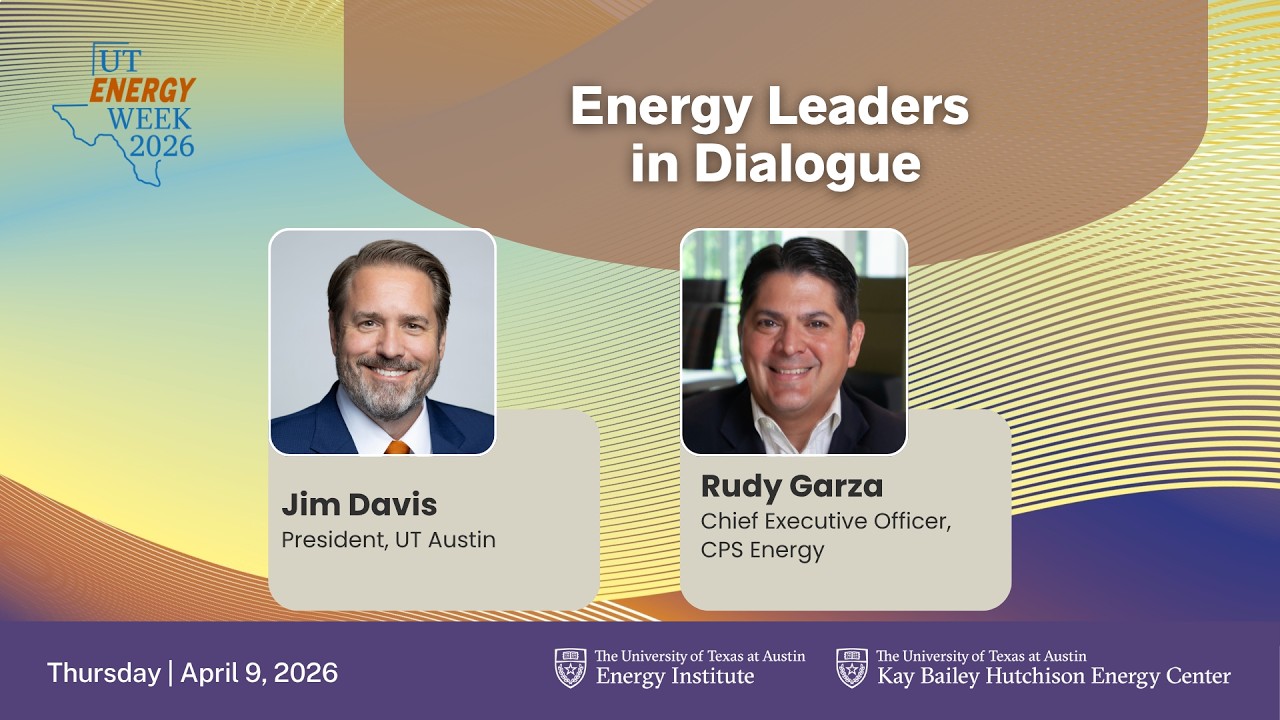
UT Energy Week 2026: Energy Leaders in Dialogue
Keywords
Summary
150 words
Critical Evaluation
Value of the Information & Strength of the Argument
The value of the information lies in the direct insights from a major utility CEO on the practical challenges of energy transition, including specific figures on load growth and infrastructure needs. Garza’s argumentation is coherent, grounded in his professional experience, and acknowledges trade-offs (e.g., the need for both renewables and gas). He provides a realistic perspective on the scale of investment and the importance of diversification. However, the discussion is largely opinion-based and lacks detailed technical analysis or citations, which limits its depth.
Scientific Rigor, Source Quality, Title Accuracy
The discussion is based on the speaker’s professional expertise rather than formal sources. No specific studies or reports are cited, though the speaker references CPS Energy’s strategic plans available online. The title accurately reflects the content, and the dialogue format is appropriate for the subject. The absence of external references reduces the scientific rigor, but the speaker’s authority lends credibility. No comments were provided for analysis.
164 words
Title / Content Match
The title accurately reflects the content: a dialogue between two energy leaders during UT Energy Week.
Quality & Reliability
7/10
The discussion features an experienced utility CEO providing informed perspectives on energy challenges and strategies. While not peer-reviewed, the content is grounded in professional expertise and specific data (e.g., ERCOT peak load, transmission voltage).
Key Moments
Markers derived by PSI from the transcript: the creator did not define chapters.
- Introduction of Rudy Garza and his background.
- Discussion of CPS Energy's mission and Vision 2027.
- Outlook for Texas energy industry, ERCOT challenges.
- Need for generation and transmission expansion, 765 kV system.
- Investment areas: renewables, storage, gas, nuclear, SMRs.
- Role of universities and AI in workforce transformation.
- Skills sought in new employees: communication and learning ability.
- Career advice: taking risks and embracing diverse roles.
- Advice for students: value of learning and work experience.
- Q&A: LCRA relationship and demand-side flexibility.
Cited Sources
- CPS Energy Strategic Plans — Mentioned by Rudy Garza as a resource for their strategic plans.
Concurring Sources
- ERCOT — The grid operator mentioned in the discussion, relevant to load growth and reliability.
Contribution & Novelties
The video provides a candid, high-level perspective from a utility CEO on the practical challenges of energy transition in Texas, including specific load growth projections and infrastructure needs. It offers insights into the strategic thinking of a major municipal utility and the importance of workforce development and AI integration.
Pour aller plus loin :
- ERCOT — The Texas grid operator, central to the discussion on load growth and reliability.
- Small Modular Reactors (SMRs) — Garza highlights SMRs as a future technology; IAEA provides authoritative information.
- 765 kV Transmission — The proposed higher voltage transmission system in Texas; Wikipedia offers background on such systems.
103 words
Radar Profile
The radar profile shows high scores in information quantity and reliability, reflecting the speaker's expertise and specific data. The moderate technical level indicates accessibility to a general audience, while the lower score in information quality suggests a lack of formal citations and depth.