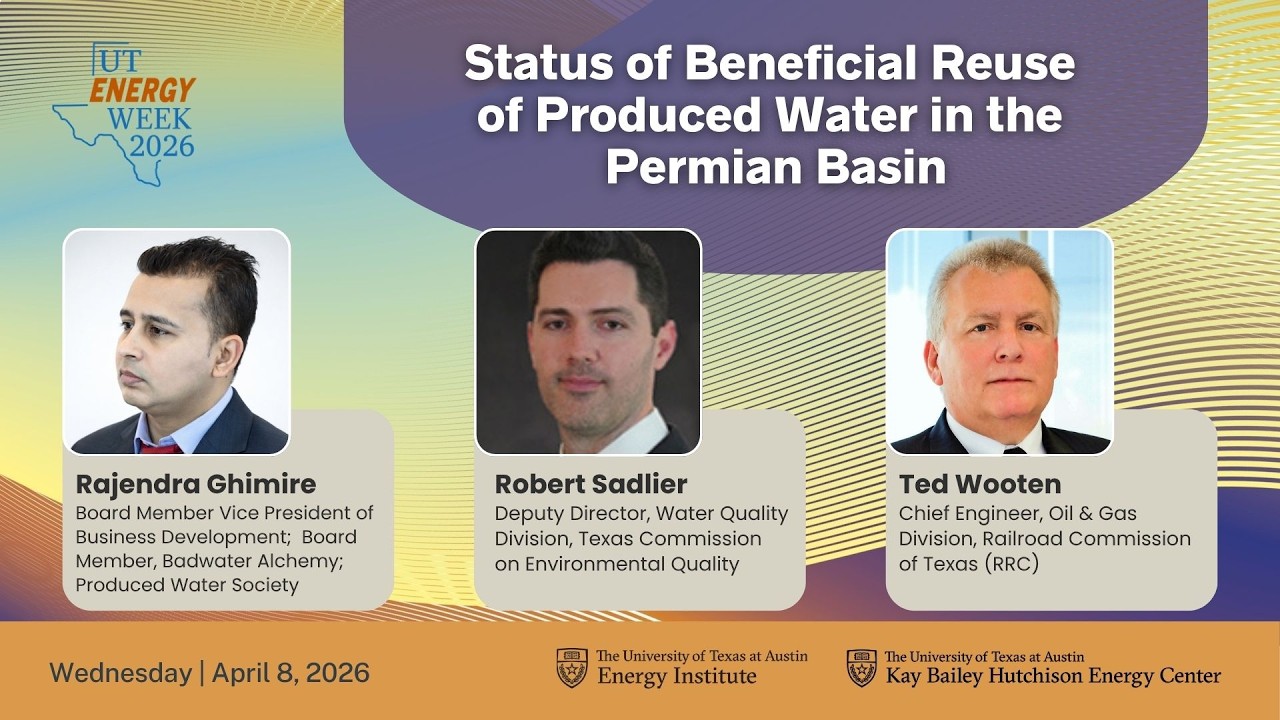
UT Energy Week 2026: Status of Beneficial Reuse of Produced Water in the Permian Basin
Keywords
Summary
206 words
Critical Evaluation
Value of the Information & Strength of the Argument
The panel provides valuable insights into the regulatory landscape and practical challenges of produced water management. The argumentation is grounded in the speakers’ direct experience, with Terry Wooden offering candid assessments of data limitations and the need for a paradigm shift in thinking about water production. Robert provides concrete details on TCEQ’s permitting process and the scientific considerations involved. The discussion is balanced, acknowledging both the necessity of reinjection and the potential for beneficial reuse, while cautioning against overestimating the impact of recycling on reducing disposal volumes. The moderator adds context on the scale of the problem and potential future applications, but the panel does not delve deeply into technical solutions or economic analyses.
Scientific Rigor, Source Quality, Title Accuracy
The panel is scientifically rigorous in its reliance on regulatory expertise and practical knowledge, but it does not cite specific studies or data sources. The speakers acknowledge data gaps and the need for better fidelity, which adds credibility. The title accurately reflects the content, focusing on the status of beneficial reuse. The discussion is well-structured and stays on topic, though it could benefit from more quantitative data and references to external research. No comments were provided for analysis.
207 words
Title / Content Match
The title accurately reflects the content: a panel discussion on the status of beneficial reuse of produced water in the Permian Basin, with regulatory perspectives.
Quality & Reliability
7/10
Panel with regulators from Railroad Commission of Texas and TCEQ, providing authoritative insights into regulatory frameworks and current practices. Data is presented with caveats about data fidelity, and no external sources are cited. The discussion is grounded in practical experience and regulatory knowledge, but lacks quantitative rigor and peer-reviewed references.
Key Moments
Markers derived by PSI from the transcript: the creator did not define chapters.
- Introduction: moderator Raj sets the context, highlighting the scale of produced water in the Permian (24+ million barrels/day) and the need for beneficial reuse.
- Terry Wooden (RRC) discusses the regulatory perspective, emphasizing that reinjection remains the primary method due to cost and proximity, and mentions the need for responsible management.
- Robert (TCEQ) explains TCEQ's role in permitting produced water discharges, noting the transfer of authority from RRC and the recent legislative changes.
- Discussion on data gaps: Terry estimates 20 million barrels/day of new water injected, and highlights the lack of reporting on reuse percentages.
- Moderator notes that operators aim to reduce disposal volumes by 50% in 3-5 years, and discusses the cost implications.
- Robert details the eight pending discharge permit applications in West Texas, all from midstream companies, and the one land application permit.
- Discussion on water quality standards: case-by-case determination, constituents like TDS, and the challenge of 'too fresh' water.
- Terry discusses regulatory changes and the need for a paradigm shift: minimizing water production and maximizing oil recovery.
- Closing remarks: emphasis on collaboration and the need for better data to inform regulatory decisions.
Contribution & Novelties
The panel provides a current snapshot of the regulatory and practical status of produced water beneficial reuse in the Permian Basin, offering insights from two key state agencies. It highlights the tension between the need for reinjection and the potential for reuse, and underscores the importance of data quality. The discussion is particularly valuable for its candid assessment of the limitations of current recycling efforts and the regulatory challenges ahead.
Pour aller plus loin :
- Texas Produced Water Consortium — Official state initiative to study and promote beneficial reuse of produced water.
- Railroad Commission of Texas - Produced Water — Regulatory information on produced water management and disposal.
- TCEQ - Produced Water — TCEQ’s page on produced water permitting and regulations.
- Enhanced Oil Recovery — Background on EOR methods that can reduce water production.
- Direct Air Capture — Potential use of produced water in DAC processes.
146 words
Radar Profile
The radar profile shows relatively balanced scores across all dimensions, with slightly lower technical depth and source rigor, reflecting the panel's focus on regulatory and practical aspects rather than detailed technical or scientific analysis. The high scores in information quantity and quality indicate a substantive discussion, while the moderate technical level suggests accessibility to a broad audience.