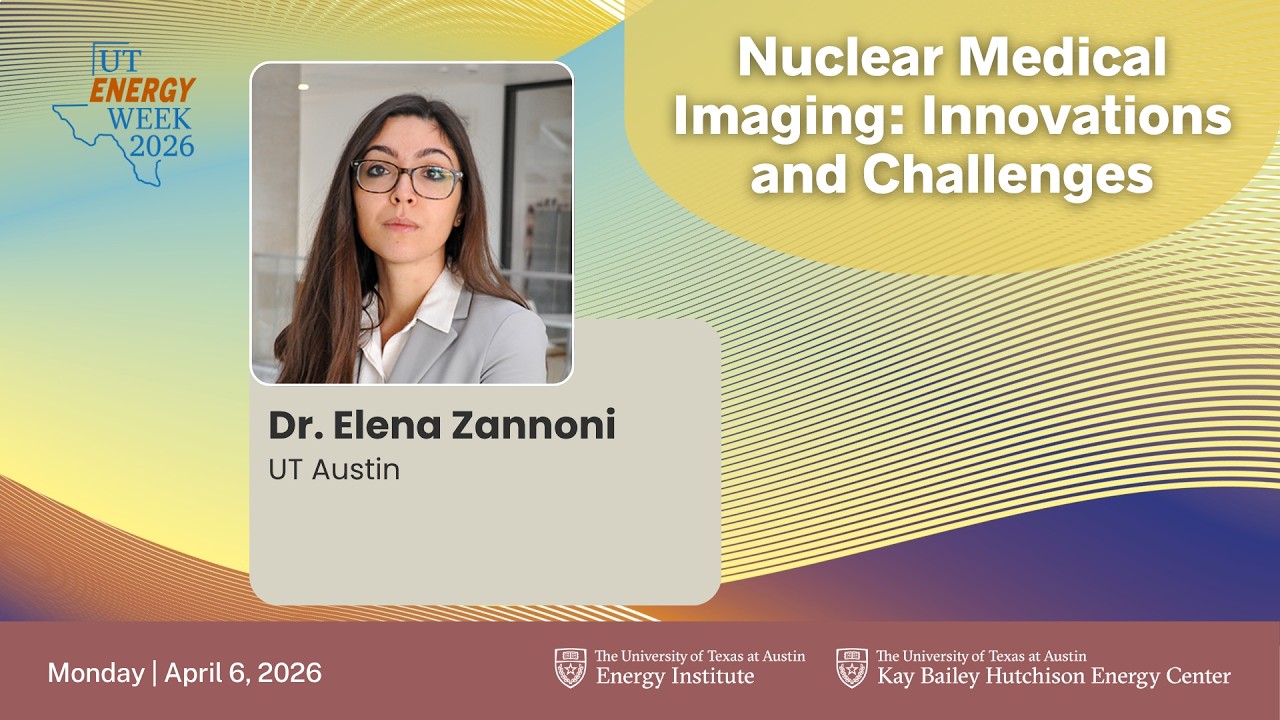
UT Energy Week 2026: Nuclear Medical Imaging-- Innovations and Challenges
Keywords
Summary
142 words
Critical Evaluation
Value of the Information & Strength of the Argument
The talk provides valuable insights into current research directions in nuclear medical imaging, particularly the development of new instrumentation for alpha-emitting radiotheranostics and adaptive imaging systems. The argumentation is based on the speaker’s direct involvement in these projects, lending credibility. However, the presentation is primarily descriptive, with limited critical analysis or comparison to alternative approaches. The Q&A segment briefly addresses a technical question but does not deeply explore the trade-offs.
Scientific Rigor, Source Quality, Title Accuracy
The speaker is a domain expert, and the content aligns with her research. However, no specific sources are cited within the talk, and the only link in the description is to the UT Energy Week program, which does not provide detailed references. The title accurately reflects the content. The talk is more of an expert opinion and project overview than a rigorous scientific review.
149 words
Title / Content Match
The title accurately reflects the content, focusing on innovations and challenges in nuclear medical imaging.
Quality & Reliability
7/10
The speaker is a professor with direct research involvement, providing credible expert opinion. However, the talk is a high-level overview with limited technical depth and no detailed citations, reducing the score.
Key Moments
Markers derived by PSI from the transcript: the creator did not define chapters.
- Introduction to nuclear medical imaging and its role in diagnostics.
- Explanation of structural vs. functional imaging (CT vs. SPECT).
- Introduction to radiotheranostics and the concept of 'see what you treat, treat what you see'.
- Statistics on nuclear medicine procedures and growth in clinical trials.
- Presentation of Alpha Spect system for alpha-emitting radiotheranostics.
- Discussion of adaptive imaging using robotics for flexible and portable imaging.
- Introduction to multimodal imaging capsule for minimally invasive surgery.
- Q&A about collimation and mechanical movement.
Cited Sources
- UT Energy Week 2026 Program — Official program page for the event where this talk was given.
Concurring Sources
- Society of Nuclear Medicine and Molecular Imaging — Professional society mentioned by the speaker as a funding source and relevant to the field.
Contribution & Novelties
The talk presents ongoing research at UT Austin on novel nuclear imaging technologies, including Alpha Spect and adaptive imaging systems. The original contribution lies in the development of instrumentation for alpha-emitting radiotheranostics and the integration of robotics for flexible imaging.
Pour aller plus loin :
- Radiotheranostics — Overview of theranostics combining therapy and diagnostics.
- SPECT imaging — Explanation of SPECT technology.
- Alpha particle therapy — Details on alpha-emitting radionuclides in therapy.
71 words
Radar Profile
The radar profile shows balanced scores across information quantity, quality, technical level, and reliability, with a slight emphasis on quantity and quality. This indicates a well-rounded presentation with solid content, though not extremely technical or highly cited.