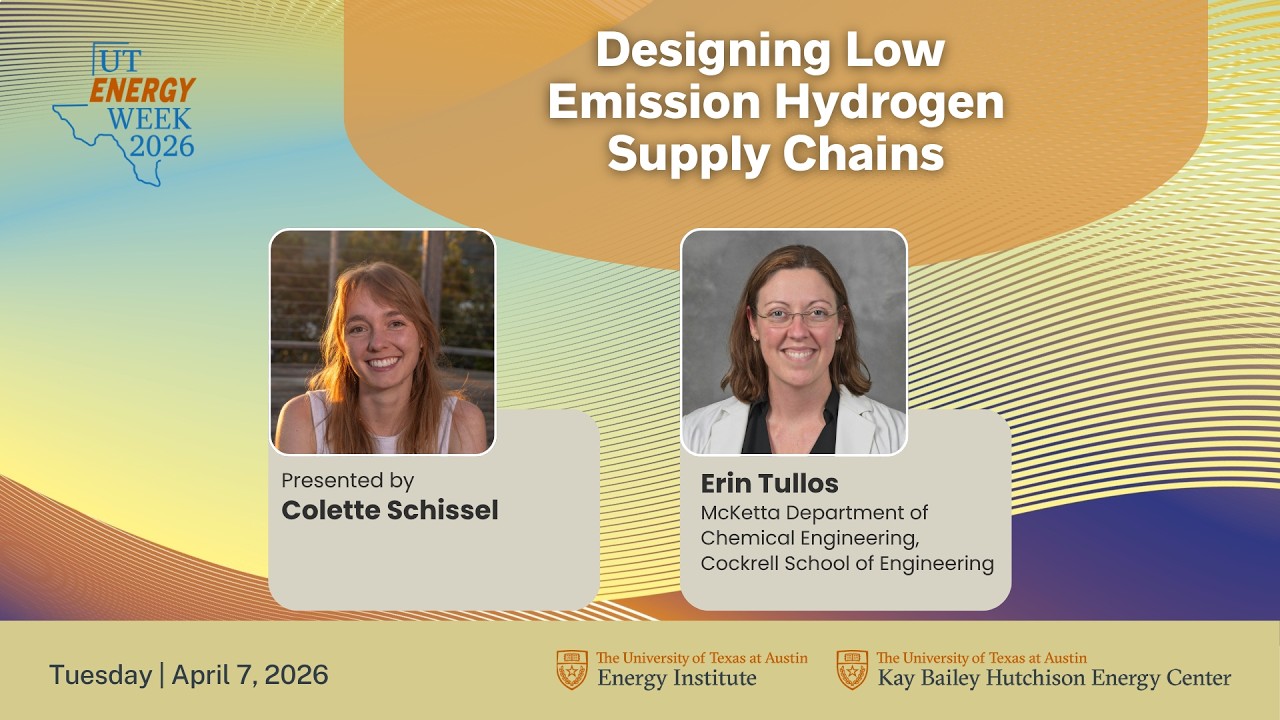
UT Energy Week 2026: Designing Low Emission Hydrogen Supply Chains
Keywords
Summary
164 words
Critical Evaluation
Value of the Information & Strength of the Argument
The presentation provides valuable insights into a relatively understudied aspect of hydrogen’s climate impact: emissions from production. The speaker effectively argues that the climate benefit of hydrogen is highly dependent on loss rates, and that current estimates may be incomplete due to a lack of measurement data. The argumentation is logical and builds on prior methane research, which strengthens the credibility. However, the talk is a high-level overview with limited quantitative detail, and the results are based on a single case study, which may limit generalizability. The speaker acknowledges uncertainties and the need for further research, which is commendable.
Scientific Rigor, Source Quality, Title Accuracy
The speaker is a research scientist with relevant expertise, and the work is informed by a decade of methane research, lending scientific rigor. However, no specific sources are cited during the talk, and the only link in the description is to the conference program, which does not provide direct references. The title accurately reflects the content, focusing on designing low-emission hydrogen supply chains. The presentation is a conference talk, so it lacks the depth of a peer-reviewed publication, but it provides a useful overview of ongoing research.
201 words
Title / Content Match
The title accurately reflects the content, which focuses on designing low-emission hydrogen supply chains through emission estimation and mitigation.
Quality & Reliability
7/10
Presentation by a research scientist with relevant expertise, based on a case study and informed by prior methane research. However, it is a conference talk with limited detail, no peer-reviewed references cited, and the results are preliminary and not yet published.
Key Moments
Markers derived by PSI from the transcript: the creator did not define chapters.
- Introduction and background on hydrogen as a clean energy carrier and the importance of loss rates.
- Explanation of hydrogen as an indirect greenhouse gas and the 7% leak rate threshold.
- Overview of the research goal: estimating hydrogen emissions from SMR facilities.
- Lessons learned from methane research: categorizing emissions as routine vs. unintended.
- Methodology for estimating routine and unintended emissions, including expert consultations.
- Discussion of post-release scenarios: ignition, shutdown, and undetected emissions.
- Results for a large commercial SMR facility: vent stream handling and safety monitoring.
- Highlighting scenarios exceeding the 7% loss rate and the role of safety systems.
- Need for more measurements and development of ppb-level hydrogen sensors.
- Q&A: monitoring technologies, GWP estimates, and comparison with methane detection.
Cited Sources
- UT Energy Week 2026 Program — Conference program where the presentation was given.
Concurring Sources
- UT Energy Week 2026 Program — Conference program confirming the presentation's context.
Contribution & Novelties
This presentation contributes to the emerging field of hydrogen emissions accounting by applying lessons from methane research to SMR facilities. It highlights the importance of considering unintended emissions and the role of safety systems in constraining them. The work is preliminary but provides a framework for future measurement-informed inventories.
Pour aller plus loin :
- Hydrogen’s indirect greenhouse gas effect — Background on hydrogen’s properties and climate interactions.
- Steam methane reforming — Overview of the SMR process.
- Methane emissions from oil and gas — Context on methane research that informs this work.
91 words
Radar Profile
The radar profile shows a balanced presentation with moderate scores across all dimensions. The highest scores are in quality of information and reliability, reflecting the speaker's expertise and the logical argumentation. The lower score in quantity of information is due to the short duration and limited detail, while the technical level is moderate, accessible to a general audience.