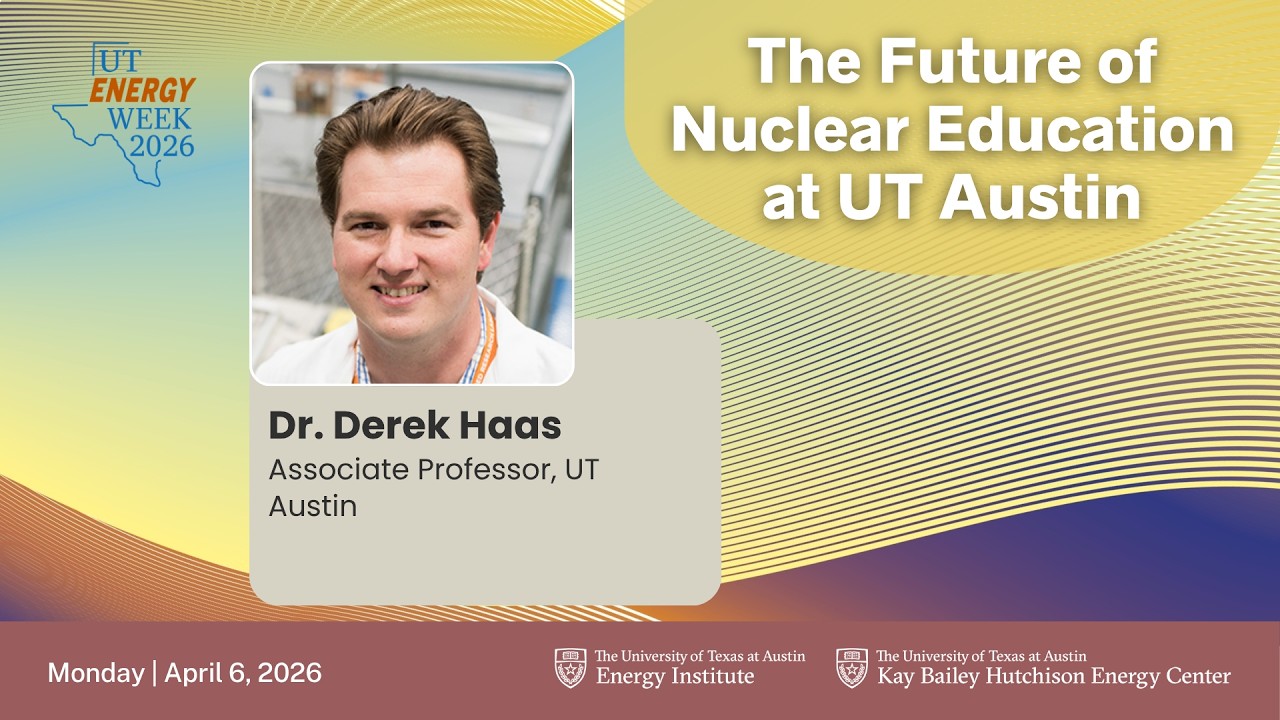
UT Energy Week 2026: The Future of Nuclear Education at UT Austin
Keywords
Summary
143 words
Critical Evaluation
Value of the Information & Strength of the Argument
The talk provides valuable insights into the current state and future plans of nuclear education at UT Austin, including specific program details and industry partnerships. The argumentation is coherent, supported by concrete examples like the MSR-1 project and policy reports. However, it is primarily descriptive and promotional, lacking critical evaluation of challenges or potential drawbacks. The speaker’s expertise adds credibility, but the presentation is more of an update than a rigorous analysis.
Scientific Rigor, Source Quality, Title Accuracy
The speaker references specific reports and collaborations, but no external sources are cited in the talk. The description includes a link to the Energy Week program, which may contain additional references. The title accurately reflects the content. The talk is based on the speaker’s direct involvement, which is a strength, but it lacks independent verification. No comments were provided for analysis.
148 words
Title / Content Match
The title accurately reflects the content, which focuses on the future of nuclear education at UT Austin.
Quality & Reliability
7/10
The speaker is a domain expert (faculty in nuclear engineering) and provides specific program details, but the talk is largely descriptive and promotional, with limited critical analysis or external validation.
Key Moments
Markers derived by PSI from the transcript: the creator did not define chapters.
- Introduction and acknowledgments
- Discussion of energy demand driven by AI and data centers
- Overview of UT Austin nuclear program: faculty, students, funding
- Student research experience and national lab collaborations
- Partnership with Natura Resources on MSR-1
- Involvement in state nuclear policy and workforce reports
- New nuclear engineering minor and law course
- Multidisciplinary approach and student demand
- Q&A: interactions with startups and synergies with other Texas programs
Cited Sources
- UT Energy Week 2026 Program — Official program page for the event, providing context for the talk.
Concurring Sources
- UT Energy Week 2026 Program — Official event page, consistent with the talk's content.
Contribution & Novelties
The talk provides an insider perspective on the evolution of nuclear education at UT Austin, highlighting innovative initiatives like the nuclear minor and law course. It underscores the importance of multidisciplinary training and industry partnerships.
Pour aller plus loin :
- Nuclear engineering — Background on the field.
- Molten salt reactor — Relevant to the MSR-1 project.
- Nuclear workforce development — DOE resource on workforce needs.
65 words
Radar Profile
The radar profile shows balanced scores across information quantity, quality, technical level, and reliability, with a slight emphasis on quantity and reliability. This suggests a well-rounded but not deeply technical presentation, suitable for a general audience interested in nuclear education.