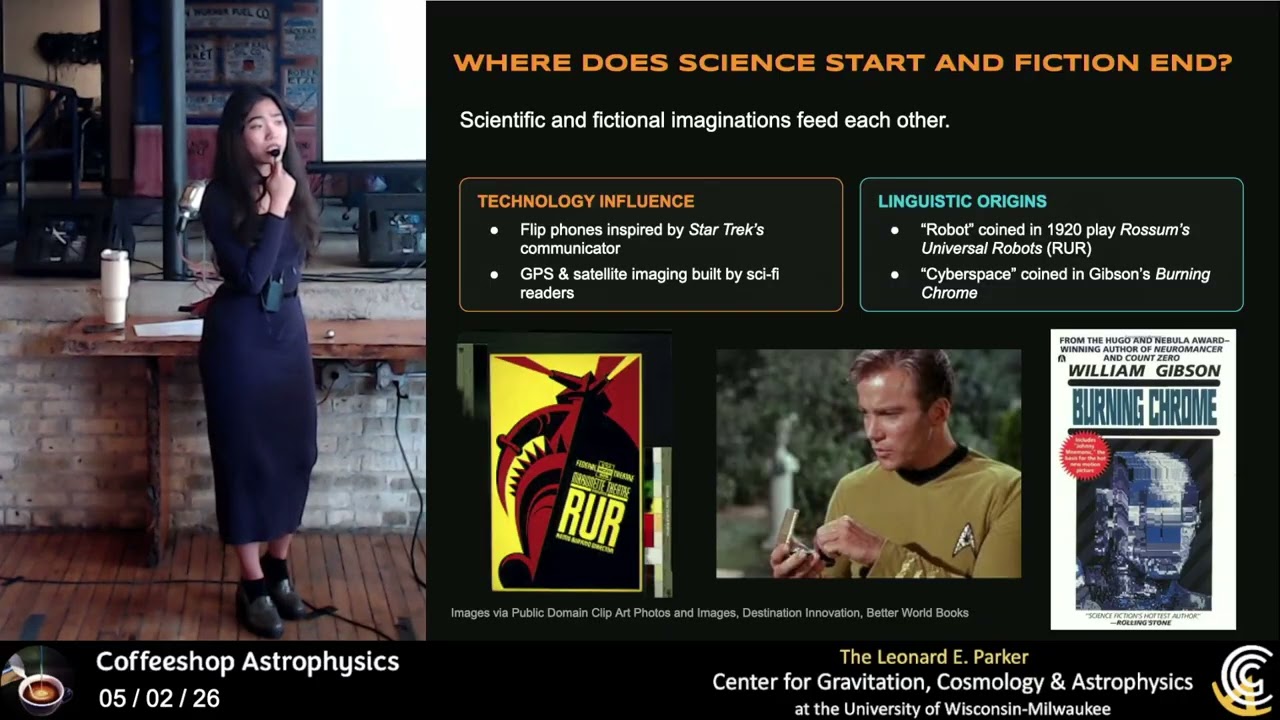
Fiction as a Science Lab - May 2, 2026
Keywords
Summary
211 words
Critical Evaluation
Value of the Information & Strength of the Argument
The talk provides valuable insights into the intersection of science and fiction, particularly the detailed explanation of Fermat’s principle and its implications for understanding time and causality. The argumentation is solid, as the speakers connect the physics concepts to the narrative structure and themes of the stories, demonstrating how Chiang’s work is grounded in real scientific ideas. The discussion of linguistic relativity and the Sapir-Whorf hypothesis is well-presented, though the speakers acknowledge the contested nature of the strong form. The talk effectively argues that science fiction can serve as a ‘science lab’ by testing ideas and exposing hidden assumptions. However, the argumentation is somewhat informal and could benefit from more rigorous citations and a clearer structure in places.
Scientific Rigor, Source Quality, Title Accuracy
The talk demonstrates scientific rigor in its accurate presentation of Fermat’s principle and the variational formulation of physics. The speakers correctly explain the concept of least time and its connection to Snell’s law, and they appropriately use the lifeguard analogy to illustrate the principle. The literary analysis is also rigorous, with references to Darko Suvin’s definition of science fiction and the Sapir-Whorf hypothesis. However, the talk lacks formal citations; the speakers mention authors and works but do not provide specific references or sources. The title ‘Fiction as a Science Lab’ is well-matched to the content, as the talk consistently explores how fiction can function as a laboratory for scientific and philosophical experimentation. The adéquation is strong, and the title does not mislead.
255 words
Title / Content Match
The title accurately reflects the content: the talk explores how science fiction functions as a laboratory for scientific and philosophical ideas.
Quality & Reliability
7/10
The talk is an informed expert discussion by a literature graduate student and physics graduate students/postdocs, providing accurate scientific concepts (Fermat's principle, variational formulation) and literary analysis. However, it is a public lecture with informal tone and no formal citations, limiting verifiability.
Chapters
Cited Sources
- Story of Your Life (short story) — Discussed as the first main text, focusing on time and cognition.
- Exhalation (short story) — Discussed as the second main text, focusing on self-witness and alternative archives.
- Project Hail Mary (novel) — Mentioned as the third main text, though not elaborated in detail.
- Arrival (film) — Referenced as the film adaptation of 'Story of Your Life'.
- The Martian (novel/film) — Mentioned as Andy Weir's previous work.
Concurring Sources
- Fermat's principle — Supports the explanation of the principle of least time and its application in optics.
- Linguistic relativity — Provides background on the Sapir-Whorf hypothesis, which is central to the analysis of 'Story of Your Life'.
Contribution & Novelties
The talk offers a novel interdisciplinary perspective by explicitly linking Fermat’s principle of least time to the narrative structure and linguistic invention in Ted Chiang’s ‘Story of Your Life’. It highlights how the variational formulation of physics, which is often counterintuitive, can be used to imagine alien cognition and language, thus providing a concrete example of how science fiction can ‘run experiments’ on scientific ideas. The discussion of ‘Exhalation’ as a scientific log that serves as an alternative archive is also an original contribution, connecting the story’s form to philosophical questions about self-knowledge and memory.
Pour aller plus loin :
- Fermat’s principle — Provides background on the principle of least time and its historical context.
- Sapir-Whorf hypothesis — Explains the linguistic relativity hypothesis, central to the talk’s discussion.
- Variational principle — Offers an overview of variational methods in physics, including the principle of least action.
- Ted Chiang — Biographical and bibliographic information on the author discussed.
156 words
Radar Profile
The radar profile shows a balanced performance across all dimensions, with slightly higher scores in quality of information and reliability, reflecting the accurate scientific content and expert speakers. The lower score in quantity of information suggests the talk could have delved deeper into some topics, but overall it is a well-rounded presentation.