Nebulae: From Cradle to Grave, and Cradle Again - Oct. 25, 2025
Keywords
Summary
159 words
Critical Evaluation
Value of the Information & Strength of the Argument
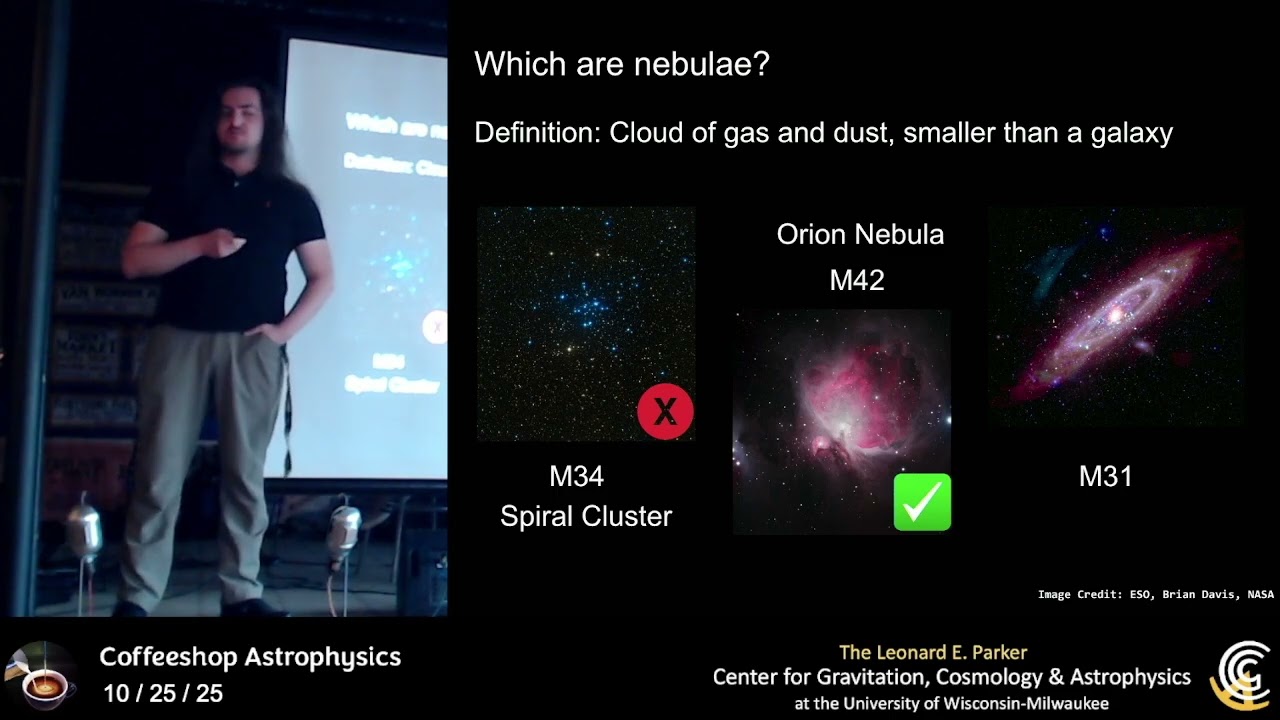
The talk provides a solid introduction to nebulae, effectively combining historical context, physical principles, and observational examples. The argumentation is clear and logical, building from basic definitions to more complex processes. The speakers use analogies (e.g., cloud vs. hurricane) and visual aids to enhance understanding. The scientific content is accurate and up-to-date, with references to well-known objects and catalogs. The presentation is engaging and well-paced, making it valuable for those seeking a foundational understanding of nebulae and star formation.
Scientific Rigor, Source Quality, Title Accuracy
The scientific rigor is high, with the speakers correctly explaining concepts such as scattering, ionization, and the classification of nebulae. They reference historical figures and catalogs (e.g., Messier, NGC) and modern observations (e.g., Barnard’s catalog). The title accurately reflects the content, which covers the full life cycle of nebulae. The talk is well-structured and the sources cited are appropriate for the level of the presentation. No external sources are explicitly cited, but the content aligns with established astrophysical knowledge.
173 words
Title / Content Match
The title accurately reflects the content, which covers the life cycle of nebulae from star formation to stellar death and rebirth.
Quality & Reliability
8/10
The talk is presented by physics graduate students and postdocs from the Leonard E. Parker Center for Gravitation, Cosmology and Astrophysics at the University of Wisconsin-Milwaukee. The content is scientifically accurate, well-structured, and based on established astronomical knowledge. The speakers demonstrate expertise and provide clear explanations. Minor simplifications are appropriate for a public talk.
Chapters
Contribution & Novelties
The talk offers a comprehensive and accessible overview of nebulae, synthesizing historical, physical, and observational aspects. It effectively explains the role of nebulae in star formation and death, providing a clear narrative of the stellar life cycle. The use of analogies and visual examples enhances comprehension for a general audience.
Pour aller plus loin :
- Nebula (Wikipedia) — Provides a broad overview of nebulae, their types, and examples.
- H II region (Wikipedia) — Details on emission nebulae and their role in star formation.
- Star formation (Wikipedia) — Explains the process of star birth in molecular clouds.
- Supernova (Wikipedia) — Discusses the explosive death of massive stars and the creation of supernova remnants.
112 words
Radar Profile
The radar profile shows high scores in information quantity and quality, with a moderate technical level. This indicates a well-balanced presentation that is informative and accurate, but not overly technical, making it suitable for a general audience. The reliability is also high, reflecting the speakers' expertise.