The View from Above - September 27, 2025
Keywords
Summary
172 words
Critical Evaluation
Value of the Information & Strength of the Argument
The talk provides a valuable overview of satellite-based Earth observation, covering a wide range of applications and connecting them to fundamental Earth system processes. The argumentation is generally sound, with clear explanations of how satellite data are used to study weather, climate, water, biosphere, and geology. The speakers effectively use examples like Hurricane Milton, the GRACE satellites, and phytoplankton blooms to illustrate concepts. However, the presentation is somewhat superficial, lacking quantitative details and specific data references. The argumentation would be stronger with more concrete evidence and citations to scientific studies.
Scientific Rigor, Source Quality, Title Accuracy
The scientific rigor is moderate. The talk presents accurate general information but does not cite specific peer-reviewed sources or provide detailed references. The quality of sources is limited to general knowledge and NASA missions mentioned in passing. The title accurately reflects the content, which is a broad survey of Earth observation from satellites. The presentation is well-organized and the information is presented in a clear, engaging manner, but the lack of citations reduces its scientific credibility.
181 words
Title / Content Match
The title accurately reflects the content, which focuses on observing Earth from satellites.
Quality & Reliability
7/10
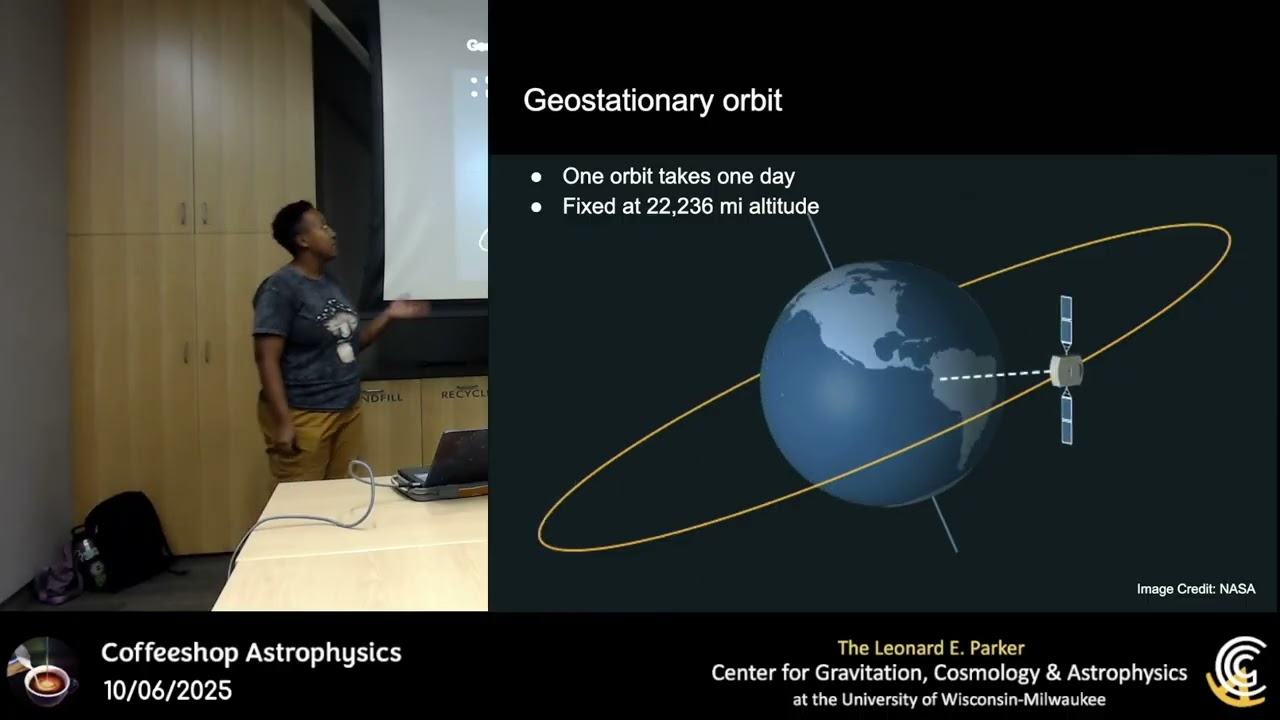
The talk provides a broad overview of satellite-based Earth observation, covering historical milestones, orbital mechanics, and applications in atmospheric science, hydrology, biosphere monitoring, and geology. The content is generally accurate and well-structured, but it lacks in-depth technical detail and does not cite specific peer-reviewed sources. The presentation is informal and aimed at a general audience, which limits its scientific rigor.
Chapters
Contribution & Novelties
The talk provides a comprehensive and accessible overview of satellite-based Earth observation, synthesizing information from various domains into a coherent narrative. It highlights the interconnectedness of Earth systems and the importance of data assimilation. The presentation is original in its structure and approach, making complex topics understandable to a general audience.
Pour aller plus loin :
- NASA Earth Observatory — Official NASA resource with satellite imagery and articles on Earth science.
- GRACE mission — NASA page on the GRACE satellites, which measure Earth’s gravity field.
- Phytoplankton — Wikipedia article on phytoplankton, the base of the marine food chain.
- Van Allen radiation belts — Wikipedia article on the radiation belts discovered by Explorer 1.
113 words
Radar Profile
The radar profile shows a balanced performance across all dimensions, with slightly lower scores in technical depth and source rigor, reflecting the introductory nature of the talk. The talk is strong in providing a broad overview and engaging the audience, but it lacks the detailed technical and citation depth expected in a more advanced scientific presentation.