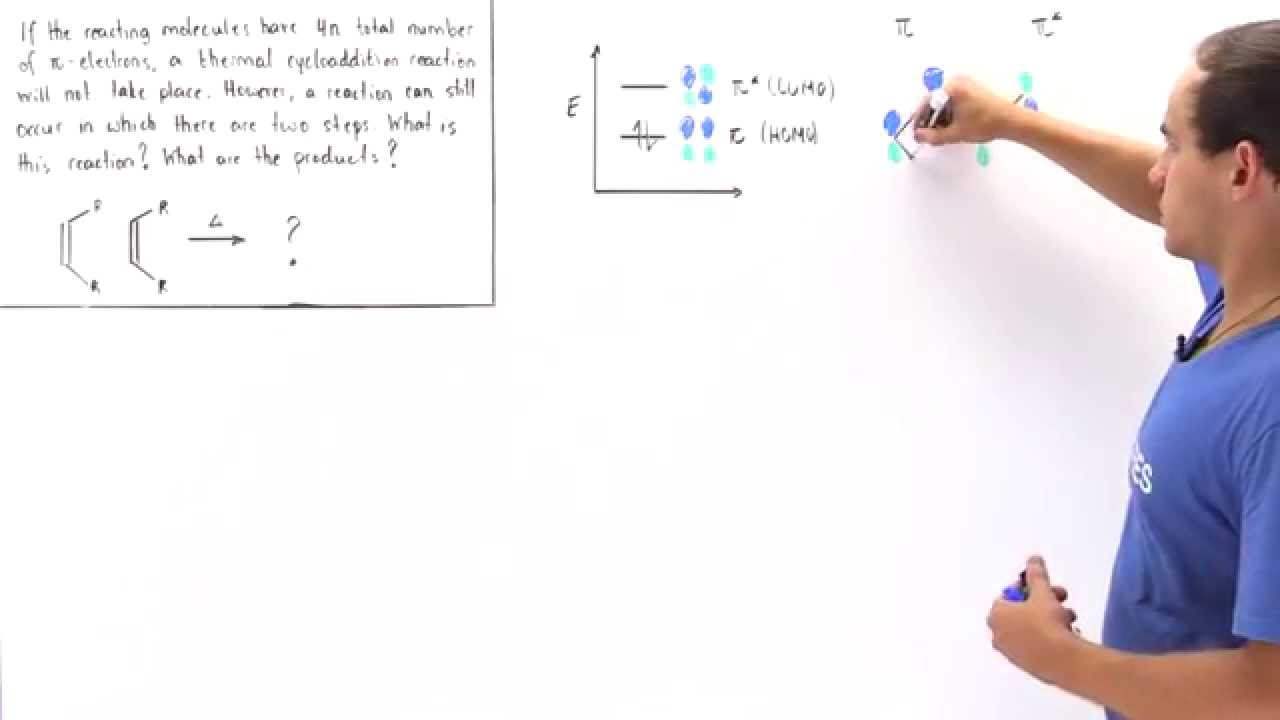
Thermal (2+2) Non-Cycloaddition Example
Keywords
Summary
116 words
Critical Evaluation
Value of the Information & Strength of the Argument
The video provides a solid educational value by clearly explaining a complex concept in pericyclic reactions. The argumentation is logical and well-structured, building from the basic principle of 4N pi electrons to the specific example of ethene dimerization. The use of orbital diagrams and step-by-step rotation illustrations effectively conveys the mechanism. However, the video does not address potential exceptions or the broader context of the Woodward-Hoffmann rules, which could enhance its depth.
Scientific Rigor, Source Quality, Title Accuracy
The scientific rigor is adequate for an introductory tutorial. The content aligns with established principles of frontier molecular orbital theory and the Woodward-Hoffmann rules. However, the video does not cite any external sources or references, relying solely on the instructor’s explanation. The title accurately describes the content, focusing on a specific example of a thermal 2+2 non-cycloaddition. No comments were provided for analysis.
150 words
Title / Content Match
The title accurately reflects the content, which focuses on a thermal 2+2 non-cycloaddition example.
Quality & Reliability
7/10
The video provides a clear, step-by-step explanation of a thermal 2+2 reaction mechanism, correctly applying frontier molecular orbital theory and Woodward-Hoffmann rules. The content is accurate but lacks citations to primary literature and does not discuss exceptions or nuances.
Key Moments
Markers derived by PSI from the transcript: the creator did not define chapters.
- Introduction to the rule: thermal cycloaddition requires 4N+2 pi electrons; with 4N pi electrons, a photochemical reaction occurs.
- Explanation that under thermal conditions, a stepwise reaction occurs instead of a concerted cycloaddition.
- Setting up the example: two ethene molecules with four pi electrons (N=1).
- Identification of HOMO and LUMO for ethene under thermal conditions.
- First step: HOMO of one molecule interacts with LUMO of the other, forming one sigma bond and a diradical intermediate.
- Second step: rotation of the diradical to allow the second bond formation, completing the cyclobutane ring.
- Discussion of stereochemistry: the diradical intermediate allows rotation, leading to four possible stereoisomers.
- Comparison with photochemical cycloaddition, which is concerted and yields only two stereoisomers.
Cited Sources
- AK Lectures - Thermal 2+2 Non-Cycloaddition Example — The video's dedicated lecture page on the AK Lectures website.
- AK Lectures — The main website of the channel, providing additional educational content.
Concurring Sources
- Woodward-Hoffmann rules — The rules predict that thermal 2+2 cycloadditions are forbidden, consistent with the video's explanation.
External References
Contribution & Novelties
The video offers a clear pedagogical explanation of a thermal 2+2 non-cycloaddition, emphasizing the stepwise diradical mechanism and its stereochemical consequences. It effectively contrasts this with the photochemical pathway, highlighting the role of orbital symmetry. The explanation is accessible and well-illustrated, making it a useful resource for students.
Pour aller plus loin :
- Woodward-Hoffmann rules — The foundational rules governing pericyclic reactions, including cycloadditions.
- Frontier molecular orbital theory — The theory used to predict reactivity based on HOMO-LUMO interactions.
- Diradical — A molecule with two unpaired electrons, central to the stepwise mechanism discussed.
93 words
Radar Profile
The radar profile shows high scores in information quality and technical level, with slightly lower scores in quantity and reliability. This indicates a focused, technically sound tutorial that could benefit from more comprehensive coverage and citations.