Gravitational Potential Energy
Keywords
Summary
148 words
Critical Evaluation
Value of the Information & Strength of the Argument
The video provides a solid introduction to gravitational potential energy, with a logical progression from definition to derivation to application. The argumentation is sound, using the work-energy theorem to derive the GPE formula and then applying energy conservation to solve a practical problem. The explanation is clear and the mathematical steps are well-documented, making it easy for viewers to follow. However, the video does not delve into more advanced aspects such as the general form of GPE for varying gravitational fields or the limitations of the approximation. The value lies in its pedagogical clarity and the worked example, which reinforces understanding.
Scientific Rigor, Source Quality, Title Accuracy
The scientific rigor is adequate for an introductory tutorial. The formulas and concepts are standard and correctly applied. However, the video does not cite any external sources, relying solely on the presenter’s explanation. The title accurately reflects the content, and the video stays on topic. The lack of citations is a minor weakness, but the content is consistent with established physics. The video’s quality is good for its intended purpose, though it could benefit from referencing textbooks or academic sources for further study.
199 words
Title / Content Match
The title accurately reflects the content, which focuses exclusively on gravitational potential energy.
Quality & Reliability
7/10
The video presents a clear and accurate derivation of gravitational potential energy, using standard physics formulas and a worked example. The content is consistent with established physics principles, but it lacks citations to external sources and does not address potential limitations or alternative perspectives.
Key Moments
Markers derived by PSI from the transcript: the creator did not define chapters.
- Introduction to gravitational potential energy and comparison with kinetic energy.
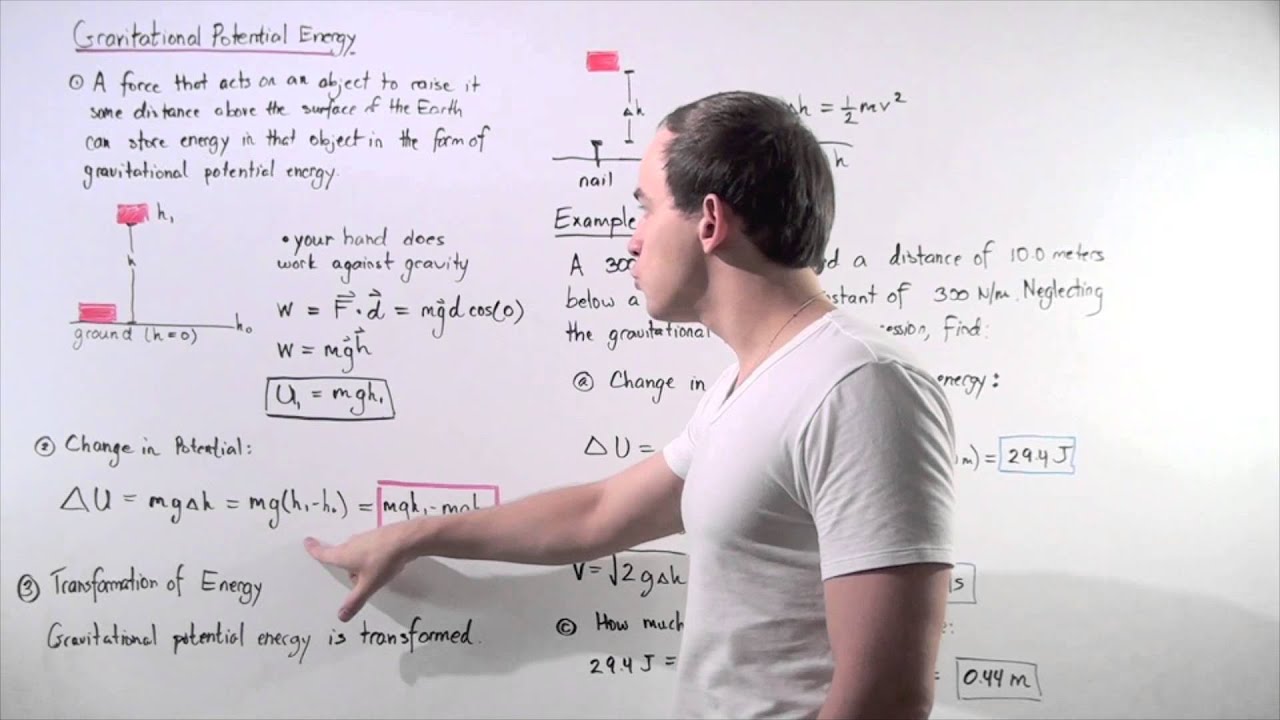
- Derivation of the work done by a constant force and the formula for gravitational potential energy.
- Explanation of change in gravitational potential energy and its dependence on height.
- Example of energy transformation: falling object converting GPE to kinetic energy.
- Worked example: box falling onto a spring, calculating GPE change, velocity, and spring compression.
Cited Sources
- AK Lectures - Gravitational Potential Energy — The video is hosted on this site and provides additional resources.
- AK Lectures — General website for the channel's educational content.
Concurring Sources
- Khan Academy - Gravitational potential energy — Similar educational content explaining GPE.
External References
Contribution & Novelties
The video provides a clear and concise tutorial on gravitational potential energy, suitable for beginners. Its main contribution is the step-by-step derivation and the worked example that ties together GPE, kinetic energy, and spring potential energy. While it does not introduce novel concepts, it effectively explains fundamental principles.
Pour aller plus loin :
- Work-energy theorem — Directly related to the derivation of GPE.
- Potential energy — General concept of potential energy, including gravitational.
- Conservation of energy — Fundamental principle used in the example.
83 words
Radar Profile
The radar profile shows a balanced performance across all dimensions, with slightly higher scores in quality and reliability, reflecting the accurate but basic content. The technical level is moderate, suitable for introductory learners.