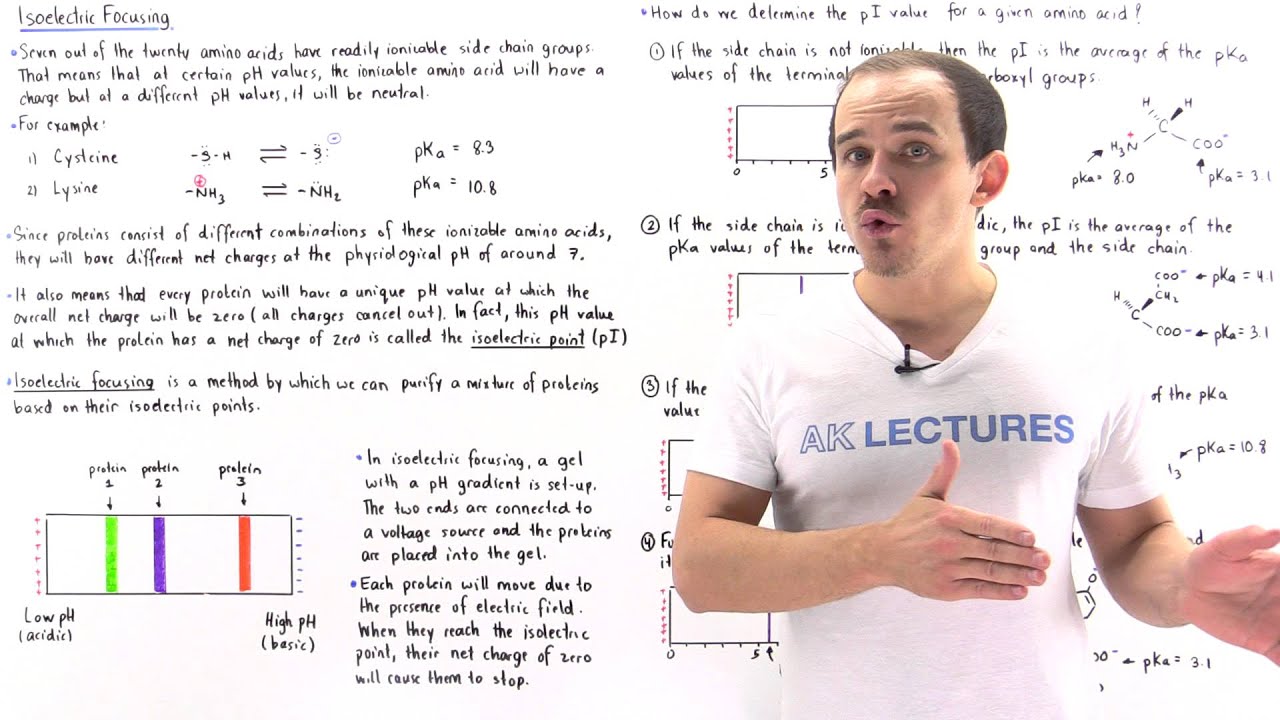
Isoelectric Focusing and Isoelectric Point
Keywords
Summary
185 words
Critical Evaluation
Value of the Information & Strength of the Argument
The video provides a solid educational value by clearly explaining the theoretical basis of isoelectric point and its application in protein purification. The argumentation is logical and well-structured, building from the properties of individual amino acids to the behavior of proteins in an electric field. The presenter uses concrete examples and step-by-step calculations, which enhances understanding. The explanation of the four cases for calculating pI is particularly valuable, as it covers all possible scenarios and clarifies the reasoning behind each formula. The video does not present any controversial claims; it aligns with standard biochemical knowledge. The argumentation is convincing and well-supported by the examples provided.
Scientific Rigor, Source Quality, Title Accuracy
The video demonstrates scientific rigor by accurately presenting the concepts of isoelectric point and isoelectric focusing. The presenter uses correct terminology and follows established biochemical principles. However, no external sources are cited, and the video relies solely on the presenter’s explanation. The title accurately reflects the content, covering both the concept and the technique. The video is consistent with standard biochemistry textbooks, and the calculations are correct. The lack of citations is a minor weakness, but the content is reliable and well-explained.
202 words
Title / Content Match
The title accurately reflects the content, covering both the concept of isoelectric point and the technique of isoelectric focusing.
Quality & Reliability
8/10
The video provides a clear, accurate explanation of isoelectric point and isoelectric focusing, grounded in established biochemical principles. The presenter uses correct terminology and logical reasoning, though no external sources are cited. The content is consistent with standard biochemistry textbooks.
Key Moments
Markers derived by PSI from the transcript: the creator did not define chapters.
- Introduction to ionizable amino acids and their side chains
- Explanation of isoelectric point (pI) and its uniqueness to proteins
- Setup of isoelectric focusing: pH gradient and electric field
- Migration of proteins in the electric field until they reach their pI
- Case 1: Calculating pI for amino acids with non-ionizable side chains (glycine example)
- Case 2: Calculating pI for amino acids with acidic side chains (aspartate example)
- Case 3: Calculating pI for amino acids with basic side chains (lysine example)
- Case 4: Calculating pI for cysteine and tyrosine (middle pKa method)
Cited Sources
- AK Lectures Website — General educational resource for biochemistry lectures
- Lecture Page on Isoelectric Focusing — Direct link to the video lecture page
Concurring Sources
- Isoelectric point - Wikipedia — Confirms the definition and calculation methods for pI.
- Isoelectric focusing - Wikipedia — Confirms the principles and applications of the technique.
External References
Contribution & Novelties
The video provides a clear and systematic tutorial on isoelectric point and isoelectric focusing, which is particularly useful for students. It breaks down the calculation of pI into four distinct cases, making it easier to understand and apply. The explanation of the technique is concise and accurate.
Pour aller plus loin :
- Isoelectric point - Wikipedia — Provides a comprehensive overview of the concept and its applications.
- Isoelectric focusing - Wikipedia — Detailed description of the technique, including its history and variants.
- Protein purification - Wikipedia — Contextualizes isoelectric focusing within broader protein purification methods.
95 words
Radar Profile
The radar profile shows high scores in quantity and quality of information, with a slightly lower but still strong technical level. This indicates a well-rounded educational video that is both informative and accessible, with a solid foundation in biochemistry.